Managing a loved one's estate can feel overwhelming, especially when you're grieving and can't find a signed will. It doesn't have to stay that confusing. Once you understand how intestacy laws in Texas sort property and family relationships, you can predict what the statute will do before anyone moves money or signs a deed.
When Intestacy Laws in Texas Take Over
A widow opens a desk drawer looking for a will. She finds bank statements, a deed, insurance papers, and notes about who her husband wanted to help, but she doesn't find a signed will. Her adult son says the house should stay with her. A daughter from her husband's first marriage asks when accounts will be divided. Everyone is trying to be fair, but fairness at the kitchen table isn't the legal test.
When a Texan dies without a will, the property doesn't become ownerless. Intestacy is the state's default distribution system. In plain English, Texas supplies the instructions the person never wrote. Those instructions may not match what the family expected, what the person said out loud, or what seems simplest.
The Statute Is a Map, Not a Personal Plan
The map sits in Chapter 201 of the Texas Estates Code, which looks at family relationships and the legal type of each asset. The Texas State Law Library's guide to intestate succession describes intestacy as the statutory process for distributing property when no will exists. That's the key idea. It's a process set by law, not a plan built around one family's wishes.
Modern Texas rules trace their main foundation to legislation from the 54th Texas Legislature in 1955, effective January 1, 1956, and those provisions were later carried into Chapters 201 through 205 of the Estates Code, as shown in the historical Texas Probate Code descent and distribution provisions. A will or trust works differently. A person who signs one can name beneficiaries, choose who serves, and set timing for distributions. The statute can't consider those personal choices because nobody wrote them down in a valid document.
Two surprises cause most of the stress in these cases. First, a surviving spouse doesn't automatically inherit everything. Second, being an heir on paper doesn't mean you can walk into a bank, withdraw funds, or sell land the next week. Legal entitlement and practical control are related, but they're not the same thing.
A calm starting point: Don't promise shares to anyone until you've identified the property type and every possible heir. That one pause prevents most early mistakes.
Families do get through this. The work becomes manageable when you take it in order. First you classify the property. Then you identify who survived. Then you ask a court, when needed, to confirm heirship so title and accounts can move safely. A Texas estate planning attorney can walk that sequence with you, but the logic below will help you understand each step before you agree to any distribution.
How Texas Classifies Property Before Shares
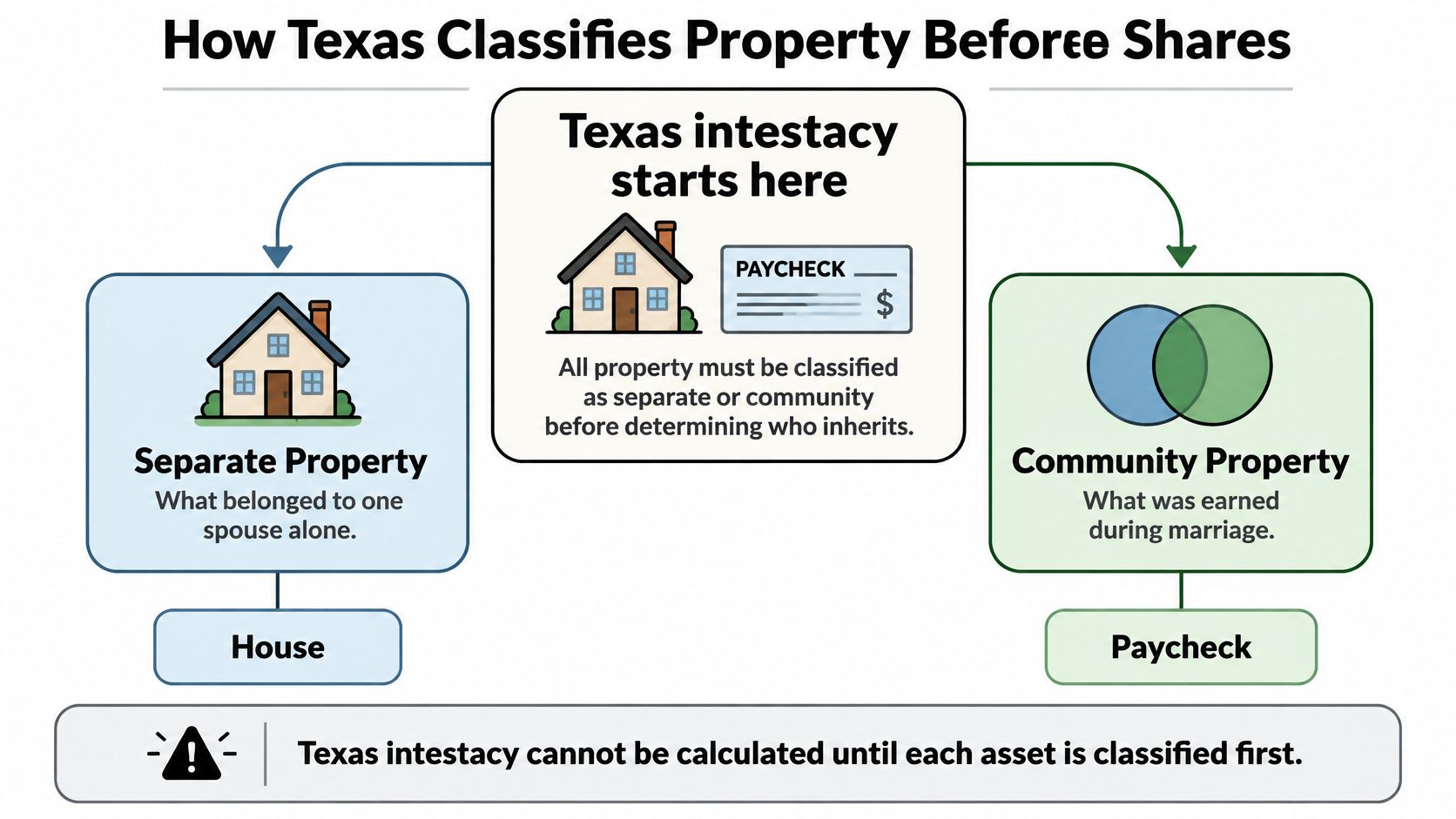
Most families start with the wrong question. They ask who gets what percent. Texas starts earlier. It asks what kind of property this is. You can't calculate a share until each asset is classified as community property or separate property, because the same spouse and children can receive different results for different assets in the same estate.
Think of a house and a paycheck. The paycheck a spouse earned during marriage usually points toward community property, meaning property the marriage built together. A house one spouse owned before marriage, or received as a gift or inheritance, may point toward separate property, meaning property that belonged to one spouse alone. Close calls turn on records and tracing, not on whose name feels most familiar or who paid the last bill.
The diagram below shows why classification comes before any math.
What Happens to Community Property
For a married person who dies without a will, Texas Estates Code § 201.003 controls the deceased spouse's community interest. In plain words, each spouse owns an undivided one-half interest in the community estate. Und ivided means you don't own a specific half of the couch or bank account. You own a half interest in the whole community pot.
That deceased spouse's one-half passes entirely to the surviving spouse in two situations under the text of Texas Estates Code Chapter 201. The first is when the decedent leaves no child or descendant. The second is when every surviving child is also the surviving spouse's child. In a family where all children belong to both spouses, the survivor ends up with the full community estate.
The result flips in a blended family. If the decedent leaves a child or descendant who is not also a descendant of the surviving spouse, the decedent's one-half community interest passes to the decedent's descendants. The surviving spouse still keeps the spouse's own one-half. That spouse doesn't lose everything, but the spouse also doesn't absorb the other half. For many second marriages, that's the moment the plan everyone assumed falls apart.
Separate Property Follows a Different Track
Don't copy the community answer onto separate property. Texas analyzes separate property under its own spouse and descendant rules, covered in the next section. A ranch inherited by one spouse, a brokerage account owned before marriage, or land received as a gift may move in a completely different direction from wages earned during the marriage.
Debts matter at this stage too. The community estate remains subject to community debts, so a family shouldn't treat the gross value of community assets as money available to divide. Creditors, taxes, and administration costs can reduce what's distributable. A careful inventory protects everyone, including the person who will serve as administrator.
Before anyone negotiates a settlement, work through this short checklist.
- List what was acquired during marriage: Paychecks, accounts funded with wages, and property bought while married often need a community analysis first.
- Trace separate property claims: Gather deeds, old account statements, gift letters, and inheritance records that show where an asset came from.
- Confirm each child's parentage: Ask, in writing, whether any child is a child of only the deceased spouse, because that answer can redirect the decedent's community half.
- Check how title is held: Beneficiary designations, survivorship language, and trust ownership can move an asset outside the intestate share calculation.
That checklist is the heart of property classification. Do it well, and the percentages that follow become much easier to apply. Skip it, and even correct math will produce the wrong distribution.
Who Inherits Under Texas Intestacy Rules
A family can agree about who mattered most to the person who died and still disagree about who inherits a particular asset. Texas intestacy rules look at both the surviving relatives and the property category. Chapter 201 sets the order for spouses, children, parents, siblings, and more remote relatives. A closer relative can take priority over a more distant one, while descendants of a child who died earlier may take that child's place.
Separate property falls into two categories: separate personal property, such as money, vehicles, and household items owned separately, and separate real property, meaning separately owned land or a house. The spouse's share differs between these categories. One family may therefore have different heirs or ownership shares for a bank account and a home.
The Spouse and Children Fractions
When a person dies with a surviving spouse and children, the spouse receives one-third of the separate personal property, and the children or their descendants receive the remaining two-thirds. That distribution is set out in Texas Estates Code § 201.055. For separate land, the spouse receives a life estate in one-third, while the children or descendants receive the remainder. A life estate gives the spouse the right to use that portion during life. The children's interest is the right to full ownership after the life estate ends, rather than an immediate right to possess that share.
The result changes when there is a spouse but no children or descendants. The spouse receives all separate personal property and one-half of the separate land. The other half passes to the next relatives identified by the descent rules.
For example, if someone owned a house before marriage, then dies leaving a spouse but no children, the spouse takes one-half of the land and the decedent's parents or siblings may take the other half. The widow or widower and those relatives can become co-owners of the same property. The home may not pass to the spouse alone.
A spouse does not automatically inherit everything. The outcome depends on how Texas classifies the property and whether the surviving children are also the spouse's children.
Community property follows a separate path from separate property. The two systems cannot be blended into one average share. A family business interest shows why the distinction matters: owners who want to understand inheritance law for business succession should not assume intestacy will keep a company with the person best placed to run it. The statute assigns ownership based on family relationships, not business roles.
Who Counts as a Child
The legal parent-child relationship determines whether someone inherits as a child. An adopted child is treated according to the parent-child relationship recognized by law. A stepchild does not inherit from a stepparent solely because they lived together as a family. If that question affects your household, review Texas stepchild inheritance rights before assuming a share applies. Birth records, adoption decrees, and court orders can help establish the relationship.
The table summarizes common situations involving a married decedent. It focuses on the spouse and children; the result can differ when no spouse survives and parents, siblings, or their descendants are the relevant relatives.
| Property | Who survived | What passes |
|---|---|---|
| Community property | Spouse, and all children are also the spouse's children, or no descendants | Decedent's one-half passes to the surviving spouse |
| Community property | Spouse and a child who is not the spouse's descendant | Decedent's one-half passes to the decedent's descendants; spouse keeps spouse's own one-half |
| Separate personal property | Spouse and children | Spouse receives one-third; children or descendants receive two-thirds |
| Separate real property | Spouse and children | Spouse receives a life estate in one-third; children or descendants receive the remainder |
| Separate personal property | Spouse, no children or descendants | Spouse receives all of it |
| Separate real property | Spouse, no children or descendants | Spouse receives one-half; the other half passes under descent rules |
Without a surviving spouse, children and their descendants are first in line. If there are none, the rules look to the decedent's parents, then address situations involving one surviving parent and siblings. A missing child or sibling can change who shares in the estate, so the family relationships need to be established before the shares are worked out.
From Heirship to Administration and Clear Title
Knowing the fractions still doesn't put money in an heir's hands. A bank may say it's sorry for your loss and then refuse to release an account. A buyer may want the land, while the title company refuses to insure the sale. That's not the institution being difficult. It needs reliable proof of who owns what.
The flow below separates heirship from administration and from clear title.
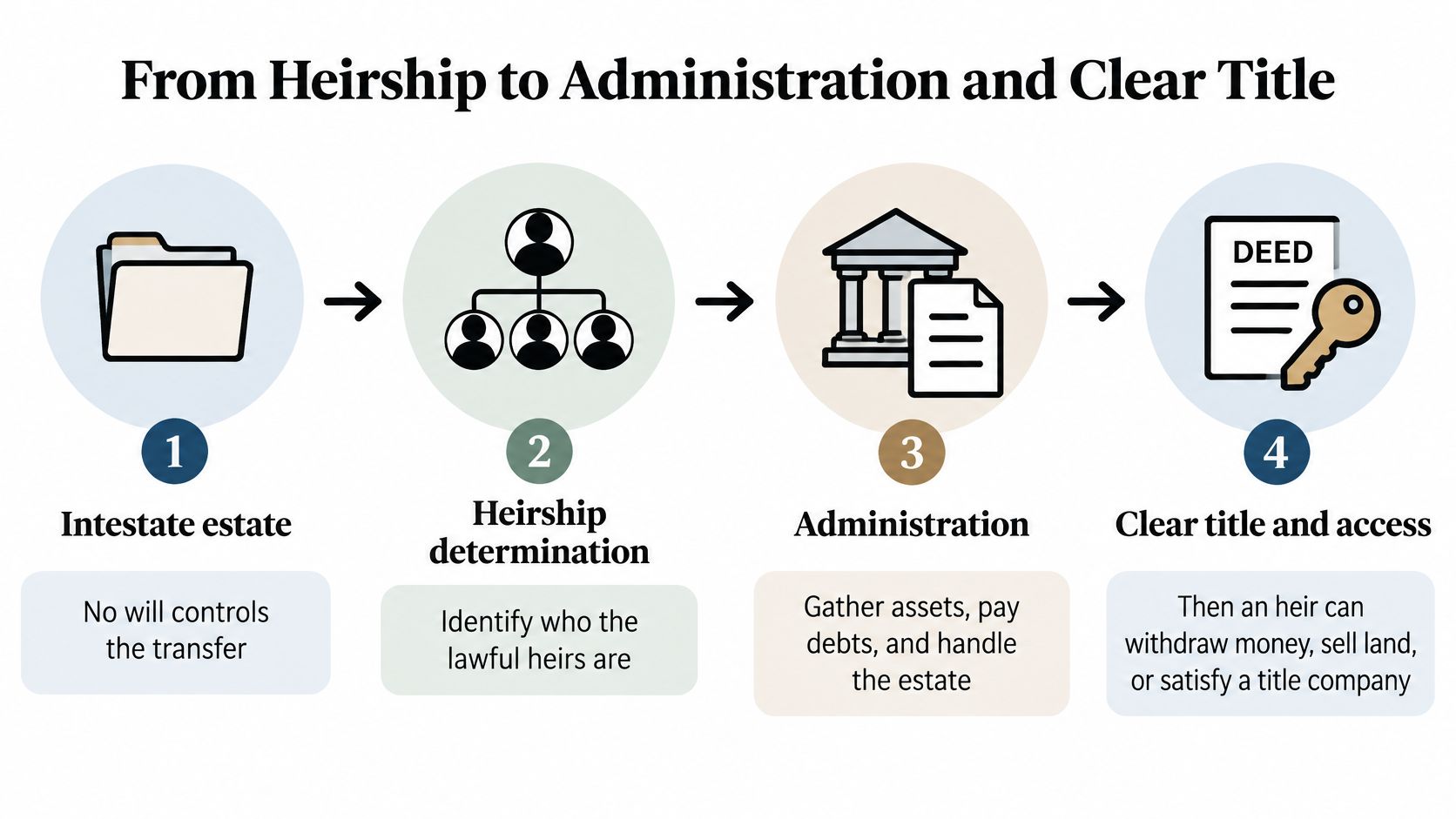
Texas law generally provides that an intestate estate vests immediately in the heirs at law, a principle reflected in Texas Estates Code Chapter 101 on estate vesting. Vests means ownership rights arise at death. It doesn't mean the heir automatically has marketable title, which means title a buyer or title company will accept without extra proof. Families often still need a formal probate or heirship proceeding before anyone can sell, withdraw, or transfer property with confidence.
Timing Rules and Proving Heirship
One timing rule can reroute an entire share. A person who fails to survive the decedent by 120 hours is generally treated as having predeceased the decedent for intestate succession, subject to statutory exceptions, under Texas Estates Code § 121.052 and the 120-hour survival rule. In everyday terms, if two relatives die close together, the order and length of survival can decide whether property passes through the second person's estate or directly to someone else.
When identity, parentage, adoption, or marital history is uncertain, a court may conduct a determination of heirship under Chapter 202. You can see the structure in Texas Estates Code Chapter 202 on heirship proceedings. That proceeding asks the court to declare who the heirs are. It's evidence work, not a formality, and contested facts can add service, testimony, guardianship issues, or extra administration for property in another state.
The short video below adds a plain language walkthrough of why proof and procedure matter before distribution.
Independent administration can reduce court supervision, but it isn't automatic in an intestate case. Under Texas Estates Code § 401.003 on independent administration by agreement, all distributees may agree and designate a qualified administrator, yet the court may not appoint that administrator until a Chapter 202 proceeding determines that those people are all of the decedent's heirs. Even after appointment and the required inventory, appraisement, and list of claims, or an authorized affidavit in lieu, the administrator still owes fiduciary duties in Texas. That phrase means the administrator must act loyally, keep records, handle creditors properly, and distribute only to the right people in the right amounts.
An affidavit can help in some title situations, but it isn't a universal substitute for a court order. Rural landowners and out-of-state heirs should compare that route carefully through guidance on a Texas affidavit of heirship before relying on it for a sale. Families comparing states sometimes also look at what Florida probate can cost, but Texas heirship and title requirements still control Texas land. For a different comparison, Trust Administration vs. Probate in Texas explains why trust assets generally avoid probate and how the two processes differ.
Start the file with death certificates, marriage and divorce records, birth or adoption papers, prior probate filings, deeds, account statements, and evidence about the 120-hour period. That intake packet is what turns a family story into proof a court and title company can use.
Example Distributions for Common Texas Families
Rules are easier to trust when you can see finished pictures. The examples below don't repeat the full chart. They show how classification and family structure work together in three households a Texas probate lawyer sees often.
The family picture below is a reminder of what's at stake. These aren't abstract fractions. They're homes, accounts, and relationships.

A Couple Whose Children Belong to Both Spouses
Maria and James were married for decades. Their two adult daughters are children of both of them. Most of what they own came from wages and purchases during marriage, so it's community property. James dies without a will. His one-half community interest can pass to Maria because every surviving child is also her child. Maria keeps her own half too, so the community estate consolidates with her, subject to community debts and proper administration.
That clean result stops at the community line. Suppose James also owned a small tract he inherited from his father and kept as separate property. That land doesn't follow the community answer. Because Maria and the daughters survive, Maria receives a life estate in one-third of that separate land, and the daughters receive the remainder interests. If James had separate personal property, Maria receives one-third and the daughters receive two-thirds. One estate, two tracks, and a deed that needs careful handling before anyone sells the tract.
A Blended Family With a Child From an Earlier Relationship
Now change one fact. James also has a son, Caleb, from a prior relationship. Maria is not Caleb's mother. That single fact redirects James's one-half community interest to his descendants instead of to Maria. Maria retains her own one-half of the community estate, but she may now co-own community assets with James's children, including Caleb, depending on the exact descendant shares.
Tension often rises here, frequently between people who all loved the decedent. Maria may be living in the home and paying the bills. Caleb may want his share recognized before accounts are closed. Homestead rights, community debts, and the character of the home can affect possession and timing, but they don't erase the classification analysis. A court-supervised heirship and inventory give everyone the same set of facts. Without that shared record, each side fills the silence with suspicion.
Separate property still gets calculated on its own track in this blended picture. Don't assume Caleb's presence changes only the community half and nothing else. Each asset needs its label first, then the spouse and descendant rule that fits that label.
An Unmarried Person With Parents, Siblings, and a Deceased Child
Denise dies unmarried. Her mother and two brothers survive her. Her only daughter died years earlier but left a young son. A brother says he's the closest relative handling things and asks the bank to release Denise's account to pay expenses. That request is understandable, and it may still be wrong.
Descendants of a deceased child can take that child's place in the heirship analysis. If Denise's grandson is a qualifying descendant, he may stand ahead of Denise's mother and brothers. A disputed adoption, a missing relative, or unclear proof of parentage can shift the class again. If the grandson is a minor, the estate may also need guardianship planning or a court structure to protect his share. The administrator shouldn't pay the relative who seems most available. The administrator should assemble family history evidence first, then seek the right orders.
Land outside Texas adds one more practical layer. Texas heirship may establish who inherits, while the other state may require its own ancillary process before title moves there. Spotting your family's picture early helps you avoid signing a deed or closing an account before the right court has spoken.
Choosing a Will or Trust Over the Statute
A surviving spouse may expect to inherit the family home, while a child from an earlier relationship may have rights to part of it. The result depends on whether the home is community or separate property and on who legally qualifies as a descendant. Intestacy is therefore a property and title problem, not just a family-tree question. Being an heir does not automatically give someone immediate possession or clear title to sell property.
The comparison below shows how intestacy, a will, and a trust can lead to different outcomes.
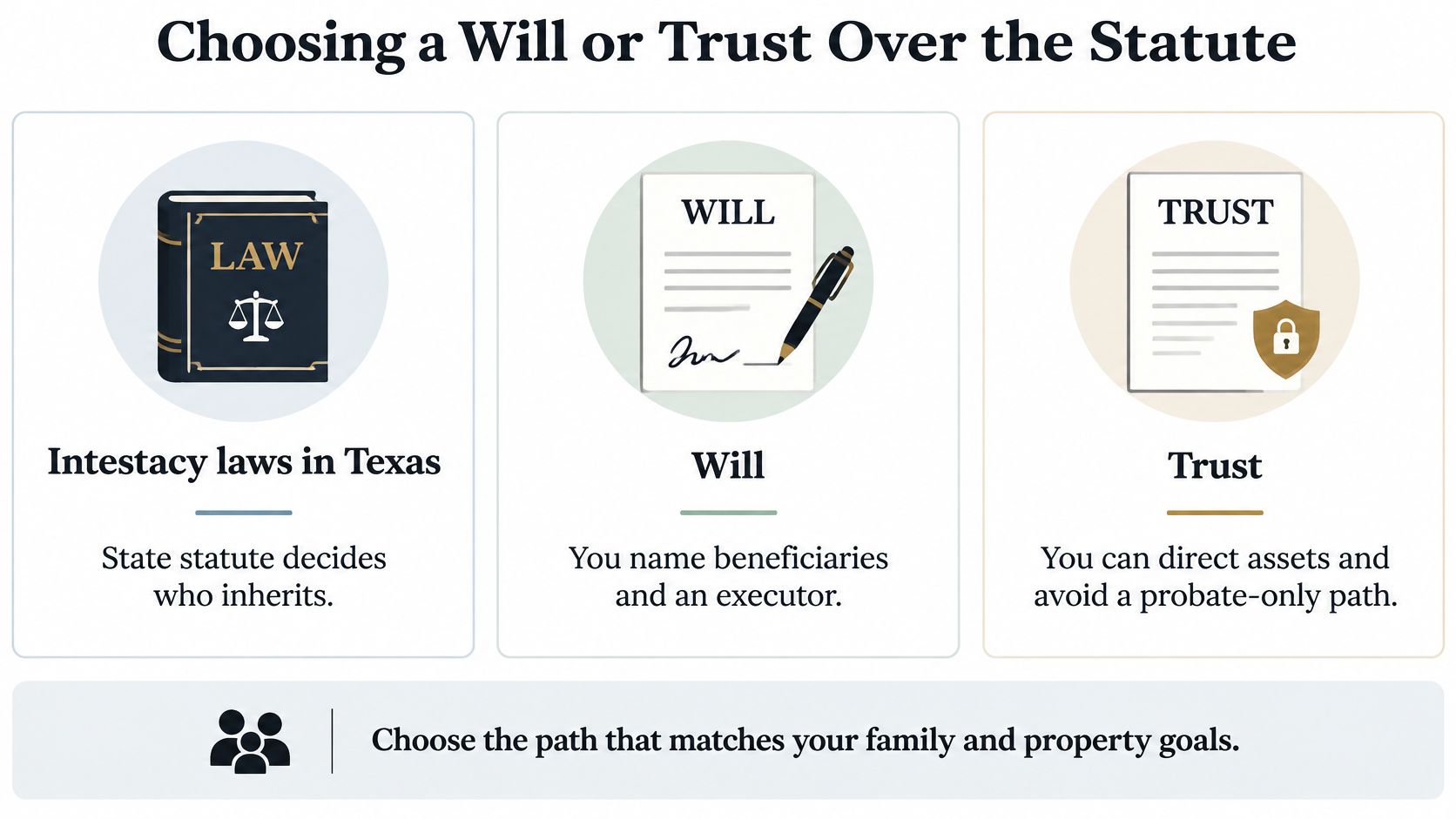
Under the Texas Estates Code, intestacy directs property to statutory heirs. It does not automatically create a trust for a minor, a child with special needs, or a blended-family member who should not receive a large share outright. The personal representative must follow Chapters 201 and, when needed, 202. If a decedent tells a stepchild at a holiday dinner that the house will be theirs, that promise does not make the stepchild an heir. Without a will or trust naming them, they may receive nothing under Chapter 201.
A will lets you name beneficiaries and an executor, direct specific property, and provide for someone who is not a statutory heir, such as an unadopted stepchild. A trust can hold and distribute property over time under the Texas Trust Code, with a named trustee and conditions for distributions. Planning should also address how to modify a trust in Texas as family circumstances and property change. Neither document fixes unclear title, beneficiary designations, or creditor issues on its own. Ownership records and planning documents need to work together.
The Law Office of Bryan Fagan, PLLC advises Texas families on estate planning, probate, and trust administration. Trustees can review first steps for a successor trustee and the Texas trust administration timeline to understand practical duties and timing. A Texas trust administration lawyer can explain those responsibilities.
To test whether the statute fits your wishes, list who would inherit your community property, separate personal property, and land if you died without a will. If the result leaves someone you want to protect with nothing, or gives someone property before they are ready to manage it, a will or trust can set different instructions. Clear planning can also reduce uncertainty about who has authority to manage property and establish title.
What to Do After a Death Without a Will
The first week after a death isn't the time to divide accounts. It's the time to protect records, people, and property. Grief makes even organized families forget passwords, misplace deeds, or promise shares they can't legally deliver. A calm sequence keeps compassion and accuracy together.
Start with these steps.
- Secure the death certificate: You'll need it for court filings, banks, insurers, and title work, so order enough certified copies through the proper channel.
- List known assets and debts: Write down accounts, land, vehicles, business interests, beneficiary designations, and bills you can identify, without retitling anything yet.
- Gather family records: Collect marriage, divorce, birth, and adoption records, plus prior probate filings and any documents about parentage or informal marriage.
- Pause distributions: Don't pay heirs, close accounts, or sign deeds until heirship, property classification, and debts are clear enough to support those moves.
Separate the three jobs that often get tangled. One job is identifying heirs. Another is safeguarding property, such as locking the house, forwarding mail, and preserving statements. The third is communicating with relatives who may disagree. One person can help with all three, but the jobs shouldn't blur. A family argument shouldn't become an early wrongful payment.
Emotional support matters alongside the paperwork. Some readers find it helps to read about grief support after a father's death while the legal file is being built, especially when an adult child is suddenly handling both mourning and administration. You can take care of your family and still insist on proof before property moves. Those two things support each other.
A Texas estate planning attorney can turn that early file into an heirship petition, an inventory, and a distribution plan. If you're being asked to serve, learn what an administrator of an estate in Texas is expected to do before you accept the role. The statute will make a decision if the family doesn't. Early advice lets you see that decision before money moves, and for living readers, it can replace the default with a will or trust that reflects real wishes.
If you're managing a trust or planning your estate, contact The Law Office of Bryan Fagan, PLLC for a free consultation. Our attorneys provide trusted, Texas-based guidance for every step of the process.
If someone you love died without a will, or your own plan still leaves Texas intestacy in control, Law Office of Bryan Fagan, PLLC can help you identify heirs, classify property, and build a clear path through probate, trust administration, or a new estate plan. Reach out for a free consultation and get advice matched to your family's records before you distribute property or sign away title.