A loved one has died, the house is still titled in that person's name, and a title company has mentioned an affidavit of heirship. You may be grieving, trying to help relatives who live elsewhere, and wondering whether one document can really solve a property problem that feels much larger than a form.
In some Texas estates, it can provide a practical path for documenting who inherited real property. But it isn't a deed, it isn't a court order, and it doesn't automatically settle every issue involving the estate. The document's usefulness depends on complete family-history information, proper execution, recording, and the way a buyer or title insurer evaluates the title.
When Texas Families First Hear About an Affidavit of Heirship
Maria usually hears about an affidavit of heirship after her father dies. He owned a home in Texas, never signed a will, and left adult children who agree that the house should eventually be sold. The county records still show her father as the owner. When the family contacts a title company, someone suggests an affidavit of heirship as one possible way to document the heirs.
That suggestion doesn't mean the family has made a mistake. It means the property record needs reliable evidence about what happened after the owner's death. An affidavit may fit when the main issue concerns Texas real property, the family history is clear, and the heirs are cooperative. It may not fit when relatives disagree, important heirs are unknown, or the estate includes assets that require broader administration.
Families often confuse an affidavit of heirship with a small estate affidavit. They serve different purposes, so read the facts carefully before choosing a form. The Texas small estate affidavit resource can help you distinguish that process from an affidavit used to document heirship in real property records.
The first questions to ask
Before anyone signs, identify:
- The property: Is the asset land, a residence, a mineral interest, or another interest in real estate?
- The family history: Was there a marriage, divorce, adoption, child born outside marriage, or predeceased child?
- The level of agreement: Do all potential heirs accept the family history and proposed ownership?
- The estate's scope: Are there bank accounts, investments, business interests, debts, or creditor issues that need a court-supervised process?
An affidavit of heirship is most understandable as a way to place sworn family facts into the county's real property records. It gives future reviewers a documented account of the decedent's family relationships. It doesn't require you to become an estate-law expert overnight, but the facts must be handled carefully because an omission can affect a future sale.
What an Affidavit of Heirship Is Under Texas Law
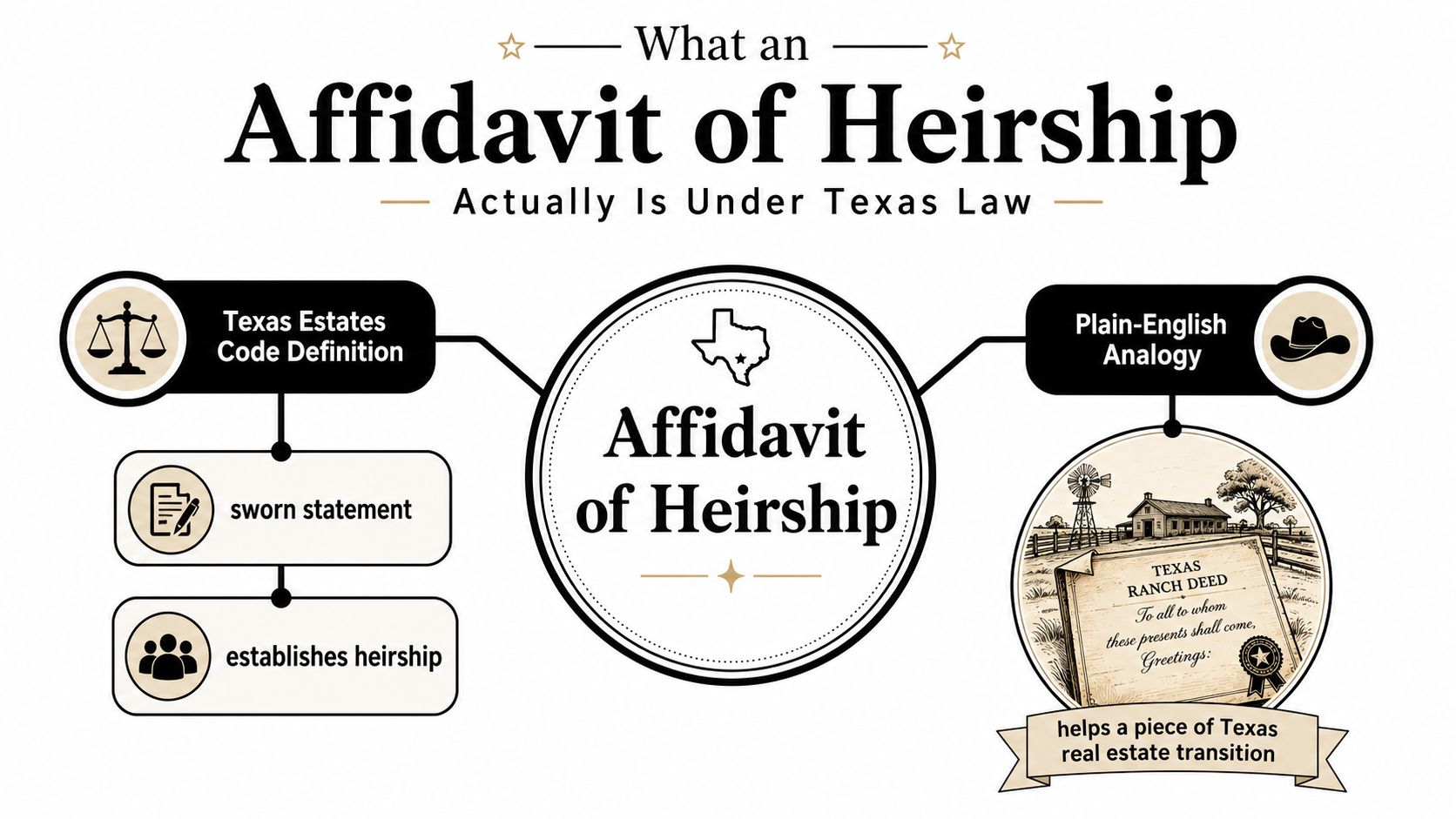
Texas Estates Code § 203.002 provides a statutory form for an affidavit of heirship. The affiant appears before an authorized officer and swears to facts about the decedent's identity, family history, marriages, and heirs. In plain language, it is a sworn family-history statement used to help establish who inherited a particular piece of real property.
The affidavit works like a genealogical anchor in the county records. It secures the family facts in a public place so a title examiner can follow the property's history after the recorded owner dies. That record may support the heirs' claim, but the affidavit itself is not the instrument that conveys the property.
Evidence is not the same as transfer
Texas practice sources explain that an affidavit of heirship does not itself transfer title. It identifies heirs and supports a record-title claim, which is why families record it in the county's real property records rather than treat it as a probate judgment. The Texas State Law Library's explanation of informal probate methods describes the document as sworn family-history evidence, not a judicial determination.
A deed transfers an interest through a conveyance signed by a person or entity authorized to convey it. A court determines heirship through a judicial proceeding. An affidavit has a narrower function: it places sworn facts about the family into the public record, subject to statutory requirements and later review.
That distinction matters during a sale. A title company may request more than the affidavit if the estate is contested, a possible heir was omitted, or the document has not satisfied the statutory recording period. The underwriter may then require additional evidence or a court proceeding before accepting the title.
How trusts fit into the picture
Trust administration generally concerns property owned by a trust and managed under the Texas Trust Code. An affidavit of heirship concerns the family history of a deceased owner of real property. For a broader explanation of trust administration and its difference from probate, see Texas Trust Administration: A Trustee's Guide.
The trustee's fiduciary duties, the executor's responsibilities, and the heirs' rights come from different legal frameworks. A trustee follows the trust terms and applicable fiduciary principles. An executor or administrator handles estate property through probate. The affidavit records evidence about heirship, so it cannot replace the duties created by a trust or probate proceeding.
Who Can Sign and What the Document Must Contain
A recordable affidavit depends on both knowledge and formalities. The person making the statement, called the affiant, should have personal knowledge of the decedent's family history. The document also requires two credible subscribing witnesses who can provide reliable information about the family relationships.
A 2025 legislative update adds another requirement for affidavits concerning property. The enrolled Senate Bill 648 text requires acknowledgment or swearing by each living heir to the property who isn't under a legal disability, along with signatures, two witnesses, and notarization as recording conditions. Review the enrolled Texas Senate Bill 648 text with counsel or the county recorder before relying on an older form.
Build the family history before drafting
The affidavit should address the facts that allow a reviewer to identify every possible heir. Gather records concerning:
- The decedent: Full name, date of death, place of death, and residence or domicile at death.
- Marital history: Every marriage, divorce, and relevant spouse relationship.
- Children: All children, including adopted children and children born outside a marriage.
- Earlier deaths: Any child or heir who died before the decedent, together with that person's descendants.
- Parents and relatives: Information relevant to the succession facts under Texas law.
- The property: The legal description and county where the property is located.
Birth and death certificates, divorce decrees, adoption records, marriage records, and prior deeds can help confirm the narrative. A family member's memory may start the process, but memory alone can miss a marriage, an adopted child, or descendants of a predeceased heir.
Choose witnesses carefully
The witnesses need to be credible and able to explain how they know the family. A witness who has a financial interest in the property may create questions about independence. The safest approach is to identify people who knew the decedent and can truthfully confirm the family history without benefiting from the outcome.
All required signatures and sworn statements should be completed before an authorized officer, ordinarily a notary. Signing a document first and trying to correct the execution later can create recording or underwriting problems.
Practical rule: Complete the family-history investigation before the notary appointment, not while people are signing.
The Five-Year Rule and What It Means for Title
The most important timing point is found in Texas Estates Code § 203.001. An affidavit of heirship gives it real evidentiary weight only after it has been recorded for at least five years in the deed records of the county where the property is located, or in the county where the decedent was domiciled or had a fixed residence at death. After that period, it can serve as prima facie evidence of the stated family history, genealogy, marital status, and identity of heirs in a title dispute or heirship proceeding. See the Texas Estates Code provision on affidavits of heirship.
“Prima facie evidence” means the document can serve as sufficient initial proof unless opposing evidence challenges it. It doesn't mean no one can question the affidavit. It means the law gives the recorded document a stronger evidentiary position after the required period has passed.

Recording creates the timeline
The timeline begins when the affidavit is properly recorded, not merely when a family member signs it. Recording also needs to occur in a county recognized by the statute. A family that waits to record may delay the point at which the document gains its statutory evidentiary effect.
Before the five-year period matures, a buyer, lender, or title insurer may ask for more proof. That request can include additional family records, affidavits, releases, probate filings, or a judicial determination of heirship. Acceptance is a title-risk decision, and each transaction may involve different underwriting requirements.
Timing can change the right legal strategy
Suppose heirs want to sell the property soon after the owner's death. Filing an affidavit now may establish a public record of the family history, but waiting for the statutory period may not work if the sale is already pending. A court proceeding may provide the stronger and faster form of certainty needed for that transaction.
Families should ask the title company about acceptance before spending time preparing a form. If the underwriter won't rely on an early affidavit, the family can evaluate probate or a judicial determination rather than discovering the problem at closing.
How It Compares With Probate and Muniment of Title
When a Houston family needs to sell a paid-off home left to three adult children, an affidavit of heirship may clear the title faster than probate. That approach depends on facts such as the absence of a will, agreement among the heirs, and acceptance by the title company. If those conditions are missing, a court proceeding may provide the needed authority.
The right path turns on the property involved, the existence of a will, family agreement, debts, creditor concerns, and the deadline for producing marketable title. Each option answers a different legal question.
| Feature | Affidavit of Heirship | Probate Administration | Muniment of Title |
|---|---|---|---|
| Primary function | Records sworn evidence about heirs and family history | Administers the estate under court supervision | Establishes a will as the document supporting title |
| Court involvement | Usually recorded in county real property records rather than decided by a judge | Requires a probate court process | Requires a court proceeding |
| Asset scope | Focuses on real property | Can address the estate's broader assets, debts, and administration | Primarily supports transfer of property under a will |
| Best fit | Clear, cooperative heirship facts involving real property | Contested, complex, or asset-heavy estates | A valid will and facts meeting the proceeding's requirements |
| Title certainty | Evidentiary support, with statutory weight after the recording period | Court-based determination and administration | Court-based title support through the will |
| Main limitation | Does not itself transfer title or resolve every estate issue | More formal and involved | Requires the necessary will and supporting facts |
Probate administration reaches beyond a house or parcel of land. It can provide authority to collect personal property, financial accounts, and other estate assets, address creditor claims, and distribute what remains. An affidavit records heirship facts for real property, so it does not give someone authority to withdraw funds from a bank account or transfer stock.
A muniment of title follows a different route. The court admits a will as the document supporting title, allowing property to pass under that will when the proceeding's requirements are met. An affidavit generally records family-history evidence when the family is establishing heirship without that court determination. Families weighing this option can review the Texas muniment of title guide.
The document chosen should also match the person handling the property. A trustee must follow the trust instrument and fiduciary duties under the Texas Trust Code. An executor or administrator must follow the Texas Estates Code and the authority granted through probate. A form that appears faster may leave the family with an unresolved title issue, so the title company's requirements and the estate's facts should guide the decision.
A Real-World Example of an Affidavit in Practice
Consider a representative Houston-area family. Their parent dies without a will, leaving a paid-off residence and a small mineral interest. Three adult children inherit under Texas law, but one child lives outside Texas. The family agrees about the relationships, yet the residence remains in the parent's name and a buyer may eventually require a clear record.
The child who knows the family history best becomes the likely affiant. Before drafting, the family gathers the death certificate, marriage and divorce information, children's records, details about any deceased child's descendants, and the legal descriptions for the residence and mineral interest. The family also identifies two credible witnesses who knew the decedent and can truthfully confirm the history.
Turning facts into a sworn record
The affidavit should clearly identify the decedent and state the relevant family history. It should address marital relationships, children, predeceased descendants, and the identity of all heirs. If the facts support it, the document can state that no will exists. Any release or disclaimer language should be reviewed for the actual transaction rather than copied casually from another form.
The out-of-state heir still needs to complete the required acknowledgment or sworn statement under the current recording framework if that heir is living, has an interest in the property, and isn't under a legal disability. The signatures, witness statements, and notarization must be completed correctly before the affidavit is recorded in the appropriate county deed records.
The affidavit may help create a public family-history record, but it doesn't itself sign a deed or transfer title. If the family later prepares a deed, the people authorized to convey must use a legally appropriate instrument. For a plain-language overview of deed-transfer concepts, the family might also consult the Dollar Land Store buyer deed guide, while recognizing that a guide cannot replace advice about the family's specific heirship and title facts.
A mineral interest deserves special attention because its ownership history may appear in separate records and may be reviewed by different parties. The family should ask the title company to evaluate both the residence and the mineral interest before assuming one affidavit will resolve every title question.
Common Misconceptions and Title Pitfalls to Avoid
Families often approach an affidavit with understandable hope. The document looks simple, but its legal effect is more limited than many online forms suggest.
Misconception one, it transfers title. Texas practice sources explain that it doesn't transfer title by itself. It identifies heirs and supports a title claim, while a deed or court order may still be needed for the transaction.
Misconception two, it replaces probate for every asset. The affidavit is directed toward real property. It doesn't serve as a universal method for collecting bank accounts, stocks, personal property, or resolving creditor claims.
Misconception three, every title company will accept it. An underwriter may ask for more proof when the estate is disputed, an heir didn't join, or the statutory recording period hasn't matured. Acceptance depends on the title risk presented by the particular record.
Misconception four, a quick signature fixes everything. Missing an adopted child, undisclosed spouse, predeceased descendant, or living heir's required acknowledgment can undermine the document. A form that wasn't prepared from a complete family investigation may create a larger title problem later.

Texas administrative rules also use fixed thresholds for certain unclaimed-property claims. Claims of $5,000 or less may rely on a two-witness affidavit, claims over $5,000 up to $10,000 require a recorded affidavit, claims over $10,000 up to $75,000 require a small estate affidavit, and claims over $75,000 require a judicial determination of heirship, as reflected in the enrolled legislative materials cited above. Those rules concern unclaimed property and shouldn't be confused with the separate real-property recording process.
Practical Tips and When to Call a Texas Estate Attorney
Start with facts, not forms. Write out the decedent's complete marital and family history, then compare that narrative with available records. If the family can't agree on who the heirs are, stop before signing and get advice.
A careful preparation sequence
- Gather the records. Collect death, marriage, divorce, birth, adoption, and relevant property documents.
- Identify every possible heir. Include descendants of anyone who died before the decedent.
- Confirm the county. The property location and the decedent's domicile or fixed residence at death may matter under the recording statute.
- Ask the title company early. Find out whether the underwriter will accept an affidavit before the five-year period has matured.
- Review alternatives. A pending sale, contested heirship, or complex assets may point toward probate or a judicial determination.
- Use qualified guidance for difficult facts. Blended families, out-of-state heirs, mineral interests, and missing records justify a conversation with counsel.
A Texas estate planning attorney can also help a living property owner avoid this uncertainty by preparing an estate plan that addresses real estate, beneficiary designations, trusts, and incapacity planning. If you're comparing counsel for a broader plan, this guide on how to choose an estate planning attorney offers practical considerations.
A Texas trust administration lawyer may be the right resource when property is held in a trust, a successor trustee must act, or beneficiaries question administration. Trustees must follow the trust terms, manage property carefully, communicate as required, and satisfy fiduciary duties in Texas. Executors face different duties under the Texas Estates Code, and neither role should be assumed from the appearance of a family document.
If you're handling an affidavit of heirship in Texas, The Law Office of Bryan Fagan, PLLC can review the family history, recording plan, title concerns, and probate alternatives affecting the property. Visit Law Office of Bryan Fagan, PLLC to schedule a free consultation and receive Texas-based guidance for your family's circumstances.