Managing a loved one's trust can feel overwhelming, especially when the person in charge is a sibling, step-parent, or long-trusted advisor. You may already have the sinking feeling that something's off, but you still need more than suspicion if you want a Texas court to act.
That's because trustee removal in Texas is a legal fight over proof, not just frustration. A beneficiary who wants a trustee removed has to tie the trustee's conduct to one of the statutory grounds Texas courts recognize, and the strongest cases usually rise or fall on documents, records, and witness testimony that tell a clear story.
A judge is not looking for the loudest complaint. The judge is looking for evidence that shows a material violation, incapacity or insolvency, a failure to account, or some other cause the court finds sufficient under Texas law, which means a careful record often matters more than family drama.
When Trust Concerns Become a Legal Fight
A Texas daughter calls after discovering her brother, who serves as trustee, has stopped returning messages, sold an asset the trust seemed to protect, and won't produce a meaningful accounting. She's angry, worried, and ready to file something in court, but she also knows a judge won't remove a trustee just because the family is in conflict.
That's the practical reality of evidence you need to win a trustee-removal petition in Texas. The court acts in its discretion, and Texas law gives it four specific grounds to remove a trustee on petition of an interested person, so the proof has to fit the statute and show a real harm, not just a personality clash. Under the Texas approach, the evidence should connect the trustee's conduct to a concrete statutory problem, especially material financial loss or a clear failure of fiduciary duty. That's why a petitioner usually needs accountings, bank records, correspondence, and proof of missed duties, not just a stack of upset texts.
For families in that spot, a calm review of the trust file can be more useful than a heated confrontation. A resource like Olson & Sons trust conflict help can be useful background for understanding how trust disputes are commonly framed when communication has broken down and the record matters more than emotion.
What a judge wants to see first
The statute doesn't reward outrage. It rewards a paper trail that makes the trustee's conduct measurable, traceable, and legally relevant.
Practical rule: if you can't point to the document, the date, and the harm, you probably don't have a removal case yet.
In Texas, that distinction matters because trustee removal is not automatic. The court may act when the evidence shows the trustee's continued service is inconsistent with the trust's administration, but it won't guess, fill in gaps, or remove someone based on family tension alone. That's why a careful beneficiary starts by separating what feels unfair from what can be proven.
The Four Grounds Texas Courts Recognize
Texas Trust Code § 113.082 gives courts four removal paths on an interested person's petition, and each one calls for different proof. The law points to a material violation of the trust that causes a material financial loss, incapacity or insolvency, failure to provide a legally required accounting, or some other cause the court finds sufficient. A beneficiary who understands which lane the facts fit into can collect the right evidence instead of chasing everything at once. See the statute itself at the Texas Trust Code's removal provision, Texas Trust Code § 113.082, and the court-centered authority described in Texas trustee removal authority.
Material violation causing financial loss
This is the clearest ground when a trustee's decision violates the trust and the numbers show real harm. Bank statements, brokerage records, sale documents, appraisals, and missed-opportunity evidence are the usual tools, because they show where the money went and what the trust lost.
Incapacity or insolvency
A trustee who can't manage their own affairs may not be fit to manage trust property. Medical records, bankruptcy filings, and financial documents often matter here, especially if the other side disputes capacity and tries to frame the issue as simple disagreement.
Failure to provide an accounting
A trustee's refusal, delay, or defective response can become its own ground for removal when the law requires an accounting and the trustee doesn't provide one. Written demand letters and proof of service matter because they show the beneficiary asked for the record and the trustee still didn't comply.
Other cause
This is the broadest and most overlooked category. Chronic silence, favoritism, hidden conflicts, or a pattern of conduct that makes proper administration impossible can matter if the record shows more than irritation.
The fiduciary baseline also matters. The duties described in The Fiduciary Duties of a Texas Trustee center on loyalty, prudence, and impartiality under the Trust Code, and those duties are often the lens through which a judge reads the evidence. If the trustee's conduct cuts against those duties, the rest of the paper trail becomes much more persuasive.
A strong petition doesn't just say “the trustee was unfair.” It shows which statutory box the facts fit into, then backs that box with records.
| Statutory Ground | Strongest Evidence | Why Courts Credit It |
|---|---|---|
| Material violation causing financial loss | Bank records, accountings, valuations, transaction histories | They link the act to a measurable loss |
| Incapacity or insolvency | Medical records, bankruptcy filings, financial statements | They show the trustee can't competently serve |
| Failure to account | Written demand, proof of service, missing or defective accounting | They show a direct statutory breach |
| Other cause | Emails, meeting notes, pattern evidence, witness testimony | They show the trustee can't administer the trust properly |
Evidence That Carries the Most Weight at Trial
Texas judges usually respond best to records that are routine, contemporaneous, and hard to fake. A formal accounting with supporting bank reconciliations usually carries more weight than a beneficiary's memory of what the trustee said at a holiday dinner, because the accounting lets the court trace the money and compare it to the trust's obligations.
The evidence hierarchy in a real hearing
At the top are financial records. Bank and brokerage statements showing unauthorized transfers, unusual withdrawals, or distributions that don't match the trust terms tend to be the most persuasive because they reveal the trustee's conduct in plain numbers. Written communications come next, especially emails or letters showing the trustee made decisions without notice, ignored requests, or admitted facts that matter to the case.
At the next level, forensic accounting can turn raw records into a clear narrative of harm. Expert analysis is especially useful when the trustee's transactions are layered, commingled, or spread across multiple accounts, because the expert can connect the paper trail to the alleged breach.
Contemporaneous notes and meeting minutes matter too, but they matter most when they corroborate the harder evidence. A note that says a trustee refused to explain a transfer is useful. A note standing alone is rarely enough.
Hostility, personality clashes, and unsupported accusations usually don't move a Texas judge. Records do.
The practical dividing line is simple. Documents that merely suggest friction can help provide context, but documents that prove a statutory ground are what win cases. That's why a beneficiary should focus on trust accountings, transaction records, written correspondence, and expert analysis before spending time on dramatic but unprovable allegations.
A good comparison is the Texas breach-of-duty framework discussed in trustee breach of fiduciary duty in Texas. The court is much more likely to care about a documented breach than about a personal story that never gets tied to a duty, a transaction, or a loss.
How to Collect and Authenticate Your Evidence
The safest evidence is the evidence gathered lawfully. In a Texas trustee-removal case, that usually means formal discovery, third-party subpoenas, and expert review, not self-help searches through private accounts or paper files you aren't authorized to access.
Discovery tools that force the records into the open
Requests for production can compel the trustee to produce trust statements, tax documents, correspondence, and internal records. Interrogatories can lock the trustee into sworn answers about who approved a transfer, when an asset was sold, or why no accounting was delivered. Depositions let counsel question the trustee and key witnesses under oath, which often exposes gaps between the story the trustee tells and the records already in hand.
Subpoenas matter when the trust records sit with banks, brokers, accountants, or other third parties. Those records are often more reliable than the trustee's own copies because they come from the institutions that processed the transactions.
Authentication and preservation
Courts still care how a document gets admitted. Affidavits, sworn declarations, and properly preserved originals help show the records are what they claim to be. Electronic files should be saved with the metadata intact, and paper records should be kept in their original condition when possible.
For a practical analogy, businesses that handle sensitive files rely on documented movement and storage. An ITAD chain of custody guide is a useful reminder of how important provenance is when records may later be challenged, even though trust litigation uses different legal rules.
Why experts help
A forensic accountant can translate a stack of statements into a timeline the judge can follow. That matters when the trustee has moved money between accounts, paid personal expenses from trust funds, or tried to bury the issue under volume.
If you're unsure where to start, the process of getting records through how to get an accounting of a trust in Texas is usually the first disciplined step. It creates a written request, a response deadline, and a cleaner record for court.
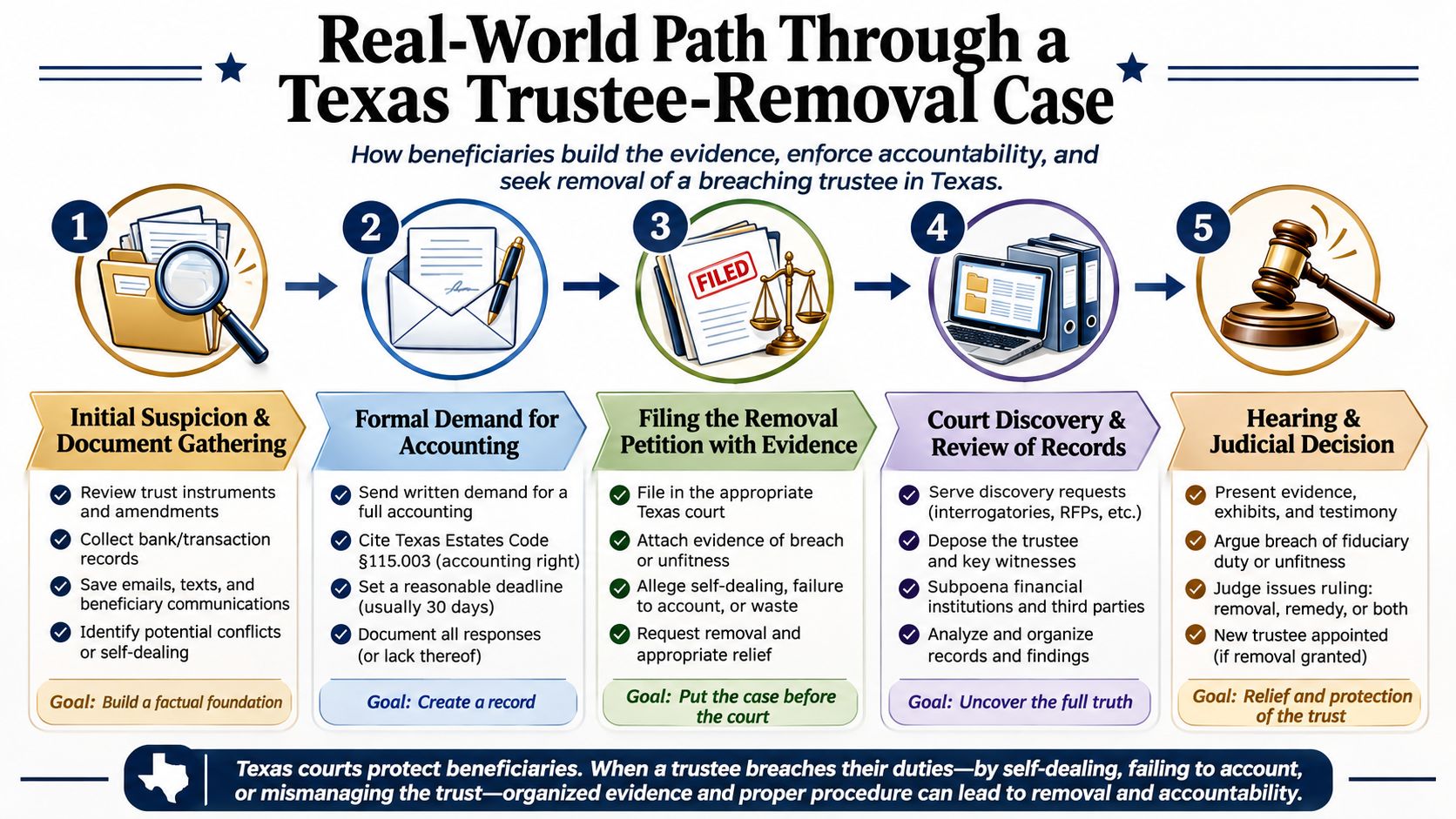
A Real-World Path Through a Texas Trustee-Removal Case
A common Texas pattern looks like this. One sibling serves as trustee, another sibling is a beneficiary, and the beneficiary starts noticing unexplained transfers, missing updates, and no usable accounting. The first mistake many families make is arguing about fairness instead of building a file.
The stronger path starts with the trust instrument. If the document contains removal language, succession language, or accounting requirements, that text becomes the anchor for the case. Then the beneficiary sends a written demand for an accounting or correction, keeps every email and meeting note, and preserves the original bank statements and correspondence.
What turns suspicion into a case
The petition has to say which statutory ground applies and include the supporting documents. If the complaint is about self-dealing, the filing should point to the transfers, the accountings, and the harm, not just describe a family rift.
Proper service matters too. Texas practice expects the trustee and other beneficiaries to be notified so they can respond, and notice defects can undo an otherwise promising case. That's not a technicality, it's part of due process and part of the trust-removal record itself.
When discovery begins, the best cases already know what they're looking for. Counsel can compare the trustee's answers against bank records, then use the forensic expert to explain where the money went and why the story doesn't match the paper.
A firm like the Law Office of Bryan Fagan, PLLC handles trust disputes, fiduciary accounting questions, estate planning, guardianships, and asset protection, which can help when a removal fight overlaps with broader family or tax issues. That kind of coordination matters because a removal case often touches tax planning, successor administration, and future distribution issues at the same time.
Defenses You Must Be Ready To Beat
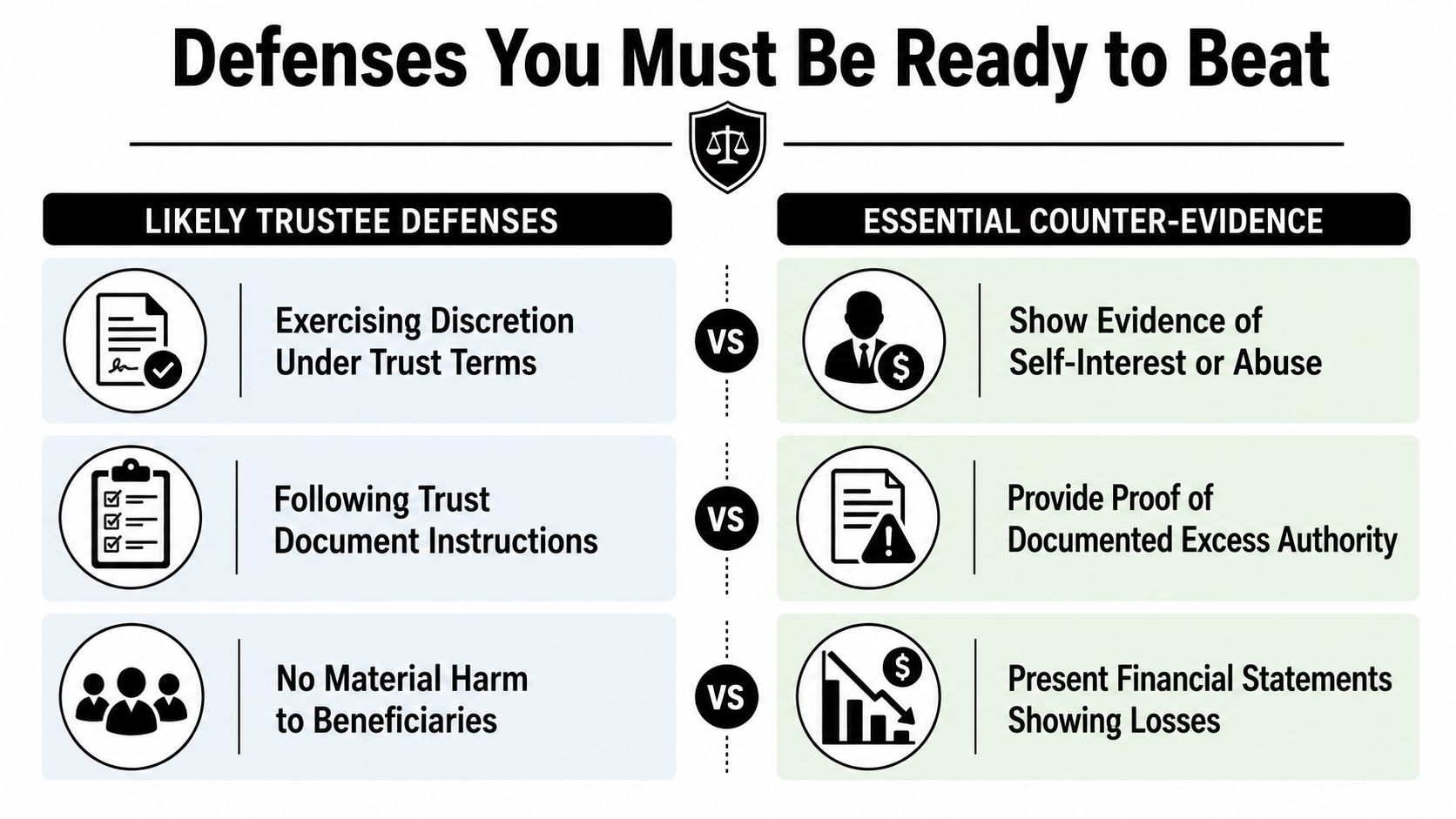
Trustees rarely admit the record is bad. More often, they say they were exercising discretion, following the trust terms, relying on counsel, or acting in good faith without causing real harm.
The usual defenses and how to answer them
If the trustee says, “The trust gave me discretion,” the response is not argument, it's evidence of abuse of that discretion. Emails, transfers to personal accounts, or selective treatment of beneficiaries can show the discretion was used for self-interest, not administration.
If the trustee points to advice of counsel, the record should show exactly what the lawyer was told and whether the advice was followed in good faith. A trustee can't hide behind a generic legal consultation if the underlying documents reveal they ignored the trust terms or failed to disclose key facts to counsel.
If the defense is “no material harm,” the beneficiary needs financial statements, valuation evidence, and transaction records showing the loss, the risk, or the missed accounting. Texas courts care about whether the conduct harmed the trust, so the answer has to be as concrete as the defense.
A trustee defense is strongest when the beneficiary's file is thin. Build the counter-file before the hearing.
Procedure can also become a defense. Texas commentary notes that removals have been reversed when the trustee didn't receive proper notice of the hearing, so service, pleading, and demand letters need to be clean from the start. And if the trust has an in terrorem or no-contest clause, counsel should draft carefully so the petition focuses on statutory removal grounds, not a speculative attack on the settlor's plan.
For the hearing itself, the beneficiary should expect the trustee's expert and prepare deposition questions that force the expert to identify the source documents, the assumptions, and the missing records. That's often where a weak theory starts to fall apart.
Practical Tips for Building a Winning Record
The best trustee-removal petitions in Texas usually look boring in the right way. They're built from preserved records, dated communications, and a short list of statutory grounds that can be proven without theatrics.
The checklist that actually helps
- Preserve every message: Keep emails, texts, and letters with the trustee, because casual statements often become important later.
- Save the original trust papers: Secure certified copies of the trust and amendments so no one can argue about the controlling language.
- Make the demand in writing: Send a written request for a full accounting by certified mail and keep proof of delivery.
- Organize the finances: Gather bank statements, brokerage statements, and tax records in date order so the transactions can be followed.
- Line up witnesses early: Get signed affidavits from beneficiaries or others who saw the trustee's conduct.
- Get counsel involved before the file gets messy: A Texas probate attorney can help choose the right ground, avoid notice problems, and decide when to bring in a forensic accountant.
The practical goal is not to sound more outraged than the other side. It's to build a record that lets a judge see the statutory breach without having to infer anything.
If you're handling a family trust, dealing with a resistant trustee, or trying to decide whether you have enough evidence to act, a Texas trust administration lawyer can help you sort the facts before they become a fight. You don't have to guess at the next step, and you don't have to carry the case alone.
If you're managing a trust or planning your estate, contact The Law Office of Bryan Fagan, PLLC for a free consultation. Our attorneys provide trusted, Texas-based guidance for every step of the process, from fiduciary duties in Texas to trust disputes, probate, guardianship, and asset protection. Visit Law Office of Bryan Fagan, PLLC to talk through your options and get help for your situation.