
A trustee-removal case in Texas usually takes several months if it's uncontested, and one to two years or longer if it's contested. The difference comes down to whether the trustee steps aside or fights, because that choice controls the amount of notice, discovery, hearings, and motion practice the court has to manage.
A family usually reaches this point after months of frustration. One sibling is acting as trustee, statements stop arriving, questions go unanswered, and the rest of the family starts wondering whether they need a Texas trust administration lawyer to step in before more harm is done. In Texas, that worry is understandable, but the timeline isn't mysterious once you break it into stages.
What to Expect When You File a Trustee-Removal Case in Texas
A common call starts like this. Adult children are reviewing their mother's trust, and the sibling who serves as trustee has stopped sharing account statements. Everyone wants the same answer, which is simple to ask and hard to hear, how long does this take?
For a smooth case, the answer is usually several months. If the trustee contests removal, neutral Texas legal sources say the dispute commonly stretches to one to two years or longer. Neutral Texas legal sources report that range because trust removal is a real court case, not a paper shuffle.
That's the part families often underestimate. A trustee-removal petition isn't just filed and granted automatically. The court has to see the petition, give the trustee a chance to respond, and decide whether the facts support removal under the Texas Trust Code.
Practical rule: the more the trustee resists, the more the timeline starts to look like litigation, not administration.
That's also why the same family can see very different results in different cases. If the trust document already points toward resignation, or the trustee agrees to step down, the matter can move quickly. If the trustee denies misconduct and demands discovery, the process slows down fast.
A Texas estate planning attorney will usually look at two questions first. What does the trust say about removal, and what evidence already exists? Those two answers often tell you whether the case is likely to resolve in months or stretch well beyond a year.
The Procedural Stages of a Trustee-Removal Case

Texas courts usually move through trustee removal in a predictable order. The case may land in probate court or a district court with trust jurisdiction, but the sequence is mostly the same.
Step one starts with the petition
Someone with standing files a petition asking the court to remove the trustee. That pleading has to identify the legal grounds and ask for the specific relief the family wants, such as replacement, an accounting, or related orders. If the trust gives a successor trustee a role, that fact can make the petition cleaner and faster to present.
Step two is notice and response
The trustee must be served, then given time to answer. This part matters because a removal case can't be rushed past basic due process. A trustee who hires counsel and contests the claims automatically lengthens the road ahead.
Step three is discovery and motion practice
Discovery is where the documents come out. Bank records, accountings, correspondence, and transaction histories often become the center of the case. If there are disputes about what must be produced, or whether records are complete, the timeline expands.
A related resource on what a successor fiduciary should do first is First Steps for a Successor Trustee in Texas, which fits naturally when a trust is already shifting toward new management.
The fastest cases are usually the ones where the facts are narrow, the records are clean, and nobody is trying to turn the hearing into a months-long fight.
A final hearing or bench trial comes next, followed by the court's ruling and any post-trial motions. A family trying to understand fiduciary duties in Texas should think in stages, not days. The court process is linear, and each step adds time if the trustee objects.
A short video overview can also help families understand how trust disputes unfold in real life.
Uncontested Versus Contested Timelines
The gap between a smooth case and a hard-fought case is wider than most families expect. A trustee who agrees to resign can shorten the process dramatically, while a trustee who disputes everything can keep the case moving for a long time.
| Stage | Uncontested | Contested |
|---|---|---|
| Initial filing and service | Moves quickly once the petition is ready | Still requires formal service and response time |
| Early communication | Trustee agrees to step aside or cooperate | Trustee denies the allegations and hires counsel |
| Discovery | Little or none | Document requests, depositions, and objections |
| Hearing or order | Often by agreement | Often after multiple settings |
| Overall pace | Several months | One to two years or longer |
The uncontested path is usually the most efficient. A trustee may resign, a co-trustee may support removal, or the trust instrument may already create a clean exit path. In those situations, the court often spends less time resolving the merits because the parties have narrowed the issue.
The contested path looks very different. Once the trustee fights back, the case becomes evidence-heavy. If beneficiaries need to prove breach, incapacity, lack of cooperation, or other cause, the timeline usually expands because the judge needs a fuller record.
That's why families should separate the legal question from the emotional one. A trustee may be difficult, dishonest, or unresponsive, but the timeline still depends on what can be proved and how much the other side resists. A calm strategy matters as much as the filing itself.
Factors That Speed Up or Delay the Case
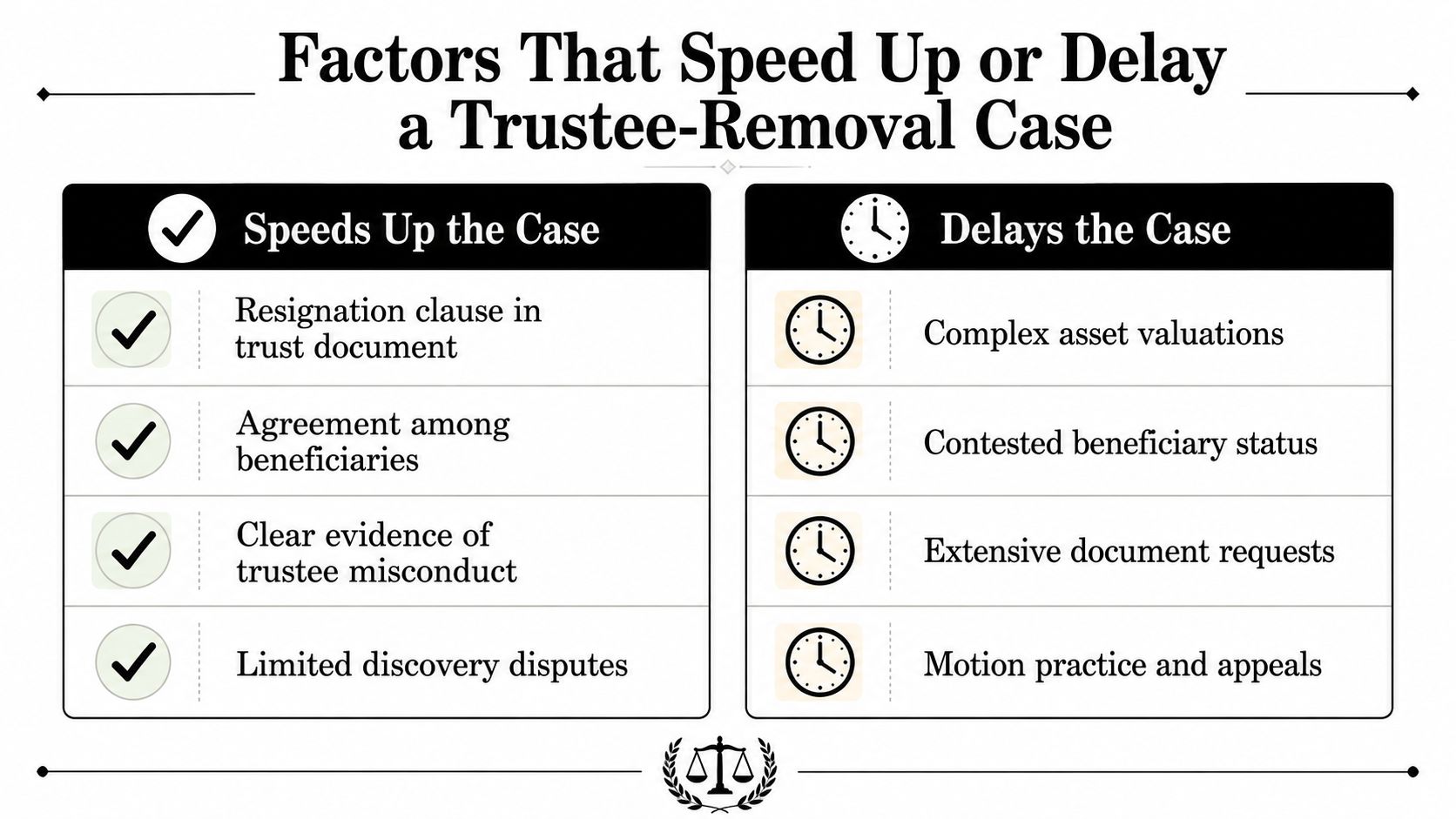
Some cases move because the paperwork is aligned. Others slow down because the facts are tangled.
What speeds things up
- Resignation clause in the trust document: If the instrument already gives a clear path for removal or replacement, the court has less to sort out.
- Agreement among beneficiaries: When the family is on the same page, fewer side disputes reach the judge.
- Clear evidence of misconduct: Clean records, direct communications, and obvious fiduciary breaches make the petition easier to prove.
- Limited discovery disputes: Fewer fights over records means fewer delays.
What slows things down
- Complex asset valuations: Real estate, business interests, and layered trust assets can create longer discovery.
- Contested beneficiary status: If people disagree over who counts as a beneficiary, the court has to sort that out first.
- Extensive document requests: Large record sets take time to collect, review, and challenge.
- Motion practice and appeals: Extra hearings mean extra waiting.
Texas Property Code Section 113.082 gives the court removal power on several grounds, including material violation of the trust, failure to account, lack of cooperation, and a judicial finding that removal best serves the trust's interests. Those grounds often determine how much evidence the judge needs before ruling. Texas Property Code Section 113.082 also reflects the point that timing is driven more by proof than by a rigid clock.
For a plain-language overview of those grounds, see When Can a Trustee Be Removed in Texas, which is useful if you're comparing your facts to the statutory standards.
Documents and Evidence You Will Need
A trustee-removal case moves faster when the record is organized. A messy file usually means more discovery, more objections, and more waiting.
Start with the trust instrument and every amendment. Then gather prior accountings, bank statements, brokerage statements, correspondence with the trustee, notes from beneficiary meetings, and any prior court filings. If there's a forensic accountant involved, keep those reports together with the source records so your lawyer can trace the money quickly.
The file should read like an audit trail for growing businesses, where each transaction lines up with the underlying documents. That kind of paper trail makes it easier to show whether the trustee followed the trust or drifted away from it. The same idea helps in trusts, even though the setting is personal instead of commercial.
Practical insight: strong records often lead to shorter negotiations, because the other side can see the proof before the hearing starts.
If you're unsure how much documentation matters, review evidence you need to win a trustee removal petition in Texas. It gives a practical picture of what a court usually wants to see.
Families sometimes ignore small records because they look unimportant at first. A text message asking for statements, a spreadsheet of missing distributions, or a note about a refused meeting can become useful later. Those details may also help your lawyer connect the story to the bigger file, including the audit trail for growing businesses that shows how each entry matches the supporting documents. Careful organization helps both the case and your stress level.
The No-Limitations-Period Rule and Related Damage Claims
Texas treats removal differently from money claims, and that distinction matters a lot. In Ditta v. Conte, the Texas Supreme Court held that there is no statutory limitations period that restricts a court's discretion to remove a trustee, while separate breach-of-fiduciary-duty claims for damages can still be limited by the four-year clock. Ditta v. Conte is the key decision for that point.
That means a beneficiary may still ask for removal even if the misconduct happened years ago. The court can look at whether the trustee should be taken out of office now, even if a related damages claim is too old to collect money. That is a major strategic difference, and families often miss it.
The practical effect is simple. If your goal is removal, older conduct may still matter. If your goal is to recover money for that conduct, the separate time limit can become a real problem. A careful Texas trust administration lawyer will sort those remedies before filing, because the relief you request can shape both the evidence and the length of the case.
For comparison, an outside resource on limitation periods in another context, SMB Law, PC injury resources, can help readers understand how limitation clocks affect claims generally. The trust point is different, though, because removal itself is not tied to the same filing deadline.
Emergency and Expedited Removal in Texas
Sometimes a family can't wait months for a regular setting. If a trustee is moving money, threatening beneficiaries, or hiding records, the court may need to hear about it on an expedited basis.
Texas courts can consider temporary restraining orders and temporary injunctions under the Texas Rules of Civil Procedure when the evidence shows immediate harm. In practice, that can mean asking the judge to freeze certain accounts, suspend some trustee powers, or appoint a special fiduciary while the case moves forward. The court usually wants specific proof, not broad suspicion.
A request for urgent relief is not the same as winning removal. It is a way to stop damage while the court decides the larger case. Families worried about active dissipation should document the conduct quickly and ask counsel about the strongest interim remedy.
For a related example of urgent fiduciary harm, trustee stealing from beneficiaries in Texas shows why speed matters when records suggest ongoing misuse. If a trustee is already acting in bad faith, waiting for a standard hearing date can make the loss worse.
Practical Steps to Shorten the Process and Next Steps
A trustee-removal case usually moves faster when the family stays focused. Gather the trust, accountings, and correspondence first, then have counsel narrow the dispute to the specific conduct that matters most. Broad accusations often lead to broader discovery.
Mediation can help when the facts are strong but the family still wants to avoid a long fight. So can a joint accounting, a clean resignation, or a written stipulation that removes the trustee without a full trial. Trustees who cooperate early often save everyone time and expense.
Beneficiaries should also avoid side disputes that don't help the core case. A fight over every email, every family grievance, or every unrelated asset can stretch a case that should have stayed narrow. Trustees, for their part, can shorten the process by producing records early and answering direct requests plainly.
If you need help evaluating the timeline, The Law Office of Bryan Fagan, PLLC handles trust administration, trustee disputes, estate planning, guardianship, and asset protection for Texas families. A focused review now can make the next step much clearer.
If you're managing a trust or planning your estate, contact The Law Office of Bryan Fagan, PLLC for a free consultation. Our attorneys provide trusted, Texas-based guidance for every step of the process, and we can help you understand how a trustee-removal case may unfold in your situation. Visit Law Office of Bryan Fagan, PLLC to get started.