An IRA usually does not go through probate when the owner has a valid beneficiary designation on file with the custodian. It can enter probate if the estate is named, no beneficiary survives, or the form is invalid; a disputed form can also bring a court into the process.
You may be sorting through a parent's account statements, holding a death certificate, and wondering whether you need an executor's appointment before calling the bank. That's a difficult moment to discover that a retirement account follows different rules from the house or the checking account. The paperwork can feel urgent, but you can approach it in an orderly way without rushing into a withdrawal.
Does Your IRA Avoid Probate? The Short Answer
The beneficiary record is the starting point. Ask the financial institution holding the IRA, called the custodian, for the current designation and its claim requirements. Don't assume that a name printed on an old statement tells the whole story.
The question “Does an IRA go through probate?” becomes easier when you separate the possible beneficiary situations.
Does an IRA avoid probate in each beneficiary situation
| Beneficiary situation | Usually avoids probate? | Why |
|---|---|---|
| Living individual named on the form | Yes | Custodian transfers the account under its beneficiary records. |
| Primary beneficiary died, contingent beneficiary living | Yes | The contingent beneficiary takes over under the same form. |
| No beneficiary on file, or all named beneficiaries died | No | Custodian default rules may send the account to the estate. |
| Estate named as beneficiary | No | The executor must collect the account through estate administration. |
| Qualifying trust named | Generally yes | Trust terms and drafting decide the outcome. |
| Form invalid, incomplete or disputed | Unclear | Custodian may pay the estate, and heirs may challenge the form in court. |
The “No” answer for an account without surviving beneficiaries describes a common outcome, not an automatic rule for every custodian. Some agreements provide another default recipient. Obtain the agreement before deciding that the estate must receive the money.
Transfer authority isn't the same as unrestricted access
A named beneficiary still has to establish identity, document the death, and complete the custodian's process. Avoiding probate doesn't mean the custodian must release funds immediately or ignore competing claims.
An executor's authority over estate property also doesn't automatically give that executor control over an IRA payable directly to someone else. Families can use this distinction between probate and non-probate assets to organize which assets require estate administration and which follow separate transfer instructions.
Practical rule: Ask for the accepted beneficiary record before asking who gets the money.
Keep the response with the estate documents. The answer turns on the account's actual transfer instructions, not whether a folder is labeled “will,” “trust,” or “complete estate plan.”
Why Your Beneficiary Form Matters More Than Your Will
A Houston retiree leaves everything in her will to her daughter, but her IRA record still names her son. After her death, the son submits the required claim forms and death certificate. The custodian generally follows the accepted beneficiary form, much like a mail carrier follows the name on a mailbox, rather than instructions in a separate letter.

Assuming the designation is valid and no competing legal claim changes the result, the IRA goes to the son. The daughter may inherit property covered by the will, but she does not receive this account under those instructions. The IRS probate-proceedings guidance explains that retirement accounts are generally controlled by beneficiary designations, so a will generally cannot override a conflicting IRA form.
The executor may still need to identify the account and determine what estate reporting is appropriate. That administrative work does not, by itself, give the executor authority to collect or distribute an IRA payable directly to a beneficiary. And avoiding probate does not settle every question: a surviving spouse may have rights, tax and payout deadlines may apply, and relatives may dispute the designation.
Different assets need different instructions
A form completed for one account does not update every other asset. Each institution keeps its own records, and each type of property has its own transfer method. For example, a brokerage account's transfer-on-death registration does not change an IRA beneficiary form. Changing a life insurance beneficiary also does not change a bank account's payable-on-death designation.
| Account or asset | Designation tool | Usual probate effect |
|---|---|---|
| IRA or 401(k) | Beneficiary designation form | Usually avoids probate; custodian or plan records control, subject to applicable protections. |
| Bank or savings account | Payable-on-death (POD) designation | Usually avoids probate if the named payee survives. |
| Brokerage account (non-retirement) | Transfer-on-death (TOD) registration | Usually avoids probate; registration controls. |
| Texas real estate | Transfer-on-death deed recorded under Texas law | Avoids probate if properly prepared and recorded. |
| Life insurance | Beneficiary designation | Usually avoids probate if a beneficiary survives. |
For plain-language context on account registrations, see estate planning guidance for Alpharetta families. Texas families should have any instruments reviewed under Texas law. If an account designation conflicts with a trust, the issue can involve more than correcting a name. This discussion of beneficiary designation disputes involving a funded trust helps explain why the account form and trust documents may need to be reviewed together.
Review designations after family changes
Marriage, divorce, a birth or adoption, a beneficiary's death, or creating a trust can change who should receive an account. These events are useful prompts to check the custodian's accepted record, including both primary and contingent beneficiaries. A form someone remembers mailing may not show what the custodian has on file.
Keep a record of each non-probate account, its named beneficiaries, and when the custodian last confirmed the designation. Store accepted copies with estate documents so the family can locate the instructions after a death. If a trustee encounters conflicting directions, When a Trustee Should Consult a Texas Attorney describes situations in which legal guidance may help protect the trustee and trust.
When an IRA Still Ends Up in Probate
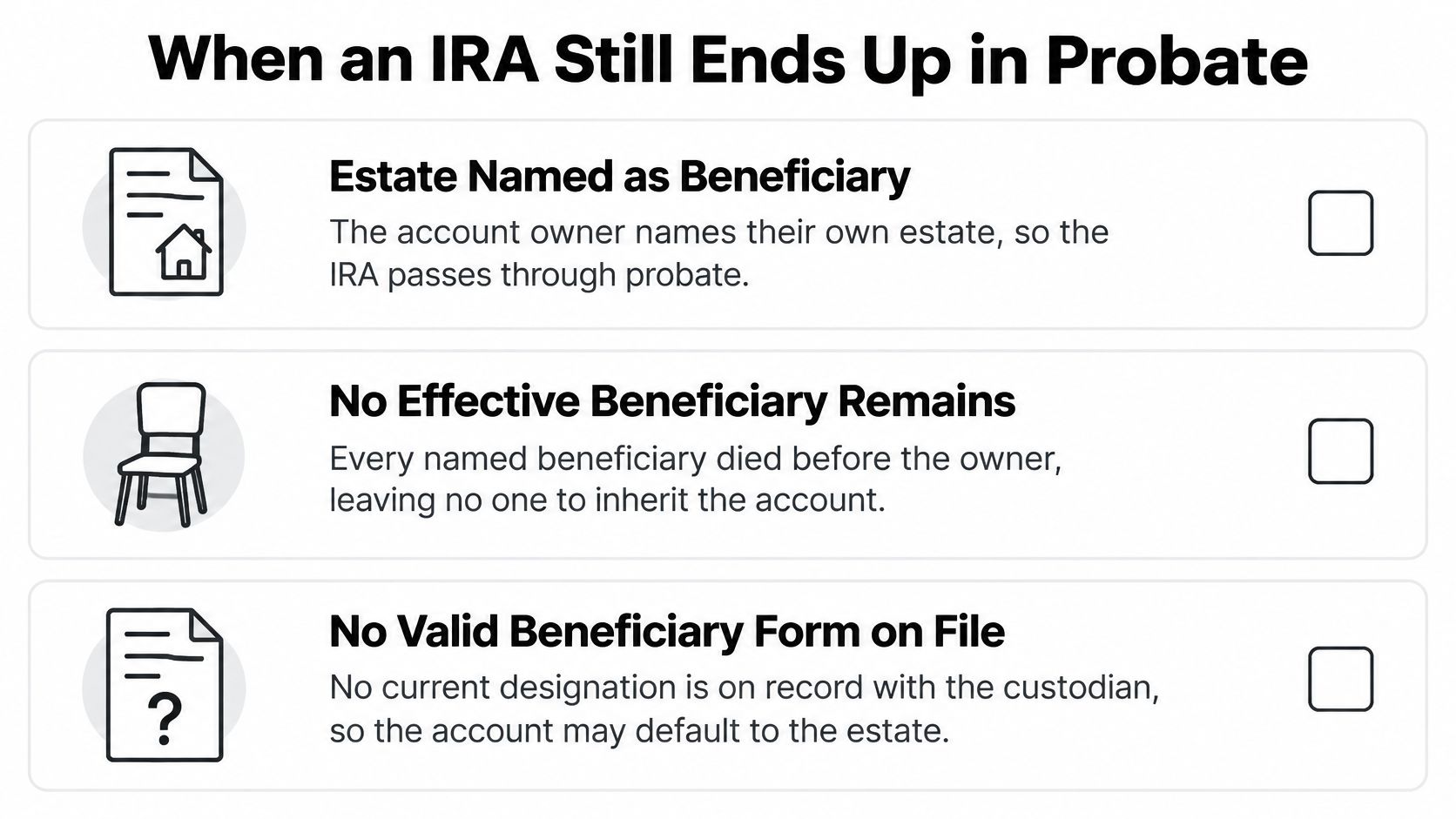
The executor opens the IRA paperwork and finds the estate named as beneficiary. The Dallas widower had updated his will after his children were young, but never changed the account form. The will does not replace that designation, so the IRA is payable to the estate and must be collected through estate administration.
That route can affect more than who handles the account. An estate is not an individual designated beneficiary for federal required-minimum-distribution purposes, as explained in the IRS written determination addressing inherited-IRA distribution rules. The estate therefore does not receive an individual beneficiary's life-expectancy payment treatment, and an eligible spouse may lose the option to roll the IRA into their own account. The applicable payout period depends on the owner's death and required-beginning-date status.
An IRA can miss probate avoidance because of a paperwork problem, even when the owner had a different plan.
Identify the trigger and the fix
- The estate is named: Confirm whether that choice was intentional. While the owner is alive, review whether naming an individual or using a carefully drafted trust better fits the plan.
- No effective beneficiary remains: If a primary beneficiary dies and no backup beneficiary survives, the custodian may apply its default provisions. Name contingent beneficiaries and update them when circumstances change.
- The form is missing or rejected: An unsigned, incomplete, or unaccepted form may leave an older designation in place. Ask the custodian which form it accepted and what beneficiary record it currently has.
The transfer process and tax withdrawal schedule are separate concerns. If the estate receives the IRA, distributing the proceeds to the children does not restore the payout rules they may have had as directly named beneficiaries. The executor should confirm the applicable timing before assuming that the estate can pass the account along.
Warning signs deserve attention before a death
Check for outdated names after divorce, vague wording such as “my children,” or a designation without confirmation that the custodian accepted it. Adding detail yourself may not solve the problem. Ask which wording the custodian supports, then coordinate the form with counsel.
A beneficiary form also does not prevent a dispute about whether the owner had capacity, signed freely, or faced pressure. If heirs challenge the instruction, a court may need to decide whether it was valid. Skipping probate does not mean the family avoids every legal or tax issue.
This video provides additional context for families considering IRA transfers and probate.
Keep written confirmation that the custodian accepted the designation. A signed copy in your desk does not establish what the institution has on file.
Texas Community Property and Divorce Rules
A signed beneficiary form doesn't necessarily settle every ownership question. In Texas, retirement savings built during marriage are often community property, which may give a surviving spouse a claim even when someone else appears on the designation.
Consider an Austin husband who names an adult child from a prior relationship. After his death, his wife claims a community-property interest in the IRA. The child may be the named recipient, but that doesn't resolve whether the husband could direct the entire account away from his spouse.
Spousal rights require a separate review
Counsel may need account-opening records, contribution histories, rollover documents, and marital agreements to evaluate the claim. The account balance alone won't establish which funds are community or separate property.
The family may resolve the disagreement through document exchange, negotiation, or mediation without a contested probate proceeding. If they can't agree, litigation may still be necessary even though the account was designed to transfer outside probate.
Divorce creates a related concern. Texas law can revoke some former-spouse designations, but exceptions, account type, and federal law can affect the result. Don't assume the custodian will automatically apply the correct rule without reviewing the decree and account documents.
Outside probate doesn't mean outside a spouse's ownership rights.
Fiduciaries must verify before distributing
The Texas Estates Code provides the framework for estate administration and an executor's authority over estate property. The Texas Trust Code governs trust administration, including how trustees exercise their powers and carry out their responsibilities.
The fiduciary duties in Texas include loyalty, good-faith administration, appropriate care, accurate records, and avoiding improper conflicts. An executor or trustee shouldn't favor a relative, ignore a documented competing claim, or distribute disputed funds just because someone is demanding payment. Paying the wrong person can create personal exposure.
A sensible dispute-resolution process is to preserve the records, identify each claimant's position, obtain legal analysis, and consider settlement before distributing contested proceeds. Trustees should document their decisions and communicate appropriately with beneficiaries.
The IRS beneficiary guidance also explains that inherited-account treatment turns on the beneficiary's relationship to the owner and the owner's death date. Resolving ownership is therefore only part of selecting the correct transfer approach.
Before updating a designation, ask a Texas estate planning attorney:
- Property ownership: Is any part of this account community property?
- Divorce documents: Does a decree or marital agreement affect the designation?
- Custodian acceptance: Will the institution confirm the revised form in writing?
Tax and Payout Rules That Still Apply
An adult son inherits a hypothetical $400,000 traditional IRA. If the ten-year rule applies, the account generally must be emptied by the end of the tenth year. If the owner died after reaching the required beginning date, annual distributions may also be required before then. The IRS's Publication 590-B explains these requirements. Taking the entire balance in year ten can add $400,000 of taxable income to that year, potentially pushing more income into higher tax brackets.
Payout rules by beneficiary type after the owner's death
The general rules vary by beneficiary. The owner's death date, required beginning date, and the beneficiary's circumstances affect the applicable schedule.
| Beneficiary type | Typical payout rule | Planning note |
|---|---|---|
| Surviving spouse | Can generally roll the IRA into their own IRA or keep it as an inherited IRA | Usually has the most flexible options. |
| Minor child of the owner | Life-expectancy payments may apply until majority, followed by the ten-year rule | Eligible status doesn't continue indefinitely. |
| Disabled or chronically ill individual | Life-expectancy payments may apply | IRS definitions and documentation matter. |
| Individual not more than ten years younger than owner | Life-expectancy payments may apply | May include a sibling close in age. |
| Other individual, such as an adult child | Generally the ten-year rule, with annual withdrawals when applicable | Concentrated withdrawals can increase income tax. |
| Trust | Governing payout rule follows trust classification and drafting | Review the terms before naming the trust. |
IRS guidance for IRA beneficiaries describes eligible designated beneficiaries, including spouses, the owner's minor children, qualifying disabled or chronically ill individuals, and people not more than ten years younger than the owner.
Plan withdrawals before taking them
If the son can wait until year ten under his applicable rules, a lump-sum withdrawal could mean reporting the full $400,000 as income in that tax year. If annual withdrawals are required, waiting until year ten would also fail to meet the distribution schedule. Spreading withdrawals over eligible years can help manage taxable income; the effect depends on the beneficiary's other income and deductions.
The recipient's taxpayer identification number is used to report distributions. A beneficiary, estate, or trust should coordinate that reporting with its tax preparer so the distribution and tax records match.
Naming a trust does not automatically give it the same payout treatment as an individual beneficiary. Before making that choice, review the Texas see-through trust rules for an IRA beneficiary and how the trust is drafted.
The IRS's broader inherited-IRA guidance explains how beneficiary categories affect inherited-account rules. If a family is considering changes to a Texas trust, counsel should assess which changes are legally available and how they could affect retirement-account planning before an amendment is signed.
Verify Your IRA Designation and Take the Next Step
An IRA can pass outside probate and still leave a family with tax deadlines, questions about who may act, or disputes over who should receive the funds. A Texas trust administration lawyer or estate planning attorney can help identify who has authority, which documents govern, and what needs attention before distributions are made.
For an executor or beneficiary, follow these steps:
- Pull the latest records. Obtain the account statement, the accepted beneficiary designation, and the custodian agreement.
- Compare the documents. Check the designation against the will, any trust, and any divorce decree. Note conflicting names or instructions.
- Complete the claim process. Submit the death certificate and required forms through the custodian's secure process.
- Check required distributions. Find out whether a year-of-death required minimum distribution remains unpaid, and request a written schedule for later distributions.
- Preserve the tax trail. Keep distribution confirmations, tax forms, correspondence, and records of decisions together.
- Confirm authority before paying others. If proceeds are controlled by an estate or trust, have counsel review the fiduciary's authority before money is distributed.
The IRS draft Publication 590-B guidance says that when an owner dies on or after the required beginning date, beneficiaries must determine and distribute any remaining required minimum distribution for that year. The custodian and tax adviser can help clarify the current rules and applicable deadlines.
An account owner's preventive review
Use this visual checklist to check how the account form names its beneficiaries and whether it identifies a trust correctly.
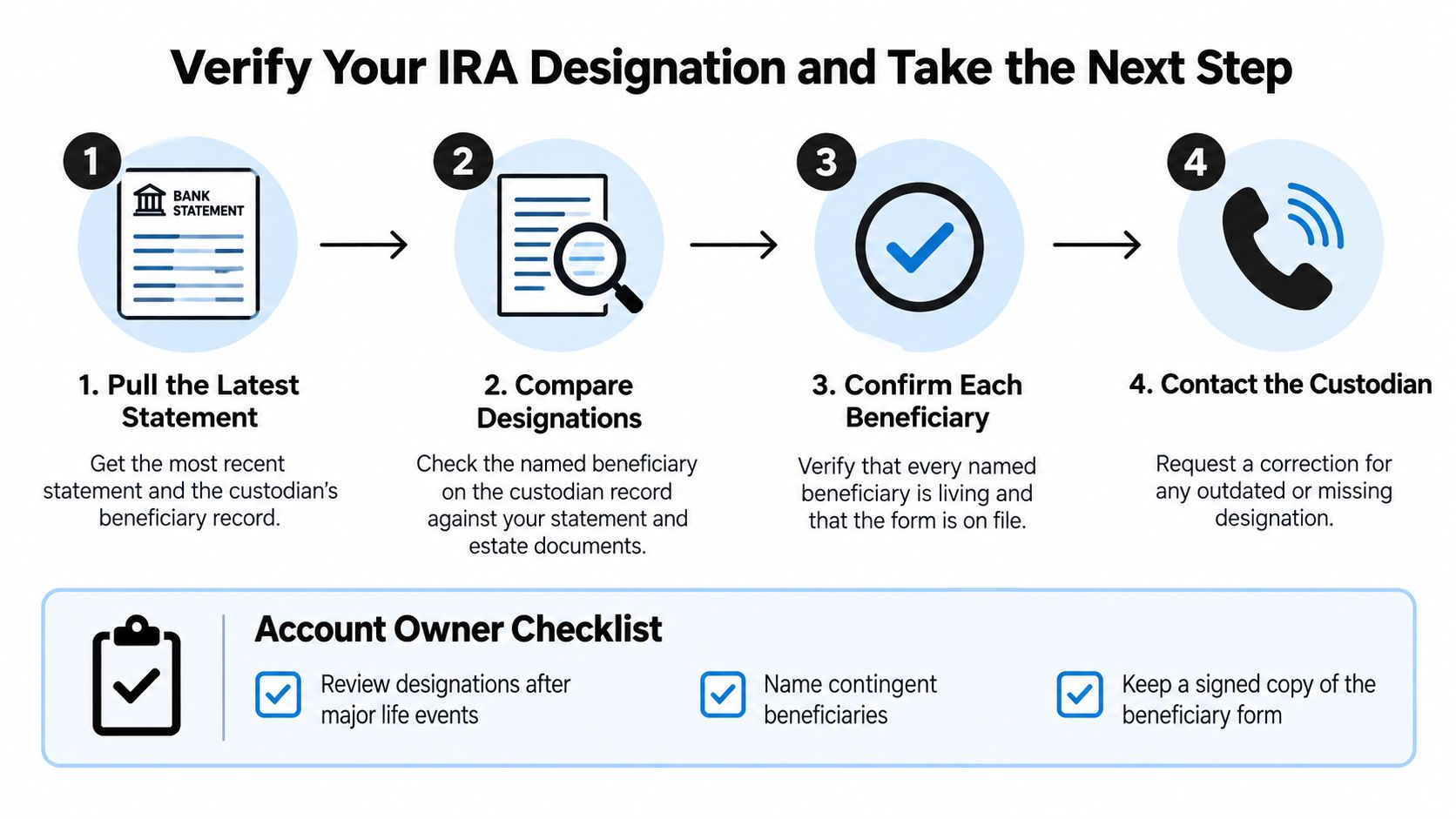
A trust's name on the IRA form should match the trust's legal name in its governing document. If the two differ, ask the custodian and an estate planning attorney whether the designation needs correction. That small wording issue can matter when the family files a claim.
To understand who receives an IRA and who administers it, distinguish assets that pass under a beneficiary designation from assets managed through an estate or trust. Avoiding probate answers who handles the transfer through court; it does not, by itself, resolve tax obligations or disputes over authority.
If you're managing a trust or planning your estate, contact The Law Office of Bryan Fagan, PLLC for a free consultation. Its attorneys provide Texas-based guidance on trust and estate administration, beneficiary designations, and next steps.