You've learned that a loved one changed a will, and the new plan doesn't resemble the wishes you remember. Someone who provided daily care now receives most of the estate, while close relatives receive little. It's understandable to feel worried, but an unexpected inheritance doesn't automatically mean someone broke the law.
Texas families need a way to separate a painful surprise from a legally supportable challenge. Undue influence in wills turns on evidence of pressure and its effect at signing, not mere access, caregiving, or unequal shares.
What Undue Influence Means in a Texas Will
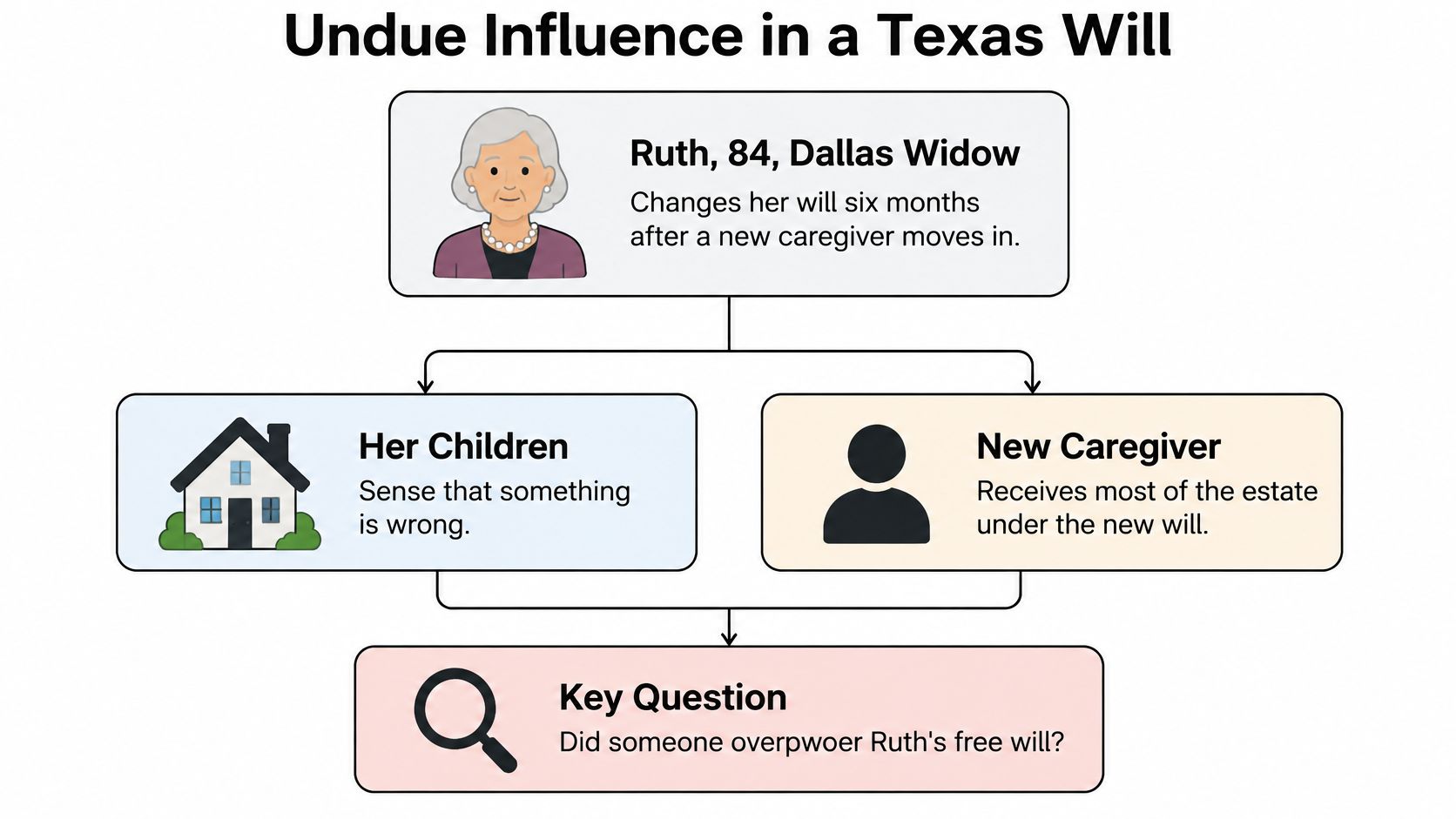
Ruth, an 84-year-old widow in Dallas, changes her will six months after a new caregiver moves in. She leaves most of her estate to that caregiver. Her children suspect pressure, but the timing and the size of the gift alone do not prove it. The legal question is whether Ruth's own judgment produced the will.
Undue influence occurs when another person's pressure overcomes the testator's free agency and causes the will to express a plan the testator would not otherwise have made. Affection, advice, persuasion, and gratitude can shape a decision without becoming undue influence. The law focuses on pressure strong enough to overpower the person's choice.
The Linked Elements of a Claim
Under the Texas Supreme Court's undue-influence framework, a contestant must connect three parts of the claim:
- Someone exerted influence. Repeated visits show access; they do not show that anyone dictated the terms. Evidence must indicate actual pressure.
- That influence overpowered the testator's mind when the will was signed. Earlier disagreements matter only when evidence links them to the will's execution.
- The will would not have been made without that influence. The pressure must have caused the challenged gift or plan.
The Texas Estates Code governs admitting a will to probate, including execution-related proof addressed by section 256.152. Undue influence is a separate question about how the testator reached the decision. A will may meet execution requirements while still being challenged on the ground that pressure overrode the testator's choice.
Three elements a contestant must prove
| Element | What It Requires | Example Evidence |
|---|---|---|
| Influence exerted | Actual pressure, rather than access alone | A beneficiary dictating instructions, making threats, or repeatedly demanding a change |
| Free will overpowered at signing | Pressure that subverted the testator's mind at execution | The testator repeats another person's instructions, considered with evidence of isolation or coercion |
| Plan would not otherwise exist | A causal link between the pressure and the final plan | Earlier wishes change after documented demands or threats |
Context Matters, but Causation Matters More
Evidence may be direct, such as a threat to withdraw essential care unless Ruth changes her will. It may also be circumstantial. Dependence, isolation, involvement in drafting, and a departure from prior intentions can carry weight when considered together.
Each fact still needs context. Ruth may freely choose to reward a devoted caregiver, even if her children find the decision upsetting. The evidence must show how pressure affected her decision and led to the final terms.
Practical rule: If you can't identify specific evidence supporting every element, you have concerns to investigate, not yet a proven undue-influence claim.
Undue Influence Versus Incapacity and Fraud
Incapacity asks whether the engine can run; undue influence asks whether someone else took the steering wheel. The analogy isn't a medical test, but it helps explain why these are different legal theories. A person may understand an estate plan and still surrender free choice under coercive pressure.
A ride to the lawyer's office illustrates the distinction between assistance and control.

Undue influence, incapacity and fraud compared
| Theory | Core Question | Typical Proof | Combined With Undue Influence? |
|---|---|---|---|
| Undue influence | Was free will overpowered when the will was signed? | Relationship dynamics, isolation, drafting control, and changed plans | It's the core theory |
| Testamentary incapacity | Could the testator understand the property, family, and document? | Medical records, observations, and capacity evaluations near signing | Yes, but each theory needs its own proof |
| Fraud | Were false statements used to induce the gift? | Misrepresentations, altered text, or false explanations | Yes, although the factual and legal proof differs |
Apply the Right Question to Ruth's Situation
Suppose Ruth's caregiver drove her to the lawyer and attended meetings. Those facts prompt questions about influence, particularly who supplied the instructions. They don't establish that Ruth lacked mental ability or that anyone coerced her.
Now suppose witnesses describe significant confusion on the signing day. That calls for a capacity investigation using medical records and contemporaneous observations. A diagnosis or memory problem shouldn't substitute for examining Ruth's actual understanding when she executed the will.
Fraud raises another question. If someone deliberately gave Ruth false information to obtain a gift, counsel should investigate the statement, its falsity, and its connection to her decision rather than treating every deception as identical to coercion.
Why Opportunity Still Isn't Enough
In Estate of Danny Lee Rubey, the court found that multiple opportunities to influence the testator weren't enough without evidence that influence was exerted in connection with the will. That distinction protects both vulnerable adults and adults who make unpopular choices freely.
Capacity and undue influence may be pleaded together, but they aren't interchangeable. Choose the theory that matches the evidence, rather than assuming an unfair-looking result proves every possible ground for a contest.
Who Carries the Burden of Proof in Texas
The contestant must prove undue influence by a preponderance of the evidence. In practical terms, the evidence must show that undue influence was more likely than not exerted. This standard asks the fact-finder to weigh the evidence, rather than accept suspicion as proof.
The Texas Supreme Court's decision addressing the contestant's burden requires tangible, satisfactory proof of the elements of undue influence. Unequal treatment or a strained relationship may provide context, but the contestant must connect evidence to the alleged influence and the will.
How a Presumption Changes the Process
A confidential or fiduciary relationship can shift who must produce evidence at a particular stage. It does not automatically transfer the ultimate burden or decide the case.
Burden of proof by stage in a Texas will contest
| Stage | Who Must Act | What They Must Show |
|---|---|---|
| Pleading the claim | Contestant | Specific facts supporting the required elements |
| Presumption from a confidential or fiduciary relationship | Contestant presents relationship evidence | A basis for shifting the burden of production only |
| Response to the presumption | Proponent of the will | Evidence showing the absence of undue influence |
| Final determination | Contestant | Undue influence was more likely than not |
The law separates producing evidence from persuading the fact-finder. If the will's proponent offers evidence contradicting an applicable presumption, the presumption disappears. The contestant still has to persuade the fact-finder that undue influence more likely than not occurred.
A caregiver's title or a family tie alone does not establish a legally significant confidential relationship. The relevant question is how much trust, dependence, and control existed in practice. Those details can help explain whether the relationship supports a presumption, though they do not by themselves prove that pressure changed the will.
Put Litigation Figures in Perspective
A historical review of reported will cases identified 513 cases discussing undue influence in detail. Wills were overturned in 170 cases, or 33.1%. These figures describe selected reported litigation, not all wills or the likelihood of success in a particular Texas contest.
For a case assessment, organize records around the execution date: who had access, what was said, Ruth's condition, who supplied drafting instructions, and how her final plan differed from earlier wishes. This timeline helps distinguish a relationship that offered an opportunity from evidence that pressure was actually exerted.
Warning Signs and the Evidence That Proves Them
Warning signs justify questions, not conclusions. A family should look more closely when several of these circumstances appear together:
- Restricted contact: Relatives can't reach the testator without another person's permission.
- Controlled appointments: A beneficiary chooses the lawyer and manages communications.
- Illness or dependence: Drafting occurs during a hospital stay or increased reliance on a caregiver.
- An unexplained reversal: A long-standing plan changes sharply.
- Beneficiary involvement: The person receiving the larger gift attends drafting or signing.
A simple, dated record can help a family distinguish observations from assumptions.

Turn Each Concern Into an Investigative Question
Suppose Ruth's caregiver booked the attorney, drove her there, and stayed during signing. Ask who requested the change, who explained it, and whether Ruth could speak privately. Those answers matter more than transportation alone.
The Texas Supreme Court's guidance on opportunity and wrongful pressure distinguishes caregiving access from actual exertion through force, intimidation, duress, deception, or excessive demands. Because direct evidence may be unavailable, investigators often need several independent records.
Warning signs and the evidence that supports them
| Evidence Type | What It Can Show | Where It Usually Comes From |
|---|---|---|
| Drafting communications | Who selected the lawyer and supplied instructions | Emails, texts, intake notes, scheduling messages |
| Prior and later wills | Changes in beneficiaries or shares | Estate files, prior probate filings, lawyer archives |
| Medical and capacity records | Vulnerability and cognitive condition near signing | Physician notes, hospital charts, evaluations |
| Transport and access records | Who arranged trips and controlled access | Calendars, transportation records, location data obtained through proper legal process |
| Financial records | Gifts, account changes, or dependence | Bank statements and agent transaction logs |
| Native drafts and metadata | Who edited a document and when | Original electronic drafting files |
| Witness accounts | Who spoke for the testator and attended | Subscribing witnesses, notary records, testimony |
Preserve Originals Before Drawing Conclusions
Save native electronic files rather than relying only on printed copies. Counsel may recommend handwriting review if signatures or alterations are disputed, or an independent medical review focused on the signing period. Neither tool, standing alone, establishes coercion.
For additional educational context, the following video accompanies this discussion.
Investigate in a deliberate order: compare estate documents, identify the lawyer's initial contact, trace transportation and communications, review relevant medical and financial records, and interview subscribing witnesses. Preserve evidence lawfully; don't access someone else's accounts or devices without authority.
How to Challenge a Will in Texas Step by Step
A contest requires more than sending objections to the executor. Families need to identify the correct court, protect deadlines, and develop admissible evidence. This overview of contesting a will in Texas provides related procedural context.
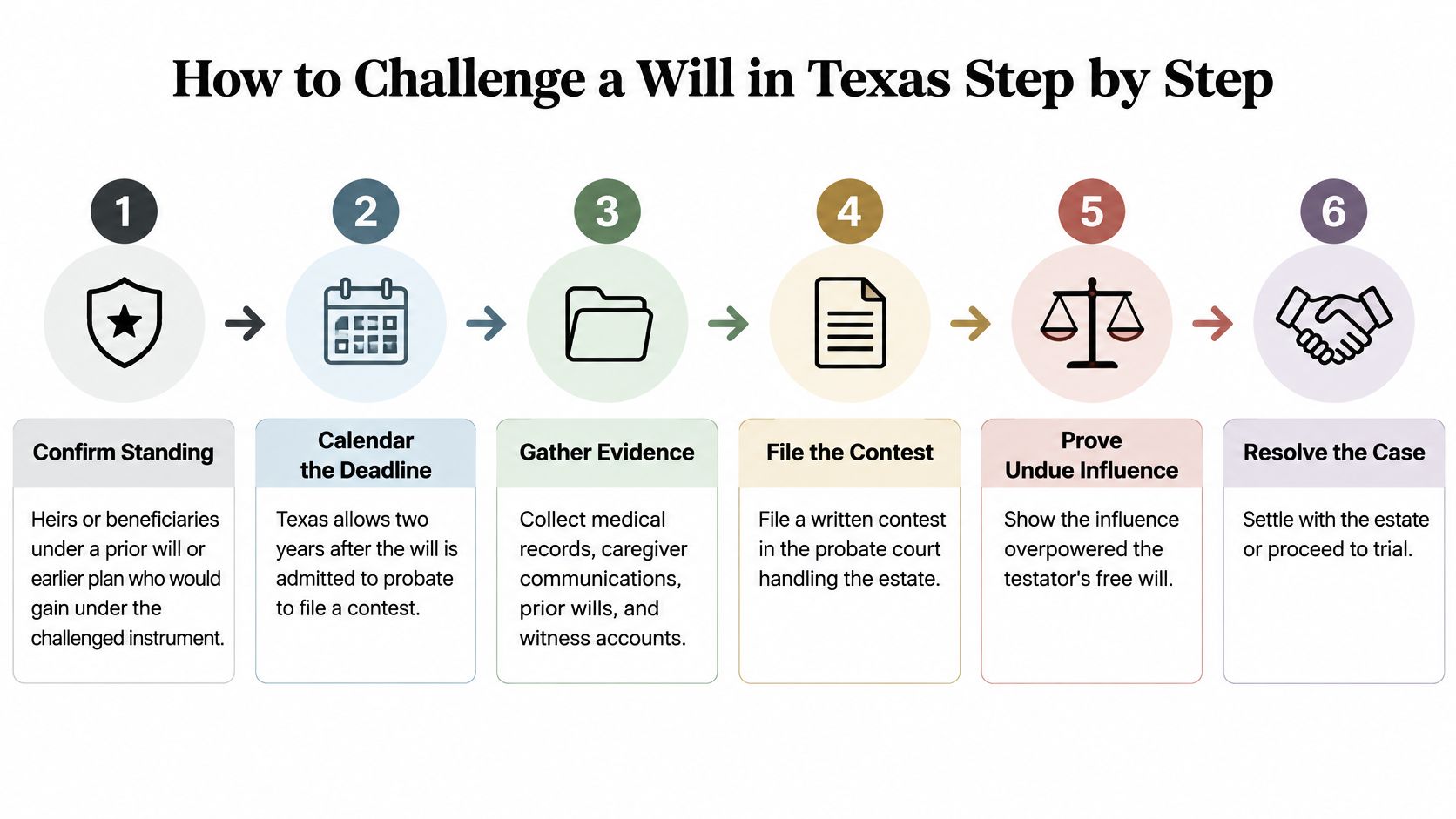
The process can be organized into manageable stages.
Move From Concern to a Properly Supported Contest
Confirm standing. Counsel should determine whether you have a legally recognized interest, such as an inheritance under an earlier will or as an heir. Usually, the question is whether you would benefit if the challenged will were rejected, not merely whether you dislike its terms.
Calendar the deadline immediately. Texas Estates Code section 256.204 generally provides a two-year period after admission to probate, subject to applicable exceptions. Don't assume negotiations pause the deadline. Trust challenges require a separate limitations analysis under the Texas Trust Code and other applicable law.
Preserve records. Ask counsel about written preservation requests to the drafting lawyer, financial institutions, healthcare providers, and relevant communications providers. A preservation request doesn't itself authorize disclosure, but it can identify material that shouldn't be lost.
File in the proper proceeding. A written contest belongs in the court handling the estate. Counsel should verify the probate status and any necessary procedural steps before filing.
Plead conduct, not just unfairness. Identify the pressure alleged, its connection to execution, and why the resulting will wouldn't otherwise have been made. Separate personal observations from information that still needs confirmation.
Use discovery to test both accounts. The Texas Rules of Civil Procedure govern discovery, including Rule 190's discovery-control framework and Rule 194's applicable disclosure requirements. Attorney records, witness depositions, and communications can reveal whether the beneficiary supplied instructions or the testator acted independently.
Evaluate mediation or settlement. Compare the available proof, litigation expense, disputed assets, and practical remedies. Settlement should follow an informed assessment rather than pressure to accept either side's initial account.
Prepare for hearing or trial. The contestant must present admissible evidence meeting the burden already discussed. Documents need context, witnesses need personal knowledge, and the timeline must connect pressure to execution.
Keep Probate and Trust Issues Separate
Discovery often determines whether a concern becomes usable proof. It can also uncover strong defenses, such as private meetings and consistent instructions.
A California probate and trust study illustrates that undue-influence disputes may resolve before verdict, but its results shouldn't be treated as Texas success rates. Texas decisions require Texas-specific analysis.
Trust property may involve a different proceeding. Trust Administration vs. Probate in Texas explains why trust assets generally avoid probate and how the processes differ. A Texas trust administration lawyer should review overlapping documents and deadlines early.
Common Defenses and How Courts Weigh Them
A family may see a beneficiary's access to an older relative and assume the will was influenced. Access creates an opportunity, though. A successful challenge needs evidence connecting pressure to the decision and the signing. The defenses help show what else the evidence may establish.
Common defenses and the contestant's response
| Defense | What It Argues | Contestant's Response |
|---|---|---|
| Self-proved will | The affidavit supports proper execution and validity | A self-proved will establishes formal execution, not freedom from pressure |
| Independent counsel | The testator privately documented personal wishes | Investigate who selected and briefed counsel |
| Natural affection | The gift reflects closeness or past care | Examine unexplained departures and restricted family contact |
| Opportunity only | The allegations show access, not exertion | Identify evidence of actual pressure connected to signing |
Match Each Defense to Its Limits
A self-proving affidavit under Texas Estates Code section 251.107 addresses formal execution. It does not establish whether the testator made the decision freely. Texas will requirements explain the formalities a will must meet, which are distinct from evidence about influence.
Independent counsel can provide strong rebuttal evidence when records show the testator met privately, explained the plan, and gave consistent instructions. The circumstances still matter. For example, a contestant may investigate whether a beneficiary chose the lawyer, provided instructions, or shaped what the lawyer heard before the private meeting.
Natural affection can also explain a gift. A parent may leave a larger share to a child who remained close over many years, even if the other children expected equal shares. An earlier plan or limited family contact may raise questions, but the court weighs those details alongside the testator's reasons and the circumstances of signing.
Understand What Rebuts a Presumption
The Texas appellate decision discussing confidential relationships and presumptions explains why contrary evidence matters. Independent advice, private meetings, and a signing without pressure can rebut a presumption. The contestant still carries the ultimate burden of proving undue influence.
Evidence works like pieces of a timeline. A lawyer's notes may show who gave instructions; messages may reveal pressure; witnesses may describe the testator's condition and words near signing. One document rarely answers every question on its own. The court considers how the pieces fit together and whether they connect pressure to the will.
Documentation matters on both sides: A proponent may rely on records of independent choice, while a contestant needs evidence showing what those records leave out.
A signed will and supporting paperwork can establish that legal formalities were followed. The dispute turns on whether the evidence also supports the testator's free choice.
Protect Your Plan Before a Contest Begins
Ruth's daughter helps arrange a new will while Ruth is ill, and the will leaves the daughter a larger share than before. Those facts may raise questions, but access and an unequal gift do not prove undue influence. A stronger plan makes room for Ruth to give instructions privately and preserves a clear record of her independent choice. A Texas estate planning attorney can help tailor those steps to her circumstances.
Create a Record Without Taking Away Control
The goal is to document the testator's own wishes, not to steer them. Let the testator select counsel, explain the plan in their own words, and meet privately with the attorney. Keep beneficiaries out of substantive discussions and the signing when practical. If illness or acute stress could affect the meeting, consider whether it can be scheduled for a more suitable time.
For example, a lawyer's notes may help show that Ruth understood who would inherit, described her reasons for changing the plan, and gave instructions without her daughter present. That record is more informative than the fact that the daughter had access to Ruth or helped with daily care.
Texas Estates Code section 251.051 addresses attested wills and credible witnesses. Section 254.001 addresses potential gift problems involving interested witnesses, so disinterested witnesses are generally the safer choice for a witnessed will. Other will forms may follow different rules.
For additional steps to reduce contest risks, see preventing will contests through careful preparation. Preparation can support evidence of independence, though it cannot guarantee that a will will not be challenged.
Check Whether Related Documents Reflect the Same Choice
A will may not control every asset. A Texas appellate matter involving a will and non-probate designations illustrates why beneficiary designations and trust documents can matter alongside a will. They need not distribute property in the same way, but a change to one document during a period of caregiver influence may invite questions about who proposed it, who communicated with the drafter, and whether the testator understood its effect.
The Texas Trust Code governs trust administration, while the Texas Estates Code covers probate and related estate matters. Fiduciary duties in Texas also require attention to the governing documents, the fiduciary's authority, and beneficiary interests. For an undue-influence concern, preserve records tied to the disputed change, such as drafts, messages about the testator's instructions, and relevant calendars or health information. These details can help distinguish a testator's deliberate decision from a change shaped by another person.
A practical safeguard is to ask the testator, privately and in their own words, why they want to make a significant change. The attorney can record the explanation and compare it with the final documents. That gives later reviewers evidence about the decision itself, not merely who was nearby when it was made.
If you're managing a trust, planning your estate, or concerned about undue influence, Law Office of Bryan Fagan, PLLC offers Texas-based guidance on estate documents, fiduciary responsibilities, and probate disputes. Schedule a free consultation to review relevant documents, evidence, and possible next steps with attorneys serving Houston, Dallas-Fort Worth, Austin, San Antonio, and The Woodlands.