Managing a loved one's estate can feel overwhelming, especially when the family home, bank accounts, and personal belongings don't pass the way everyone expected. You're not alone in feeling confused, and you don't have to sort out Texas rules by guessing. A calm, asset by asset look at inheritance laws in Texas can turn a stressful assumption into a clear next step.
Why Texas Inheritance Rules Surprise So Many Families
A father dies in Texas without a will. His second wife assumes she'll keep the house and accounts they used together, and his adult children from his first marriage assume the same. Then the family learns the house was his separate property from before this marriage, one account has an old beneficiary designation, and the rest is community property. Each asset follows a different path.

That surprise is common because three questions work together. Was there a valid will, how is each asset classified, and which relatives survive? Texas intestate succession is governed primarily by Chapter 201 of the Texas Estates Code, and it applies when a person dies without a valid will. The outcome depends on marital status, community or separate characterization, and surviving relatives.
Two Misunderstandings That Cause Most of the Stress
No will doesn't mean no rights. State law still names heirs and shares, even if the family never discussed a plan. Having a will doesn't mean no court. A will may still need probate, and it may not control beneficiary designated accounts, jointly owned property, or assets it doesn't mention.
Practical rule: Don't ask who inherits everything. Ask, for each asset, who owns it, how it's titled, and who is named to receive it.
That's why this guide doesn't reduce inheritance to a single percentage chart. We'll look at the default order when there's no will, what spouses and children receive, which assets bypass probate, and what executors and trustees must do next. The rules are detailed, but they're knowable once you separate family structure from property type.
If you're sitting at that kitchen table now, start by gathering facts instead of debating expectations. Find deeds, account statements, and any will or trust documents. Those papers usually explain more than memories of what a parent intended.
How Texas Intestate Succession Works When There Is No Will
Think of intestacy as a decision tree, not a family vote. The court doesn't ask who was closest, who provided care, or who needs money most. It follows a statutory order based on kinship.
The flowchart below shows the basic sequence before property type changes the shares.
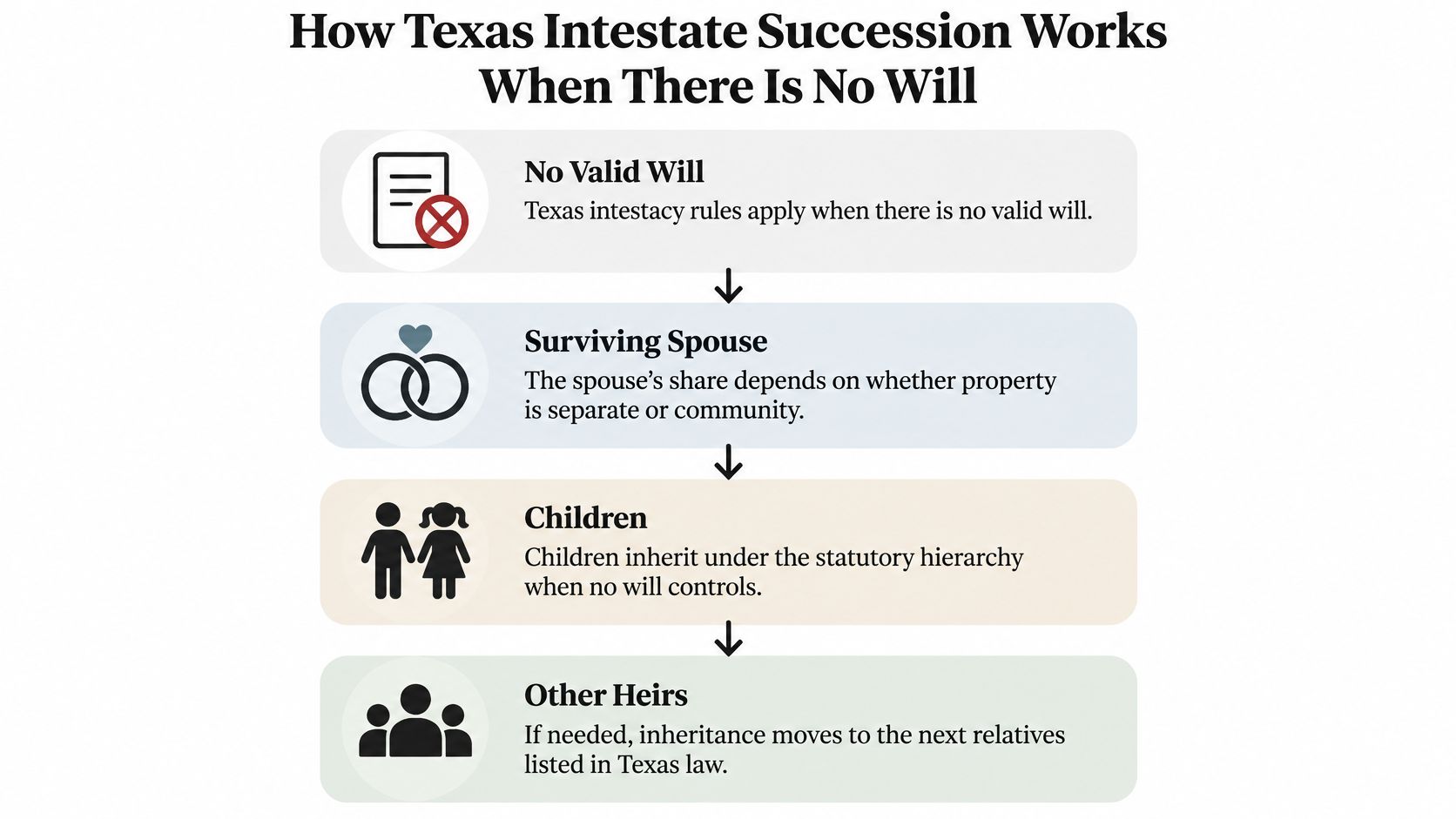
If a decedent leaves no spouse, the estate generally passes first to children and descendants. If none survive, it moves to parents, then to siblings and their descendants, with increasingly remote kin considered afterward. Texas uses this hierarchy rather than a discretionary family equity standard, as reflected in Texas law on a testator's power to change the default result.
How Shares Are Divided Within a Group
Distribution among relatives in the same degree is generally per capita, meaning each person in that degree receives an equal share. Descendants may inherit directly or by representation under the statutory rules, for example when a child has died before the parent and that child's descendants take a share. A simple example helps. A widow dies with no spouse and two surviving children, so her probate estate generally goes to those two children in equal shares, subject to debts and asset type.
- Identify everyone, not just the involved relatives: An executor must look for all potential heirs, including descendants of a deceased child.
- Confirm relationships with records: Birth, marriage, death, and adoption records matter when names or family branches are disputed.
- Separate heir status from beneficiary status: An heir under intestacy isn't always the beneficiary named on an account.
This short video walkthrough can help you picture how the order applies to a real family.
A valid will can change this default. Texas permits a competent testator to devise all property owned at death and expressly disinherit an heir, subject to other legal limitations. Without that document, kinship and classification control.
What a Surviving Spouse and Children Actually Inherit
"My spouse inherits everything" isn't a safe Texas rule. It's sometimes true for community property in an intact family, and sometimes very wrong in a blended family.
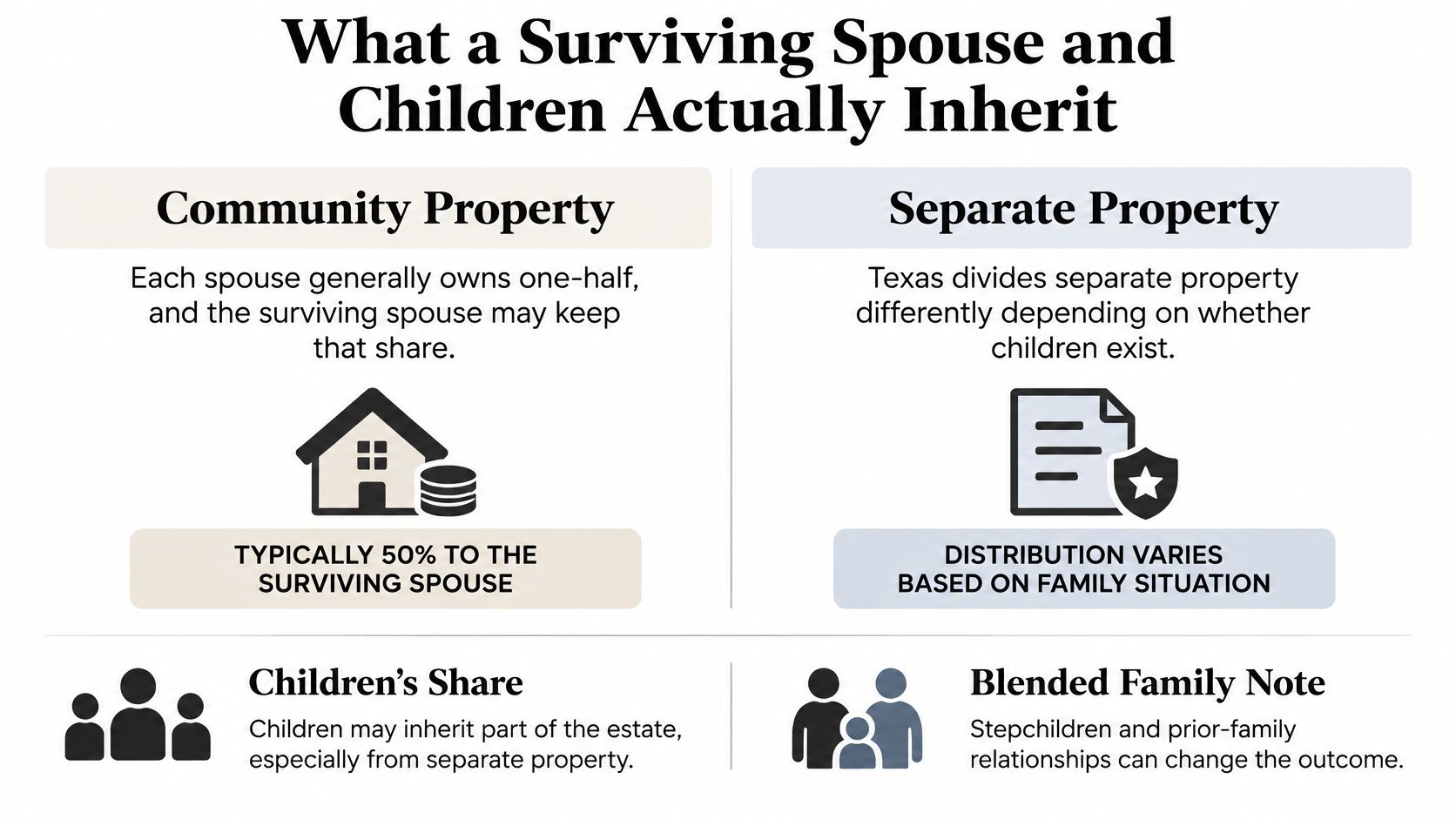
The comparison below separates the two property types that drive most outcomes.
Community Property in Intact and Blended Families
For community property, Texas generally recognizes each spouse as owning a one-half interest during marriage. If the decedent leaves a surviving spouse and no children or descendants outside that marriage, the entire community estate passes to the surviving spouse. That result fits many families where all descendants are also descendants of the surviving spouse, a distinction explained in the Texas State Law Library guide on dying without a will.
If the decedent leaves a child or descendant who is not also the surviving spouse's child or descendant, the answer changes. The surviving spouse keeps the spouse's one-half interest, while the decedent's one-half interest passes to the decedent's children or their descendants, divided under statutory representation rules. In plain terms, a child from a prior relationship can become a co-owner of community assets alongside a stepparent.
The same house, business interest, or investment account can produce a different result solely because one child came from a prior relationship.
Separate Property Works Differently
When a Texas resident dies without a valid will, the separate property rules in Chapter 201 apply. With a surviving spouse and children, the spouse generally receives one-third of separate personal property, while children and descendants receive the remaining two-thirds. The spouse also receives a life estate in one-third of separate real property, with the remainder passing to the children or their descendants.
A life estate isn't outright ownership. A widow may have a right connected to one-third of her late husband's separate land during her life, while his children hold remainder interests that matter for sale, control, and future title. If there are no children or descendants, the surviving spouse generally receives all separate personal property, subject to statutory exceptions.
Inherited community property also remains subject to community estate debts. Receiving an interest doesn't necessarily mean receiving a debt free asset.
Which Assets Pass Through Probate and Which Do Not
A will doesn't control every asset, and that's where many otherwise careful plans break. Probate validates a will, pays debts, and transfers remaining property, and probate may still be required when there's no will, as the Texas State Law Library general probate information explains. Some assets never wait for that process.
Beneficiary designated accounts and similar assets generally pass outside probate, so a will may not control them. Jointly owned property can also follow its title rather than the will. An intestate estate can vest immediately in heirs subject to estate debt rules, yet court administration may still be needed to establish heirship, collect assets, resolve creditor issues, or transfer real property.
How Common Texas Assets Typically Transfer at Death
| Asset Type | Typical Transfer Path | Controlled by Will |
|---|---|---|
| Real estate in decedent's name alone | Probate or heirship proceeding to clear title | Often yes |
| Bank account with payable on death designation | Directly to named beneficiary | Generally no |
| Retirement account | Beneficiary designation on file | Generally no |
| Life insurance | Policy beneficiary designation | Generally no |
| Business interest | Governing documents, title, and estate plan together | Sometimes |
| Jointly owned property with survivorship terms | To surviving joint owner under the title terms | Generally no |
That table is a starting point, not a substitute for reading the actual designation. An ex spouse left on a retirement account, a child added to a bank account for convenience, or a house omitted from a trust can override what the family thinks the will says. Our overview of probate assets compared with nonprobate assets in Texas walks through that inventory process in more detail.
Before assuming a will settles the matter, list each asset by owner, title, and beneficiary. Then mark whether it's community or separate property. That simple worksheet often reveals the intended plan, including gaps nobody intended.
Settling a Texas Estate Step by Step
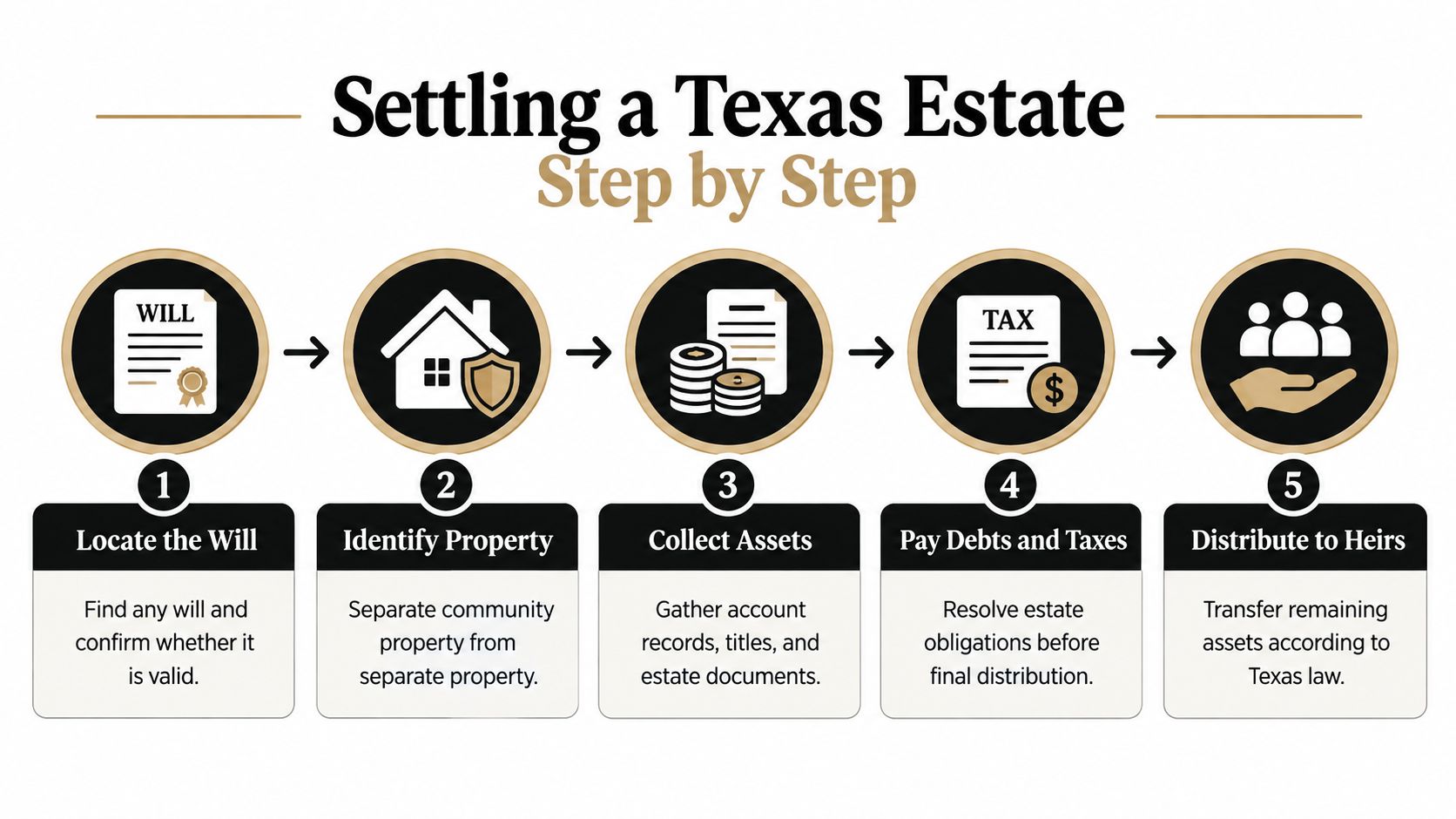
Settling an estate feels less daunting when you work in order. Don't start by dividing belongings. Start by establishing authority and identifying what the estate owns.
The process flow below outlines the sequence most families follow.
The First Decisions an Executor Makes
- Locate any will and beneficiary designations: Search the home, safe deposit records, and prior attorney files before assuming intestacy applies.
- Classify property: Identify whether assets are community or separate, because that classification drives spousal and children's shares.
- Decide the court path: Determine whether probate, a court supervised heirship proceeding, or a small estate procedure for a modest estate fits the facts. Our guide on settling an estate in Texas explains how families evaluate those options.
Independent administration can materially reduce court involvement, but intestate estates face an extra step. All distributees may agree to independent administration and collectively designate a qualified administrator, but in an intestate estate the court may not appoint that administrator until a formal heirship proceeding determines that those seeking appointment constitute all heirs, under Texas Estates Code provisions on independent administration. Once established, the independent executor generally operates with limited court supervision after required appointment and inventory related filings.
Assemble genealogical evidence, death certificates, marriage records, adoption records, and notices for potentially omitted heirs early. Unresolved heirship can delay authority to collect, sell, or distribute assets and increase litigation risk. Families comparing court and trust based paths may also review Trust Administration vs. Probate in Texas for why trust assets generally avoid probate and how the two processes differ.
Homestead Rights, Exempt Property, and the Debts That Follow
Protection for a surviving family and responsibility for debts exist side by side. Texas law provides concepts such as homestead rights, exempt property, and a family allowance to help a spouse and family during administration. Those protections don't erase every claim, and they don't turn every inherited asset into outright, debt free ownership.
Start with the home. A surviving spouse's right to occupy a homestead can be powerful, but occupancy isn't always the same as inheriting full title, especially when the home was separate property and children hold remainder interests. Exempt property and allowance questions also require looking at who survives, what property exists, and what the estate owes.
No Texas Inheritance Tax Does Not Mean No Obligations
Texas once imposed a state inheritance tax, but it is no longer collected. The tax was created in 1923 by the 38th Texas Legislature, the federal credit behind it was phased down by 25% per calendar year beginning in 2002 and eliminated in 2005, and the tax was discontinued for deaths on or after January 1, 2005, later repealed through Senate Bill 752 by the 84th Legislature, according to the Texas Comptroller history of the discontinued inheritance tax.
- Inheritance tax: Historically tied to the transfer or recipient, and no longer collected by Texas for those later deaths.
- Estate debts: Creditor claims still must be identified and resolved through administration.
- Other reporting: Federal estate tax filing or income tax reporting can still apply depending on the estate.
Our resource on what happens to debt when someone dies in Texas helps families separate personal worry from estate level obligations. Executors and trustees still need to identify assets, resolve creditor claims, determine beneficiaries, and comply with probate and fiduciary requirements. Protection helps a family stay housed and supported, but it isn't a shortcut around administration.
Choosing Between a Will, a Trust, and Professional Guidance
A will sets out who receives probate assets. It does not control a retirement account or a house titled in a trust. If beneficiary designations are outdated, property is jointly owned, or assets are left out of the plan, the family may still face probate or heirship questions.
Start with the problem you need to solve. A will can name recipients of probate property and an executor. A trust can provide a structure for managing assets during incapacity, setting the timing of distributions, or keeping trust property out of probate. For how to modify a trust in Texas, check the trust document and Texas Trust Code; an informal family agreement may not be enough.
When Tax Planning Changes the Conversation
Even without a Texas inheritance tax, families with substantial assets may need federal tax planning. For 2026, the federal basic exclusion amount is $15,000,000 for a decedent's estate, and the annual gift tax exclusion is $19,000 per recipient, according to the IRS estate and gift tax updates. The annual exclusion generally covers gifts that are not future interests. Larger gifts may require reporting and can affect the lifetime exemption.
A business owner might use annual exclusion gifts over time. A couple planning for a surviving spouse may instead consider portability or an irrevocable trust, while a family business may need succession planning. Choose the tool by the problem: a will handles probate distribution, a trust can address timing and incapacity, and gifting can affect estate size.
Tax thresholds change, so review documents periodically. A Texas estate planning attorney can coordinate a will, trust, guardianship planning, and asset protection. After a death, a Texas trust administration lawyer can help a trustee understand fiduciary duties in Texas and administer the trust. The Law Office of Bryan Fagan, PLLC offers trust administration and estate planning services, along with free consultations and a resource library.
Your Next Steps as an Executor, Trustee, or Beneficiary
The next step depends on which hat you are wearing. An executor handles the estate under the will and probate process. A trustee manages trust property according to the trust terms, while a beneficiary can ask for information and proper distribution. For example, a trustee who pays a personal bill from a trust account has crossed into self-dealing. A beneficiary who asks for records only by phone has no written trail to rely on.
A Short Checklist by Role
- Executors: Find the will, classify assets, identify potential heirs, consider independent or dependent administration, and calendar filing and creditor deadlines.
- Trustees: Keep trust property separate from personal funds, follow the trust's distribution standards, avoid self-dealing, record decisions, and share information when required.
- Beneficiaries: Keep statements and messages, request records in writing, and ask for an accounting before relying on informal accusations.
A trustee must account to beneficiaries for trust property and for profits made through or arising from trust administration, even when the profit does not result from a breach of trust. The rule has an exception for authorized compensation under Texas Property Code Chapter 114. Start by reading the trust document, identifying its beneficiaries and assets, obtaining valuations, and opening appropriate accounts. Pay permitted expenses, then distribute property only after confirming what the trust allows.
Beneficiaries also have a defined right to information. Under Section 113.151 of the Texas Property Code, a beneficiary may make a written demand for a statement of accounts covering the period since the last accounting, or since the trust began if no accounting exists. Under Section 113.151 of the Texas Property Code, the trustee generally does not have to account more often than once every 12 months unless a court orders more frequent reporting. If the trustee does not provide the statement within 90 days of receiving the demand, or within a longer period ordered by a court, the beneficiary may sue to compel delivery.
A clear accounting can resolve questions before they grow into a dispute. If records remain incomplete or trust property appears at risk, consider legal advice. Keep dates and copies of your requests. For example, write: “Dear Trustee: Under Section 113.151, I request a statement of accounts since the last accounting, or since the trust was created if none exists. Please provide it within 90 days.”
If you are managing a trust or planning your estate, contact Law Office of Bryan Fagan, PLLC for a free consultation about Texas inheritance, probate, or trust administration questions. The firm's attorneys provide guidance on classifying property, identifying heirs, trustee accounting, and dispute resolution.