Managing a loved one's trust can feel overwhelming, especially when the trustee must decide whether to release money for medical care, education, housing, or another urgent need. Families often assume that an irrevocable trust works like a personal bank account. In Texas, the trustee's authority is broader in some situations and sharply limited in others.
The answer depends on the trust document, the difference between income and principal, the type of distribution permitted, the trustee's fiduciary duties, and the beneficiary's information rights. The following guide explains irrevocable trust distribution rules in Texas through the practical questions that most often bring families to a trust lawyer.
A Family Faces the Trust Distribution Question
After their patriarch died, the Garcia family in San Antonio gathered around a problem they hadn't expected to solve so soon. Their family trust held $1.4 million. Sofia, the patriarch's daughter, was the named income beneficiary. She was 27, raising a daughter of her own, and facing medical bills that couldn't wait.
The trust's independent trustee was Sofia's uncle. He had no personal claim to the trust, but he understood that every decision could affect both Sofia and the grandchildren, who were named as remainder beneficiaries. The trust had earned $58,000 in income during the past year. The uncle needed to decide whether to distribute only that income or also use principal for Sofia's medical expenses and her daughter's preschool tuition.
Sofia saw the request as a reasonable use of the trust. The grandchildren's future interests made the decision more complicated. If the trust authorized distributions for health, education, maintenance, or support, the trustee might have discretion to reach principal. If the document required income distributions but restricted principal, the trustee couldn't follow family pressure.
A trustee's job isn't to divide money based on who needs it most. The trustee must apply the trust's language, Texas law, and the interests of every beneficiary.
The family also had to consider spendthrift protection, tax reporting, Medicaid eligibility, and whether Sofia was entitled to information about the trust's assets and administration. A decision that seems generous today can create a dispute tomorrow if the trustee doesn't document the reason, the authority, and the effect on remainder beneficiaries.
The Garcia family's situation captures the central question behind these rules: Can a trustee distribute trust property, and if so, how much, to whom, and for what purpose?
What Makes a Trust Irrevocable Under Texas Law
An irrevocable trust is controlled by its written terms and applicable law rather than by the settlor's continuing ability to change course. The settlor is the person who creates and funds the trust. The trustee manages the property, and the beneficiaries receive whatever interests the trust instrument provides.
Texas Property Code Section 112.051 says a settlor may revoke a trust unless the trust is made irrevocable by the express terms of the instrument or by a later modifying instrument. A settlor may amend a revocable trust, but cannot enlarge the trustee's duties without the trustee's express consent. Once the trust is irrevocable, the settlor generally can't unilaterally amend it, revoke it, or reclaim the assets.
You can review the basic structure of an irrevocable trust through this Texas guide to irrevocable trusts.
Three ways irrevocability can arise
The trust may become irrevocable through several paths:
Express language. The trust document may state that the settlor gives up the power to revoke or amend the trust. That language shifts control away from the settlor and places administration in the trustee's hands.
A later legal event. A court-approved modification or another legally effective instrument may change the trust's status or close off the settlor's revocation power.
A stated condition. Some trusts become irrevocable when a condition occurs, such as the settlor's death. A revocable living trust commonly becomes irrevocable after the settlor dies, although the document controls the precise result.
The date or event that creates irrevocability matters because distribution rights now flow from the trust instrument, not from informal statements the settlor may have made to relatives. A trustee should therefore begin with the complete document, including amendments, schedules, powers given to a trust protector, and any provisions governing successor trustees.
Why this changes the distribution decision
A settlor may have told Sofia that the trust was intended to help with health and education. That conversation may provide helpful context, but it doesn't replace the written distribution standard. The trustee must identify whether the trust requires distributions, permits them, or leaves them to the trustee's discretion.
Families should also separate trust administration from estate administration. A Texas Trust Code question may arise alongside probate or Texas Estates Code issues involving the settlor's estate, debts, or personal representative. Those systems can affect each other, but the trustee still must administer trust property under the trust terms and the Texas Trust Code.
Income vs. Principal and Mandatory vs. Discretionary Distributions
The first accounting question is often simple to state but difficult to apply: Is the money income or principal? Texas's Uniform Principal and Income Act, found in Chapter 116 of the Texas Property Code, requires a trustee to allocate a distribution received from another trust or estate as income when it is received as income, and as principal when it is received as principal. That classification affects fiduciary accounting and the amount available for later distributions.
Consider a Hill Country ranch held by a trust. Rent paid by a tenant generally represents trust income under the trust's accounting framework. Proceeds from selling the ranch are generally principal. A trustee must also examine the governing documents and applicable allocation rules for items such as reserves, expenses, and changes in asset value.
Section 112.071 provides an important decanting definition. Trust principal includes property held for remainder beneficiaries when the trust terminates, along with trust income that isn't currently required to be distributed when a statutory distribution power is exercised. The distinction matters because a trustee can't move property into a new trust under Texas's decanting framework unless the trustee's authority and the trust terms meet the statutory requirements.
Mandatory distributions
A mandatory distribution leaves the trustee with little or no choice about whether to pay. The trust might direct the trustee to distribute all current income, a fixed amount, or a stated share at specified times. The trustee still has to calculate the amount correctly, maintain records, and confirm that the recipient is the person identified by the trust.
A mandatory income provision doesn't automatically authorize the trustee to distribute principal. If Sofia's trust requires current income but says principal may be distributed only for defined needs, the uncle must treat those powers separately.
Discretionary distributions
A discretionary distribution gives the trustee judgment, but not unlimited freedom. A common standard refers to health, education, maintenance, and support, often shortened to HEMS. The trustee may need to consider medical care, tuition, housing, or ordinary living expenses, while still protecting the remainder beneficiaries and following the trust's purpose.
A HEMS provision can provide meaningful flexibility without turning the beneficiary into the outright owner of the trust assets. It also may support federal estate tax planning, but the tax result depends on the entire trust structure and the beneficiary's powers. A trustee should obtain tax advice before assuming that a distribution will produce a particular federal result.
The difference can be summarized this way:
| Distribution Type | Governing Texas Rule | Typical Language |
|---|---|---|
| Mandatory income | The trust instrument and applicable principal-and-income rules control the required payment. | “The trustee shall distribute current income.” |
| Mandatory principal | The trust must identify the event, amount, or formula requiring principal payment. | “The trustee shall distribute principal upon the stated event.” |
| Discretionary income | The trustee exercises judgment within the trust's standard and fiduciary duties. | “The trustee may distribute income for the beneficiary's support.” |
| Discretionary principal | The trustee must have authority over principal and act consistently with the trust's purpose. | “The trustee may distribute principal for health, education, maintenance, or support.” |
| Decanted distribution | Sections 112.071 through 112.073 govern whether principal may move into a second trust. | “The trustee may exercise the statutory power to appoint property to another trust.” |
Investment management also affects the quality of the ledger. The Trustee's Investment Duties Under Texas Law explains how the prudent investor standard applies to trust assets, which can influence both income production and principal preservation.
Trustee Powers and Fiduciary Duties in Texas Irrevocable Trusts
A trustee has authority to manage and distribute trust property, but every power must be used within legal and fiduciary boundaries. Texas Property Code Section 113.027 gives a trustee practical distribution tools. The trustee may distribute property in divided or undivided interests, assign particular assets in proportionate or disproportionate shares, value the property for distribution purposes, and adjust for valuation differences.
That flexibility helps when a trust owns a ranch, real estate, business interests, or securities that can't be divided neatly. It doesn't permit a trustee to favor one beneficiary without a valid reason grounded in the trust and Texas law.
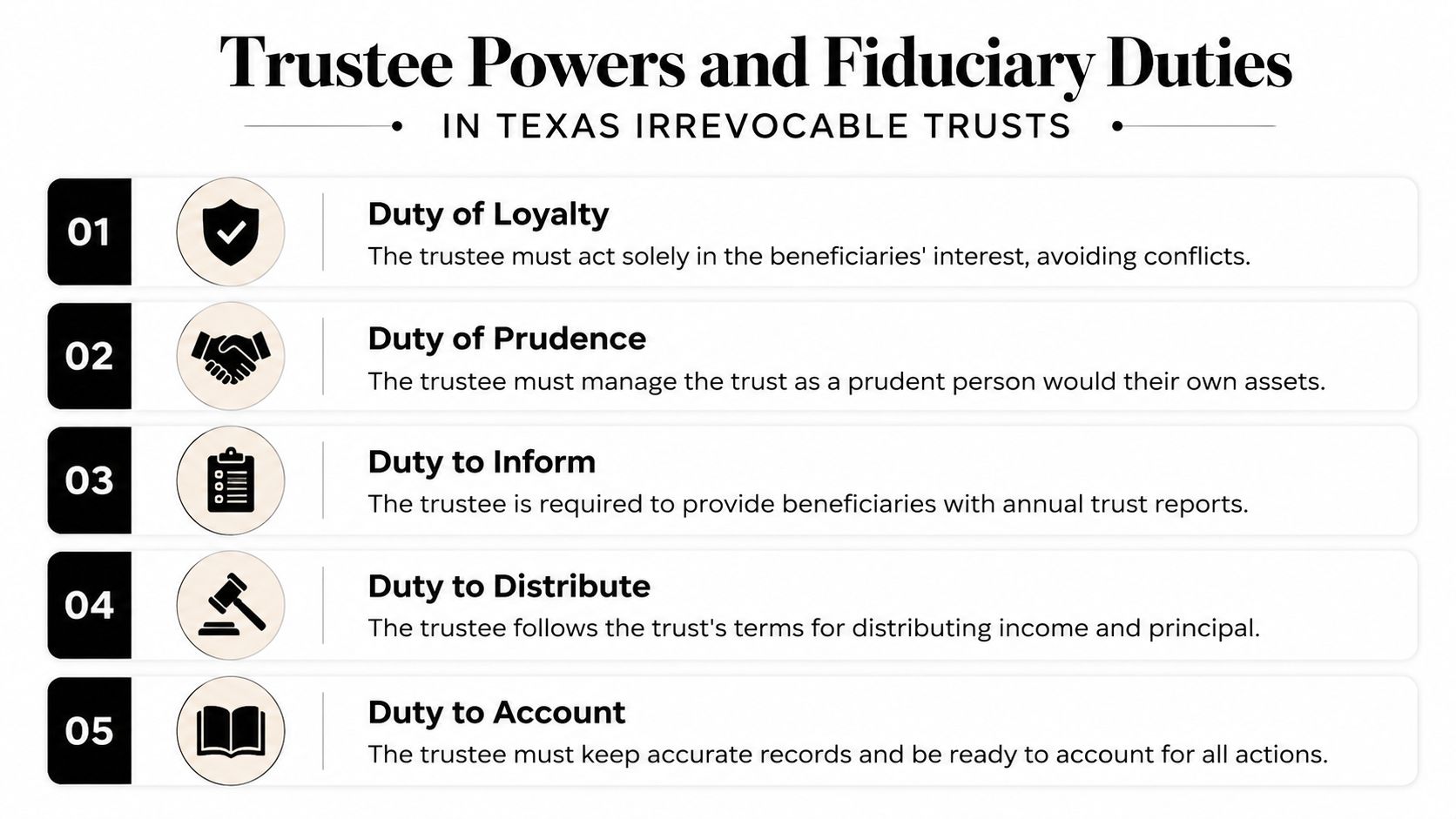
The trustee's working checklist
Review the document first. Read the distribution clauses, definitions, beneficiary provisions, spendthrift language, accounting provisions, and powers of appointment. Don't rely on a summary prepared years earlier.
Separate authority from need. A beneficiary may have a genuine medical or educational need, but need alone doesn't create distribution authority. Match the request to the applicable mandatory or discretionary provision.
Protect impartiality. A trustee must consider current and remainder beneficiaries. Self-dealing, undisclosed conflicts, or personal loans can expose the trustee to serious challenges.
Document the decision. Keep the request, supporting records, asset valuation, analysis of the trust language, and the written decision. Good records help beneficiaries understand what happened and allow counsel to assess a dispute fairly.
Section 112.072 addresses a more specialized power, often called decanting. An authorized trustee with full discretion may distribute all or part of principal to a second trust for current and remainder beneficiaries, but the trustee must act in good faith, follow the trust's purposes, and serve beneficiaries' interests.
Practical rule: Decanting is not a shortcut around beneficiary rights. Section 112.085 prohibits changes that reduce vested mandatory income, annuity or unitrust payments, withdrawal rights, and certain fiduciary or perpetuities protections.
A trustee should obtain legal review before using a sensitive power such as decanting, terminating, merging, or materially changing administration. A breach can support claims for surcharge, removal, damages, or other court-ordered relief. The trustee should also provide information and account as required by the trust and Texas law.
Here is a short video overview of the duties that often shape trustee decisions:
Spendthrift Clauses and Ascertainable Standards
Two provisions can determine whether a beneficiary can access trust property and whether creditors can reach it. A spendthrift clause generally restricts a beneficiary's ability to transfer an interest and protects that interest from creditors before the trustee distributes the money. The protection isn't unlimited, and Texas law recognizes exceptions in areas such as certain family-law and tort claims.
An ascertainable standard limits the trustee's discretion by identifying the purposes for which distributions may be made. HEMS language is the familiar example. Instead of allowing a trustee to distribute for any reason, the standard directs the trustee toward health, education, maintenance, and support.
How the provisions work in real life
Suppose Sofia has significant personal debts. If the trust contains a valid spendthrift provision, a creditor generally can't treat Sofia's undistributed trust interest as if Sofia already owned the money. Once the trustee distributes funds to Sofia, the funds may become easier for creditors to pursue.
Now suppose the trust gives the trustee discretion to distribute principal for Sofia's medical care. The trustee may be able to pay a medical provider directly rather than handing the money to Sofia. That approach may support the trust's protective purpose, but it doesn't eliminate the need to study the trust language, the claim involved, and the beneficiary's tax or benefits situation.
An ascertainable standard can also affect estate tax treatment. HEMS language is often used in planning because it can limit a beneficiary's control, but the federal tax result depends on the full set of powers and facts. A trustee shouldn't assume that a label such as “HEMS trust” settles the tax analysis.
| Feature | Spendthrift Clause | Ascertainable Standard (HEMS) |
|---|---|---|
| Main function | Limits voluntary and involuntary transfers before distribution. | Defines the purposes supporting a distribution. |
| Trustee discretion | May coexist with broad or limited discretion. | Narrows discretion to stated needs. |
| Creditor effect | Usually protects undistributed interests, subject to exceptions. | Doesn't by itself create complete creditor protection. |
| Beneficiary request | The beneficiary may request help, but the clause doesn't require payment. | The trustee evaluates whether the request fits the standard. |
| Planning concern | Distribution can expose funds after they reach the beneficiary. | The standard may support tax planning, but the full document controls. |
Families considering a needs-based trust can review what an ascertainable standard trust means before asking the trustee for a distribution.
Tax and Medicaid Consequences of Texas Trust Distributions
Texas doesn't impose a state income tax, but that doesn't make trust distributions tax-free. Trust income retains its federal character, and the tax burden may fall on the trust or the beneficiary depending on the trust's classification, the income, and what the trustee distributes.
A nongrantor trust is generally treated by the IRS as a separate taxable entity. The trustee may need an employer identification number and may need to file Form 1041. The distribution itself can change the federal reporting picture, so the trustee should coordinate with a CPA before treating income or principal as interchangeable.
A medical payment can raise several questions
Suppose a trustee pays a grandchild's medical provider directly. The family may ask whether the payment is a qualified medical payment for federal tax purposes, a distribution allowed under a HEMS provision, or a transfer that could affect the beneficiary's Medicaid eligibility.
Those questions are separate. A payment can fit the trust's distribution standard while still requiring careful tax reporting. It can also be relevant to public-benefits eligibility if the beneficiary receives or controls resources, or if the transfer is evaluated under Medicaid rules.
Medicaid planning requires special caution because transfers can be reviewed under the five-year Medicaid look-back period. The timing, trust terms, ownership, beneficiary access, and purpose of a transfer can all matter. A trustee shouldn't make a distribution because it seems medically appropriate without checking how it may affect benefits.
A practical review should include:
- Trust classification: Confirm whether the trust is revocable, irrevocable, grantor, or nongrantor for federal tax purposes.
- Distribution character: Determine whether the payment comes from income or principal and how it should be reported.
- Recipient control: Ask whether the beneficiary receives funds directly or whether the trustee pays a provider.
- Benefits impact: Coordinate with Medicaid counsel before making a payment for a beneficiary receiving or seeking public benefits.
For a closer look at the federal reporting issues, families can review how trust distributions are taxed in Texas. The safest approach is to coordinate the trustee, a Texas estate planning attorney, and the family's tax and benefits professionals before the check is issued.
Common Distribution Disputes and Remedies in Texas
Distribution disputes usually begin with a communication failure or an unexplained decision. A trustee may withhold discretionary income without giving a clear reason. A beneficiary may suspect that the trustee is favoring another family member. A remainder beneficiary may worry that repeated principal payments will leave little for the future.
Information rights often determine whether the disagreement stays manageable. Texas Property Code Section 111.0035 protects a common-law duty to keep a beneficiary of an irrevocable trust who is 25 years of age or older informed during administration when that beneficiary is entitled or permitted to receive distributions, or would receive a distribution if the trust terminated at that time. The statute also connects accounting access to distribution entitlement.
A beneficiary may seek trust records or a written accounting under the Texas Trust Code. A trustee who provides clear records, explains the decision, and preserves supporting documents is in a stronger position than one who responds only with a refusal.
Common remedies
A court may address a dispute through several forms of relief. Texas Property Code Section 112.054 allows a trustee or beneficiary to petition for modification, a trustee change, an order requiring or prohibiting an act, or termination when the trust's purposes have been fulfilled, become illegal or impossible, or when administrative changes are needed to prevent waste or impairment.
Section 112.072 may provide a decanting path when the trustee has the required distribution authority. Section 112.085 prevents the trustee from using that power to reduce protected vested rights or weaken key fiduciary protections.
| Dispute Type | Texas Statute | Typical Remedy |
|---|---|---|
| Unclear distribution power | Texas Trust Code provisions governing the trust and trustee powers | Court instructions or a declaratory ruling |
| Failure to provide information | Section 111.0035 and applicable accounting rules | Records, accounting, or other court relief |
| Improper allocation of income or principal | Uniform Principal and Income Act | Corrected accounting or adjusted distribution |
| Trustee self-dealing or bad faith | Texas fiduciary principles | Surcharge, damages, removal, or injunction |
| Trust terms no longer function | Section 112.054 | Modification, trustee change, or termination |
| Proposed decanting harms protected rights | Section 112.085 | Objection, court review, or blocked distribution |
Mediation can resolve disputes without requiring the family to turn every disagreement into extended litigation. A trust protector may help if the trust document grants that person a defined power, such as changing trustees. Beneficiaries and trustees should speak with counsel early, especially before a disputed distribution, decanting notice, or accounting demand becomes a formal court proceeding.
Putting the Rules Together and When to Call a Texas Trust Attorney
Every distribution decision brings several rules together. The trustee must read the trust, classify the asset as income or principal, identify whether payment is mandatory or discretionary, evaluate spendthrift and HEMS language, consider taxes and public benefits, and document the decision.
Age-based milestones deserve a careful review. Texas law repeatedly uses age 25 as an important trust-related point. Section 142.005 provides that a trust for a minor beneficiary must terminate on the beneficiary's death, the age stated in the trust, or the beneficiary's 25th birthday, whichever comes first. The same provision allows principal to be distributed at designated ages and in designated percentages.
That doesn't mean every beneficiary receives trust property at 25. The trust instrument may establish a different structure, and other statutes may apply. It does mean that a beneficiary approaching a stated milestone should ask what changes in distribution rights, notice, accounting, and trustee authority.
A practical administration plan should:
- Collect the governing documents. Locate the original trust, amendments, schedules, notices, and asset records.
- Map each beneficiary's interest. Separate current income beneficiaries from remainder beneficiaries and identify mandatory rights.
- Prepare the accounting. Track income, principal, expenses, valuations, distributions, and tax information.
- Review proposed changes. If the trust no longer serves its purpose, ask whether court modification under Section 112.054 or decanting under Section 112.072 may apply.
- Resolve concerns early. Use counsel, mediation, or a trust protector when available before positions harden.
A Texas trust administration lawyer can help a trustee meet fiduciary duties in Texas while also protecting a beneficiary's right to information. A Texas estate planning attorney can review whether a trust still fits the family's tax, asset protection, and long-term goals. Families may also need coordinated probate, guardianship, or broader asset protection advice when trust assets intersect with an estate, incapacity, or public benefits.
The Law Office of Bryan Fagan, PLLC provides trust administration, estate planning, fiduciary accounting, trust modification, probate, guardianship, and asset protection guidance for Texas families and fiduciaries. If you're facing a distribution decision, don't wait for a disagreement to become a lawsuit.
If you're managing an irrevocable trust or planning your estate, Law Office of Bryan Fagan, PLLC offers Texas-based guidance on distributions, fiduciary accounting, trust modification, tax coordination, and beneficiary disputes. Schedule a free consultation so an attorney can review the trust terms, explain your options, and help protect your family's interests.