Managing a loved one's trust can feel overwhelming, especially when two co-trustees look at the same document and reach opposite answers. One wants to sell the house, the other wants to wait. One sees risk, the other sees opportunity. In Texas, that kind of stalemate can put real pressure on trust property, family relationships, and beneficiary expectations.
Co-trustee deadlock: how Texas courts break the tie is a practical question, not just a legal one. Texas law starts with administration continuity, then turns to court intervention only when the trust document and the statute can't solve the impasse. For families, that means the first move is usually to understand who can still act, what the trust says, and whether a judge really needs to step in.
When Co-Trustees Cannot Agree
A father names his two adult children as co-trustees, thinking they'll balance each other out. After his death, one child wants to keep the ranch in the trust for another year, while the other wants to sell because taxes, upkeep, and family tension are piling up. Neither sibling is acting irrationally, but neither will yield. That's how a trust dispute starts in real life, not with bad faith, but with two different ideas about what protects the beneficiaries best.

How family disagreement turns into deadlock
Most co-trustee disputes begin with ordinary friction. One trustee is cautious, the other is decisive. One wants more information, the other thinks delay is its own risk. When the trust holds a house, oil interest, closely held business interest, or other illiquid asset, that tension can become costly fast.
The warning signs are usually practical. Emails stop being productive. One co-trustee refuses to sign documents. Beneficiaries start hearing different stories. A sale, distribution, or investment decision gets delayed long enough that the trust begins losing value or momentum. Once that happens, the dispute isn't just interpersonal anymore, it's an administration problem.
Practical rule: If the disagreement is starting to affect distributions, title work, or asset preservation, treat it as a fiduciary issue, not just a family argument.
Texas trust law is built to keep the trust moving when possible. That matters because a deadlock can freeze decision-making at the exact moment the trustee needs to act. Families often wait too long, hoping the co-trustees will “work it out,” but delay can make the eventual legal fix more expensive and more disruptive.
Why the courts care about harm, not just disagreement
Texas courts usually don't step in because trustees disagree. They get involved when the deadlock begins harming the trust or the beneficiaries. That's the difference between a hard conversation and a legal emergency. If no one can act, and the trust property is suffering, the court has tools to restore function.
That's also why early legal help matters. A Texas trust administration lawyer can separate a solvable dispute from a deadlock that may need court relief. For families trying to understand the bigger administration picture, Texas Trust Administration: A Trustee's Guide explains what trust administration involves and how it differs from probate.
Texas Trust Code Provisions on Co-Trustee Decision Making
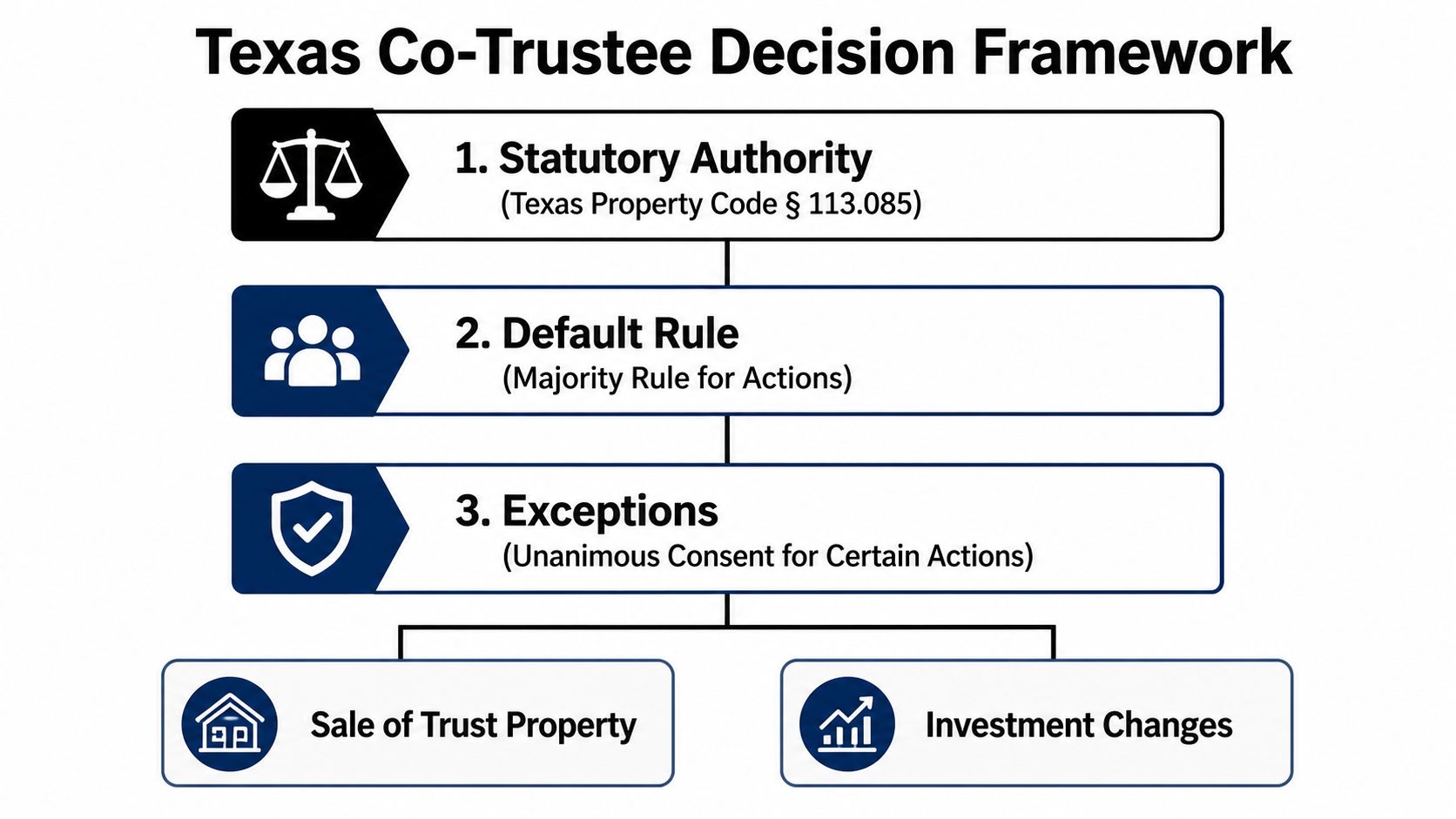
Texas Property Code § 113.085(a) gives co-trustees a built-in majority rule. That means co-trustees generally may act by majority decision. If one co-trustee is unavailable and prompt action is needed to protect the trust or a beneficiary, § 113.085(d) allows the remaining cotrustee or majority of the remaining cotrustees to act for the trust. That statutory design matters because it solves a lot of coordination problems before anyone reaches a courtroom.
Majority rule is the default, not the exception
The first question in any co-trustee dispute is simple. Can a majority still act? If the answer is yes, the trust may keep moving without judicial intervention. If the answer is no, because there's an even number of active co-trustees or the trust instrument creates a true tie, then the deadlock becomes more serious.
That's why Texas courts usually get involved only after the default rule runs out of road. A tie is not the same as a disagreement. Two trustees who oppose each other may still be bound by a majority structure if there are three or more active trustees. A true deadlock exists when the decision-making framework can't produce a lawful answer.
The default legal question is whether majority action still exists before a judge is asked to intervene.
The trust document can change the outcome
The trust instrument always matters. If the document requires unanimous approval for a specific action, the statute's general majority rule may not control that point. If the trust names a dominant trustee, an independent tie-breaker, or some other control mechanism, that language may govern the dispute before a court ever sees the file.
That's why good Texas trust administration begins with document review, not assumptions. Trustees and beneficiaries often focus on who is “right,” but the legal question is usually who has authority to act. If the trust language is unclear, a Texas estate planning attorney can help interpret the document before the family makes the mistake of treating a stalled decision like a solved one.
What the statute does and doesn't solve
Texas law does a good job preserving continuity, but it doesn't fully solve every deadlock on its own. Practitioners treat deadlock as a problem the Trust Code doesn't always finish, which is why families sometimes need a suit for instructions, receivership, injunction, suspension, or removal when the impasse is harming the trust. The statute is the starting point, not the final answer.
Judicial Remedies for Breaking Trust Deadlocks
When deadlock becomes harmful, Texas courts use equitable remedies instead of automatically picking a winner. That's the right instinct in trust cases. The court's job is to protect the trust estate and the beneficiaries, not to rewrite the family story or reward the loudest trustee.
| Texas Court Remedies for Co-Trustee Deadlock | Best Used When | Typical Timeline | Relative Cost |
|---|---|---|---|
| Suit for instructions | The trust language is unclear and the trustee needs direction | Often the quickest court-based option, depending on the docket | Usually lower than removal-focused litigation |
| Injunction | A trustee is about to take harmful action | Fast when emergency relief is justified | Can rise quickly if the dispute becomes contested |
| Removal of one or more co-trustees | The deadlock stems from conflict, misconduct, or inability to act | Slower than a narrow instruction request | Often more expensive because it becomes a deeper fiduciary fight |
| Temporary trustee or receiver | The trust needs immediate management during a breakdown | Can be relatively fast if urgency is shown | Cost increases because a third party enters administration |
| Modification of administration provisions | The trust structure itself is causing the stalemate | Depends on the relief requested and court review | Varies with complexity |
The main remedies courts actually use
Texas practitioner materials describe a broad judicial toolkit. A court may direct a trustee to take or refrain from action, remove one or more co-trustees, appoint a temporary trustee or receiver, or modify administration provisions to restore functionality. A Texas trust-law article quoting Restatement (Third) of Trusts § 39(e) states that if multiple trustees are deadlocked, a proper court may direct exercise of the power or take other action to break the deadlock.
That's important because it shows how Texas judges think. They don't just declare a winner and walk away. They use equitable remedies to keep the trust functioning. In a severe case, receivership may be available when the deadlock is harming the trust, and co-trustees can also sue each other for breach of fiduciary duty or seek removal where necessary.
Cost and timing reality
Court intervention is rarely cheap or quick. A narrow instruction request can be more efficient than a removal fight because the court only needs to clarify authority. A receivership or removal case usually expands the dispute, increases briefing, and pulls in more evidence. If beneficiaries, accountants, appraisers, or title companies are also involved, the file can become more expensive very quickly.
That's why the right remedy depends on the harm. If the trust just needs a judicial answer to move forward, instruction relief may be enough. If one trustee is actively undermining the trust, stronger intervention may be justified. If you're already trying to decide how to remove a co-trustee in Texas, the practical question is whether the problem is authority, conduct, or both.
For a deeper look at removal issues, see how to remove a co-trustee in Texas.
Internal litigation isn't always the first move
Courts can also encourage settlement pressure before final relief. That's often where mediation or targeted negotiations fit. The right remedy is the one that restores administration without causing unnecessary damage to the trust corpus or the family's position.
Procedural Steps for Resolving Co-Trustee Disputes
A co-trustee deadlock often starts with a missed signature, an unanswered email, or a sale that cannot close because one trustee will not move. The right response is orderly escalation, because early documentation and measured communication often decide whether the dispute stays contained or turns into litigation. Trustees who react on emotion usually make the record worse, and that record is what the court will later read.
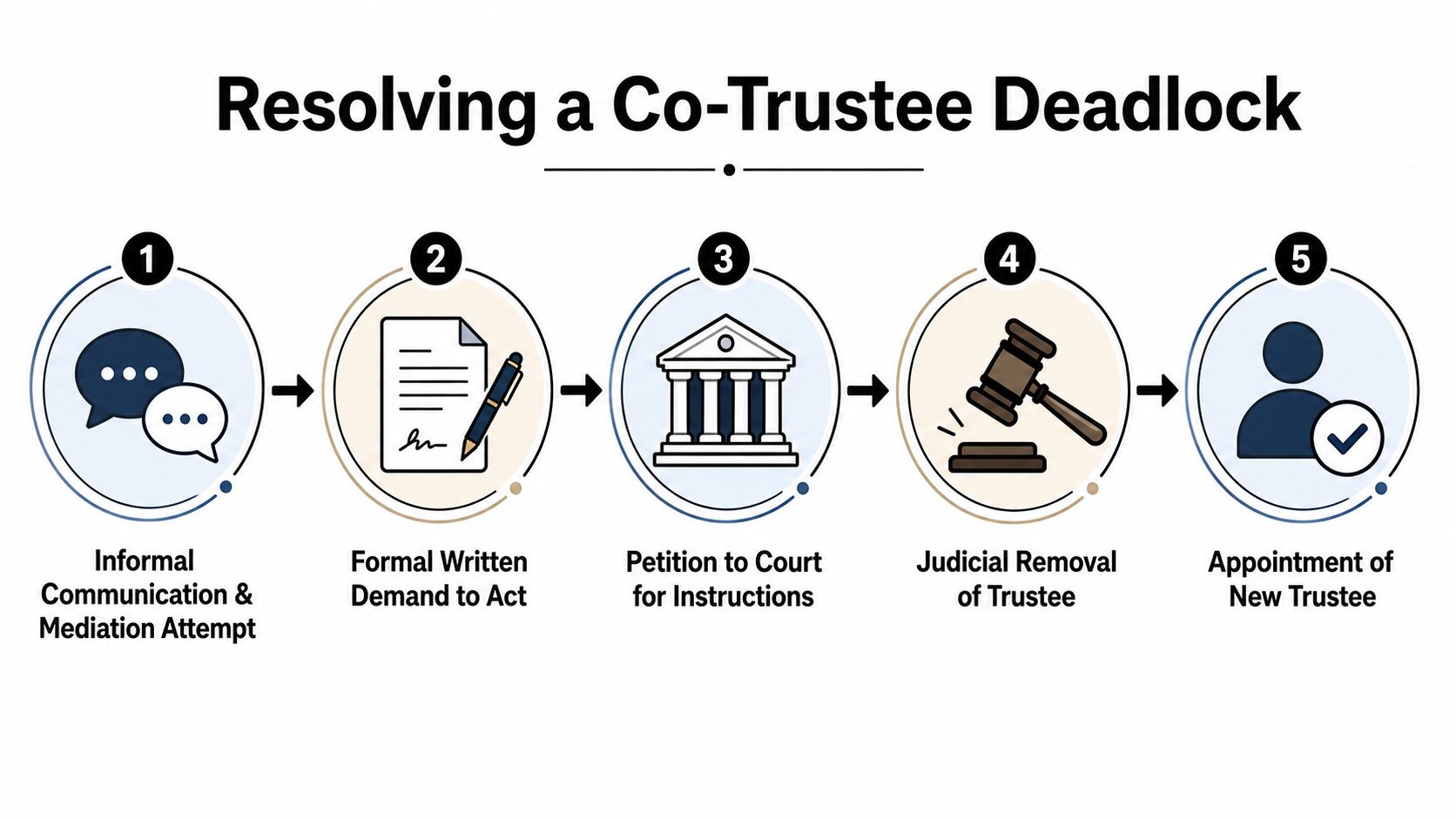
Document the dispute before acting
The first move is to build a clean paper trail. Save emails, draft proposals, calendar notes, valuations, and written objections. If one trustee refuses to sign, ask for the reason in writing. That record matters later because a judge will want to see what was disputed and whether the trustees tried to resolve it.
Written records often matter more than polished arguments.
If the conflict is still private, a neutral third party can help. A mediator or trust protector may help the co-trustees identify a workable middle path, especially when the problem is tactical rather than personal. Families sometimes see this stage as a delay, but it can preserve more trust value than immediate filing, and it often costs less than a full court fight.
Escalate in a controlled order
The next step is usually a formal written demand to act or explain the refusal. After that, counsel may seek a suit for instructions, a receivership request, or removal relief if the facts justify it. Jurisdiction depends on the trust matter and the court structure handling the fiduciary dispute, so the pleadings need to be prepared carefully.
A practical example helps. If co-trustees are arguing over whether to sell a trust-owned home, and the listing is on hold, a written demand may force the issue into the open. If the property is deteriorating or the market opportunity is slipping away, court action may be necessary before the harm gets worse. In those cases, a Texas trust administration lawyer is often the difference between a contained dispute and a stalled trust.
For families who want a broader view of conflict resolution tools, family trust disputes and mediation options in Texas is a useful resource.
Watch for the point where delay becomes damage
Deadlines matter less than harm. If the deadlock is blocking distributions, exposing the trust to loss, or making fiduciary compliance impossible, delay becomes dangerous. That is the point when informal patience stops being a virtue and starts becoming a liability.
Trustees should also consider tax and liquidity fallout before escalating. A trust that cannot sell property or make timely decisions may create avoidable administrative stress, and the added delay can raise professional fees, consume trustee time, and increase pressure on everyone involved.
Drafting Strategies to Prevent Future Deadlocks
The best deadlock case is the one that never happens. Texas families can draft around many co-trustee disputes if the trust document says who decides, how tie-breaks work, and what happens when the trustees stop cooperating. The trade-off is real, though. More efficiency can mean less shared control, so the document has to match the family's risk tolerance.
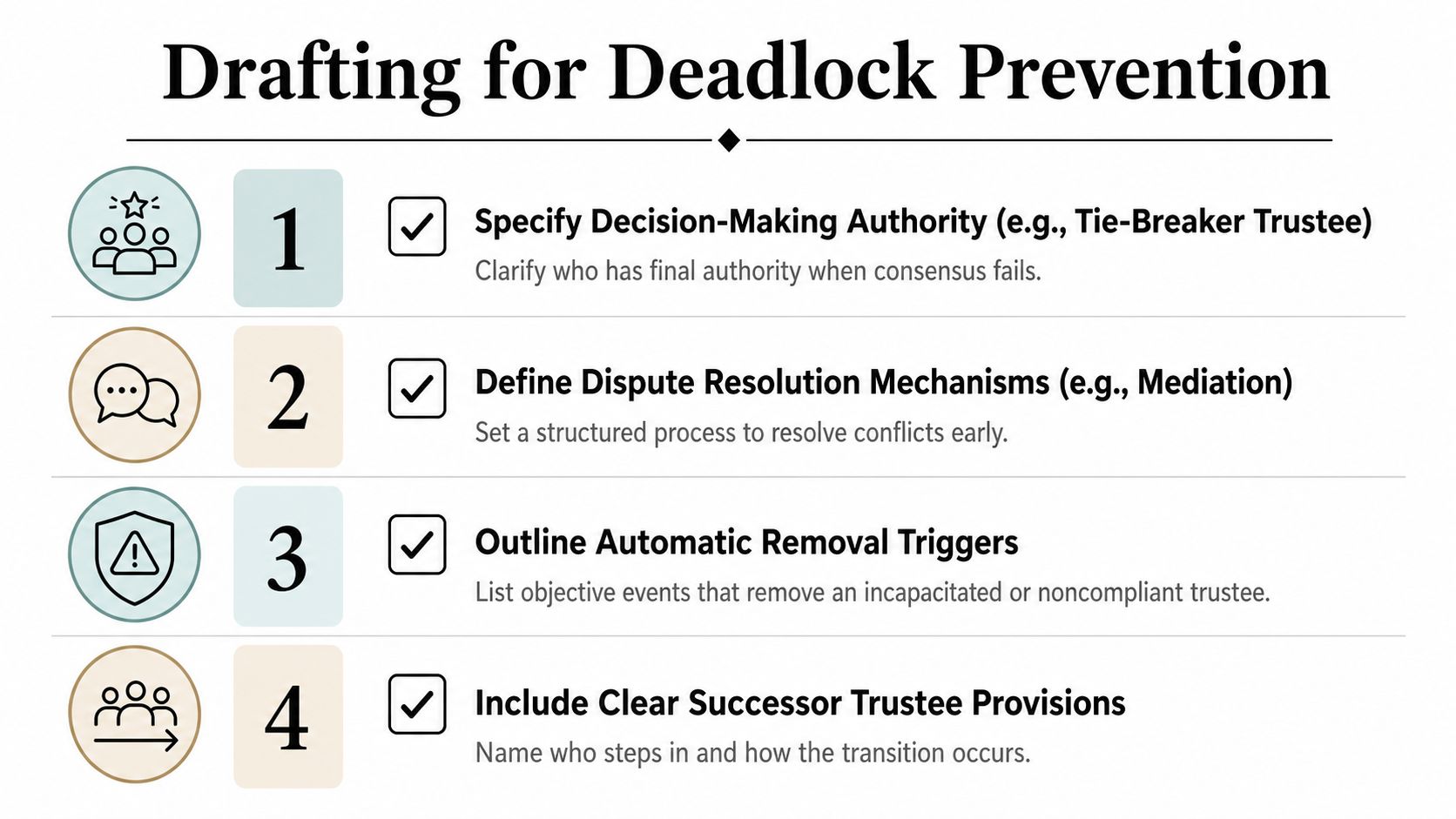
Draft for authority, not optimism
Majority voting clauses are the simplest fix when there are multiple co-trustees. A dominant co-trustee provision gives one fiduciary final authority, which can keep administration moving. Beneficiary voting rights can solve some family concerns, but they can also create new delays if the beneficiaries are divided or hard to reach.
Trust protectors and independent tie-breakers can work well when the family wants a neutral decision-maker. Still, neutrality has to be real, not just labeled that way. If the designated decision-maker lacks independence, the clause can become another source of conflict instead of a solution.
Protect balance while preventing stalemate
Blended-family trusts often need special care because the trustees may not trust each other from the start. The same is true when the trust holds high-value illiquid assets, such as family land or business interests, where delay carries practical risk. In those cases, emergency-action clauses and clear decision hierarchies can keep the trust functional when an urgent issue arises.
Generic boilerplate usually fails because it doesn't answer the next question. It says there's a tie-breaker, but not when the tie-breaker can act. It says the trustees should cooperate, but not what happens when they don't. A useful drafting clause should address both administration and accountability.
Build in a dispute path before court
A strong trust can require mediation before litigation, set an emergency decision route, and spell out automatic removal triggers for obstructionist behavior. It can also define successor trustee provisions clearly enough that a family knows who steps in, and when. If the trust is being updated, a Texas estate planning attorney can help fit those provisions into a broader plan that also considers tax planning and distribution timing.
For families who want a closer look at one of these tools, trust protector powers can be part of a deadlock-resistant design when used carefully.
Protecting Your Trust and Moving Forward
A deadlocked trust does more than freeze paperwork. It can sour family relationships, strain beneficiary confidence, and leave the grantor's plan stuck in place. The faster the family understands whether the issue is a simple disagreement or a true legal deadlock, the more options stay open.
One practical piece of the picture is tax awareness. Before anyone pushes a sale, distribution, or restructuring decision, families should also understand related tax issues and other planning concerns. For a broader consumer-friendly overview, inheritance tax facts for families can help frame questions before a meeting with counsel or a tax advisor.
If you're serving as a trustee, beneficiary, or successor fiduciary, the right next step is usually a focused review of the trust document, the current dispute, and the risk of delay. That review can show whether the problem is resolvable through communication, whether the trust needs modification, or whether a court filing is the safer path. If you're also weighing estate planning, probate, guardianship, or asset protection concerns, it helps to have one team look at the whole family picture.
If you're managing a trust or planning your estate, contact Law Office of Bryan Fagan, PLLC for a free consultation. Our attorneys help Texas families and fiduciaries handle co-trustee deadlock, trust administration, and related dispute issues with clear, practical guidance. If you need help protecting a trust, resolving a tie, or planning ahead to avoid court, we're ready to talk.