Managing a loved one's trust can feel overwhelming, especially when you suspect the person in charge may be taking money or property that doesn't belong to them. Families often arrive at this point after months of confusion. Statements don't match. Questions go unanswered. A house is suddenly for sale, or money seems to have moved without any clear reason.
If that's where you are, the most important thing to know is this. You don't need to prove everything before you act, but you do need to act carefully. Texas law gives beneficiaries tools to demand information, protect trust assets, and ask a probate court to remove a trustee who has crossed the line.
This guide is a practical roadmap for how to report a trustee for stealing in Texas. It focuses on what you can control right now, what usually helps, and what often makes things worse. It also explains how the Texas Trust Code, the Texas Estates Code, and basic fiduciary principles fit together in plain English.
Trustee Duties and Breach of Trust in Texas
Finding out that a trustee may have taken trust property is often both a legal problem and a family crisis. Many trustees are relatives. That makes people hesitate. They second-guess themselves, delay asking questions, or worry they'll be blamed for causing conflict.
Texas law doesn't treat a trustee as someone who gets broad freedom to do whatever seems convenient. A trustee is a fiduciary, which means the trustee must handle trust property for the benefit of someone else, not for personal gain. That duty is strict because the trustee controls assets that belong in a protected legal relationship.

What fiduciary duty means in real life
Under Texas law, a trustee owes duties of loyalty, care, and disclosure. The duty of loyalty matters most when theft is suspected. Under Texas Property Code Chapter 117, a trustee owes a statutory duty of loyalty and must administer the trust solely in the interest of the beneficiaries, as described in this discussion of Texas trustee obligations.
In plain English, that means a trustee can't use trust money like a personal checking account. The trustee also can't put personal interests ahead of the beneficiaries' interests.
Common warning signs include:
- Unexplained withdrawals that don't match any trust purpose
- Transfers to the trustee or to businesses tied to the trustee
- Refusal to answer questions about basic trust finances
- Deals involving trust property where the trustee appears to benefit personally
- Missing records or vague summaries instead of actual backup documents
Practical rule: Bad communication alone isn't always theft. But secrecy combined with missing money, self-benefit, or missing records often points to a deeper breach.
What counts as a breach of trust
The legal phrase you'll hear is breach of trust. Texas law defines a breach of trust as a violation by a trustee of a duty owed to a beneficiary. That can include theft, self-dealing, and failure to provide required information, and courts may void self-dealing transactions and order restitution to the trust, as explained in this Texas fiduciary litigation article on trustee disclosure duties.
That matters because many families focus only on outright stealing. Courts look more broadly. A trustee may commit a serious breach without stuffing cash into a pocket. Selling trust property to a friend on unfair terms, mixing trust money with personal money, or hiding records can also trigger court action.
Poor management versus misconduct
Not every problem is theft. Some trustees are disorganized, inexperienced, or overwhelmed. That doesn't excuse failures, but it does affect strategy. If the issue is sloppiness, a formal accounting may fix the problem. If the issue is concealment or self-dealing, the accounting often becomes the first piece of evidence in a removal case.
A short example helps. Suppose a trustee pays property taxes late because he's careless. That's a management problem. Suppose he labels withdrawals as “loan” to himself, with no note, no approval, and no repayment terms. That's a very different situation.
The point isn't to make accusations too early. The point is to recognize that Texas fiduciary duties in Texas are enforceable duties, not suggestions.
Your Immediate First Steps and Demanding an Accounting
The first move usually shouldn't be an angry phone call. It also shouldn't be a social media accusation or a family group text. Those reactions are understandable, but they rarely protect the trust.
Start with a paper trail. That strengthens your case, preserves your credibility, and often reveals whether the trustee is merely disorganized or actively hiding something.
A simple visual summary can help keep the process straight:
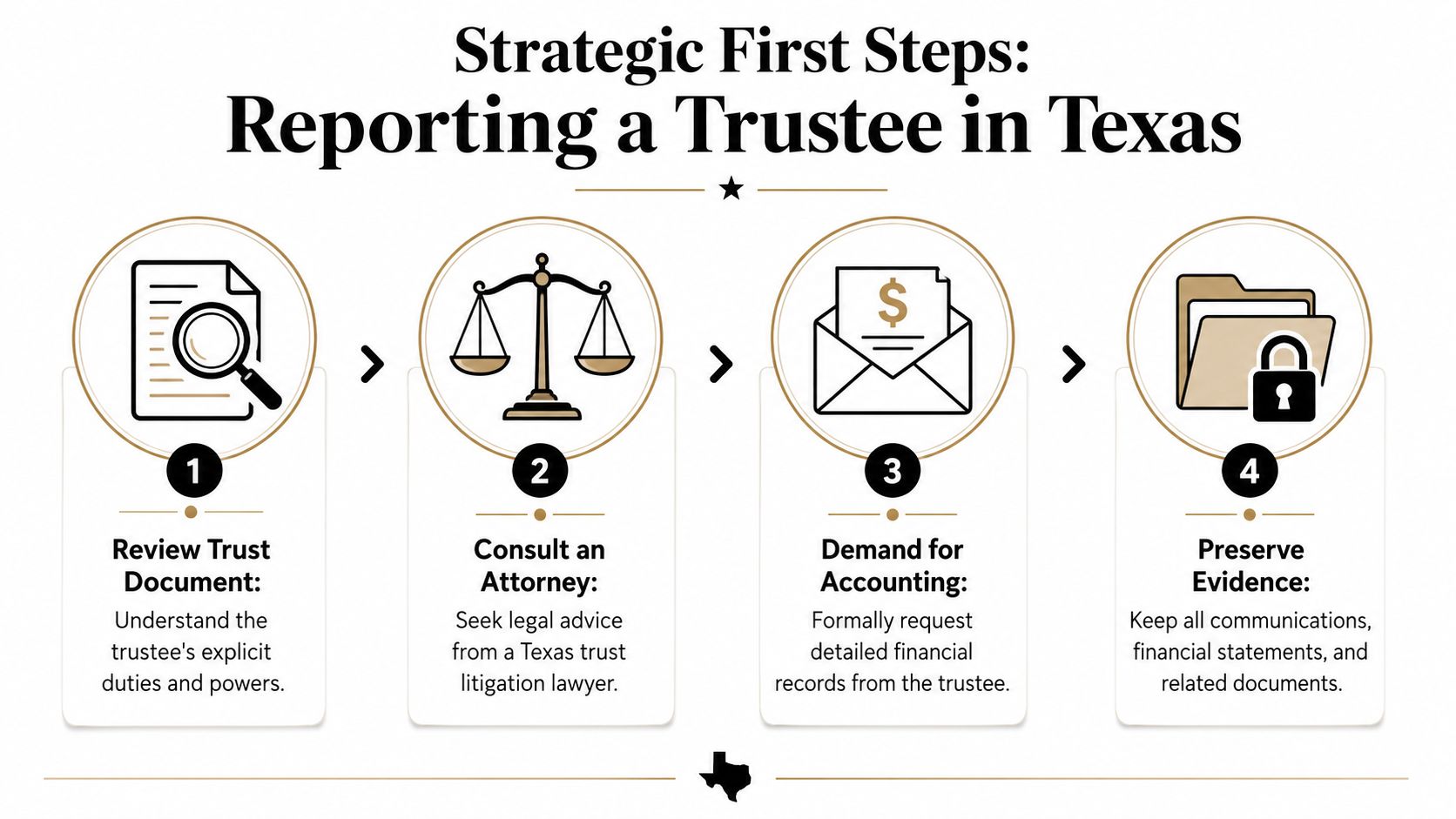
Start with the trust document and a written demand
Before you accuse anyone of stealing, gather the governing trust instrument and read the sections on trustee powers, beneficiary rights, distributions, and accounting duties. If you're a new acting fiduciary instead of a beneficiary, First Steps for a Successor Trustee in Texas gives a factual overview of what to do immediately after stepping into the trustee role.
Then send a formal written demand for an accounting. Texas law gives beneficiaries a statutory right to demand a full accounting, and if the trustee doesn't provide it after a formal request, the beneficiary can petition the probate court to compel the accounting and seek other remedies, as outlined in this Texas probate discussion of trustee breach and accounting rights. Texas Trust Code §113.151 is commonly used for this demand, and related guidance appears in this article on getting a trust accounting in Texas.
Your letter should be calm and specific. Send it by certified mail and keep a copy. Ask for:
- A full written accounting of trust transactions
- Bank and investment statements for trust accounts
- Records of distributions to beneficiaries
- Documents supporting major expenses or transfers
- An explanation of any loans, reimbursements, or sales of trust property
What to look for in the accounting
An accounting should tell a coherent story. You should be able to see what came in, what went out, and why. If the trustee sends only a summary spreadsheet with no supporting statements, that usually isn't enough for a serious dispute.
Watch for patterns such as:
| Issue | Why it matters |
|---|---|
| Vague descriptions | “Miscellaneous expense” can hide unauthorized spending |
| Transfers without backup | Missing invoices or notes can signal misuse |
| Personal benefit | Payments to the trustee may show self-dealing |
| Missing periods | Gaps in records often mean key transactions are being withheld |
Keep your request businesslike. A clean record of reasonable requests often helps far more in court than a heated exchange ever will.
Later in the process, many families also find it useful to hear a plain-language explanation of trust disputes before deciding how far to push the matter.
What not to do early on
A few mistakes show up again and again:
- Don't take original records from a home or office without legal advice
- Don't threaten criminal charges first if you still need documents
- Don't rely on verbal promises that records will be provided later
- Don't wait indefinitely because you hope the situation will calm down on its own
A written accounting demand often changes the tone of the matter quickly. Sometimes it prompts voluntary disclosure. Sometimes it exposes stonewalling. Either result gives you useful information.
Gathering Evidence to Build Your Case
Good trust cases are built from records, not outrage. That sounds cold, but it protects beneficiaries. A judge can act on documents, timelines, and account statements. A judge can't do much with a strong feeling that something is wrong unless that feeling connects to proof.
One beneficiary I've seen in situations like this usually starts with a single concern. Maybe it's a missing statement. Maybe it's a property sale that doesn't make sense. The strongest cases develop when that person stops chasing every rumor and starts assembling a clean file.
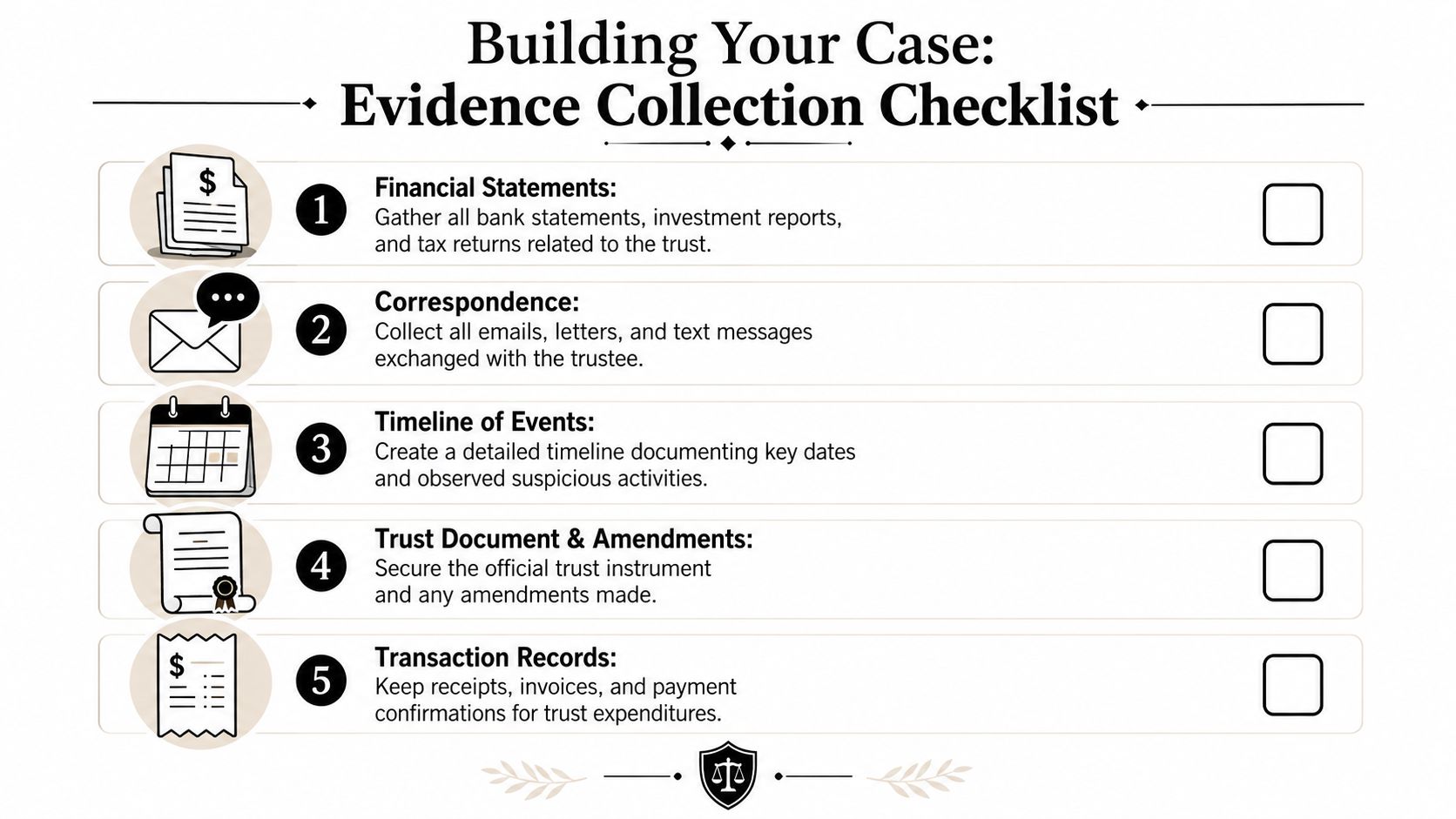
Build a record before you build an argument
A common and critical pitfall is failing to gather the trust instrument and prior accountings before filing. Cases with documented refusal to provide accountings or irregular financial records have significantly higher success rates for trustee removal and surcharge, according to this Texas probate attorney discussion of breach of trust claims.
That principle plays out in practical ways. The beneficiary who brings organized copies of trust records, deeds, emails, and account statements gives counsel something useful to work with. The beneficiary who brings only suspicions often has to spend time and money just reconstructing the basic history.
The documents that usually matter most
Gather copies, not originals, and organize them in chronological order with names and dates. That helps both a civil petition and any later criminal complaint.
Start with these:
- Trust instrument and amendments so you can identify the trustee's powers and limits
- Prior accountings to compare earlier reporting with current gaps
- Bank and brokerage statements tied to trust assets
- Deeds and closing papers for real property owned by the trust
- Tax returns and supporting schedules if available
- Emails, letters, and texts with the trustee about money, distributions, or property
- A dated timeline of suspicious events and unanswered requests
A narrative example shows why this matters. Suppose a daughter believes her brother, acting as trustee, sold trust property too cheaply. If she has only the listing screenshot, her concern may sound speculative. If she has the trust document, the deed, the sale paperwork, prior appraisals, and emails where he avoided basic questions, the issue becomes concrete.
The more your file answers “who, what, when, and where,” the easier it is for a court to see the problem.
Irregularities that deserve close attention
Some records deserve special scrutiny because they often show self-dealing or concealment. Examples include transaction entries labeled “personal loan” without a promissory note, repeated transfers just below the threshold that would normally trigger family attention, or reimbursements with no receipts.
If the numbers are hard to untangle, outside review can help. In some disputes, families use Bookkeeping and Accounting's fraud expertise to understand transaction patterns and spot records that deserve deeper legal review. That kind of analysis doesn't replace a lawyer, but it can make a complicated paper trail easier to read.
Mistakes that weaken otherwise valid claims
These errors come up often:
- Handing over originals and later losing control of them
- Mixing trust records with personal notes so dates become unclear
- Skipping “small” transactions that may reveal a larger pattern
- Waiting too long to preserve texts or emails that may disappear
A beneficiary doesn't need to solve the whole case alone. The immediate goal is simpler. Preserve the record, identify the inconsistencies, and put the facts in a form a Texas trust administration lawyer can use.
Understanding Civil vs Criminal Actions
Many people think reporting a trustee for theft means going straight to the police. Sometimes that happens, but it usually isn't the first or most effective step. In Texas trust disputes, civil and criminal actions serve different purposes.
The civil track is about control, asset protection, and repayment. The criminal track is about punishment. Families often need one, sometimes both, and occasionally only the civil route.

How the two tracks differ
Reporting a trustee for theft in Texas involves a dual-track approach. Probate court handles asset recovery through remedies such as surcharge, while the criminal track reported to law enforcement is generally reserved for egregious cases. Attorneys often advise seeking a temporary injunction to protect assets while the civil case proceeds, as discussed in this Texas elder financial abuse reporting guide.
Here is the practical comparison:
| Track | Main purpose | Who drives it | Typical result |
|---|---|---|---|
| Civil probate case | Protect the trust and recover losses | Beneficiary through counsel | Removal, accounting, surcharge, injunction |
| Criminal report | Investigate and punish theft or fraud | Law enforcement and prosecutors | Charges, prosecution, possible penalties |
When civil action usually comes first
Civil probate court is often the direct path because it addresses the question beneficiaries care about most. How do we stop the damage and recover the trust property?
A probate judge can order accountings, evaluate fiduciary duties in Texas, consider removal, and impose a surcharge, which means the trustee may have to personally compensate the trust for losses caused by misconduct. The court can also use tools like constructive trust remedies or a receiver in appropriate disputes.
This is also where emergency relief matters. If a trustee appears ready to sell property, empty accounts, or transfer assets out of reach, a request for immediate court intervention may be more useful than a police report made without the full record.
When criminal reporting makes sense
Criminal reporting may be appropriate when the conduct is blatant, the evidence is strong, or the situation involves elder financial abuse. If the victim is a senior, Adult Protective Services may also become part of the picture.
A criminal case may punish wrongdoing, but it doesn't automatically rebuild the trust or put assets back where they belong.
That trade-off matters. Families sometimes expect law enforcement to take over the whole matter. In reality, law enforcement may wait for clearer documentation, while the trust continues to suffer harm. That's why counsel often prioritizes the civil filing first, then evaluates whether law enforcement should also be involved based on the records collected.
If you're trying to decide how to report a trustee for stealing Texas assets, the better question is often not “civil or criminal?” It's “what action protects the trust fastest, and what evidence do we have right now?”
How to File for Trustee Removal and Surcharge in Court
Once the trustee has failed to account, the records suggest misappropriation, or trust assets appear at risk, the matter usually moves into probate court. That filing is often called a Petition for Removal, Accounting, and Surcharge.
This petition needs more than frustration. It needs structure. The court will expect a clear explanation of who the parties are, what trust controls the dispute, which duties were breached, and what remedies you are asking the court to order.
What the petition must accomplish
Beneficiaries must file a Petition for Removal, Accounting, and Surcharge in probate court within four years of discovering the misconduct, and a critical success factor is immediately requesting a temporary injunction to freeze trust assets while the court evaluates the case, as explained in this Texas trust accounting article discussing petitions, limitations, and injunctions.
A well-prepared filing commonly includes:
- Identification of the trust and the relevant trustee
- The beneficiary's standing to bring the case
- Specific breaches such as self-dealing, theft, or failure to provide information
- The relief requested, including removal, a compelled accounting, surcharge, and recovery of assets
- Any emergency request for a temporary injunction or receiver
If you want a useful overview of this process, petition to remove trustee in Texas gives context on how these cases are framed.
Why emergency relief can matter more than the final hearing
Families often focus on the final result and overlook the urgent step. If assets are moving now, the immediate question is whether the court should freeze the situation long enough to prevent further loss.
A temporary injunction can ask the court to stop sales, transfers, withdrawals, or other actions until the dispute is heard. In the right case, that is the difference between preserving a trust and chasing missing assets later.
Here's a practical sequence that often works better than delay:
- Send the formal accounting demand
- Collect and organize the trust records
- Prepare the probate petition with specific requested relief
- Request emergency protection if assets are in immediate danger
- Serve the trustee properly and prepare for the first court response
Once served under Texas rules, the trustee generally has about 20 to 21 days to file an answer before the case moves toward a hearing process, as noted earlier in the verified Texas materials on breach and accounting procedure. That's one reason waiting too long can be costly. A trustee who senses scrutiny may move quickly.
What works and what often fails
What works is precision. Judges respond to organized evidence, clear legal requests, and a realistic explanation of why intervention is necessary.
What usually fails is filing too early with too little support, or waiting so long that records disappear and assets move beyond easy recovery. Another common problem is asking the court for broad relief without tying each request to a documented act by the trustee.
Courts don't remove trustees because family members no longer get along. Courts act when the evidence shows a breach, risk to the trust, or failure to perform legal duties.
This is also where related planning issues can surface. Some families discover that the trust dispute overlaps with probate administration, guardianship concerns, or broader asset protection planning. A matter that starts as suspected theft can expand into a larger estate governance problem very quickly.
When You Need a Texas Trust Administration Lawyer
Trust theft cases are rarely just about one missing check. They involve statutes, fiduciary standards, evidence rules, probate procedure, and sometimes tax planning or parallel probate and guardianship issues. That's why many beneficiaries reach a point where self-help stops being practical.
A Texas trust administration lawyer can demand records in a form that matters, evaluate whether the trustee's conduct fits a legal breach, prepare a petition that asks for the right remedies, and seek emergency relief when assets are in danger. Counsel can also help coordinate related issues with a Texas estate planning attorney if the trust problem connects to a larger estate plan, probate dispute, or questions about how to modify a trust in Texas after the current dispute is resolved.
The Law Office of Bryan Fagan, PLLC handles Texas trust administration, probate, estate planning, guardianship, and asset protection matters. In practice, that means one legal team can evaluate whether your next step should be a formal accounting demand, a probate petition, or broader planning to protect a loved one's legacy.
If you suspect a trustee is stealing, don't wait for perfect proof and don't rely on family pressure alone. A careful legal response gives you the best chance to protect the trust and hold the trustee accountable.
If you're managing a trust or planning your estate, contact The Law Office of Bryan Fagan, PLLC for a free consultation. Our attorneys provide trusted, Texas-based guidance for every step of the process.