Texas law doesn't set one fixed deadline for a trustee to distribute assets. Instead, the trustee must act within a reasonable time, and many straightforward revocable trust administrations are often benchmarked at 12 to 18 months, though the actual timeline can be shorter or longer depending on the trust's terms, debts, taxes, and assets.
When you're the person waiting for an inheritance, that answer can feel frustrating. When you're the trustee, it can feel even worse because you're expected to move things forward without a simple calendar deadline to follow. Many Texas families find themselves in this exact spot after a death or major life event. One person is trying to honor the trust and avoid mistakes. Another is wondering why nothing has been paid yet.
That tension is common. It doesn't always mean someone is doing something wrong.
A new trustee may be sorting through bank accounts, real estate records, insurance papers, business interests, and family questions, all while grieving. A beneficiary may only see silence, delays, or vague updates and start to assume the trustee is withholding funds. Both sides often need the same thing: a clear explanation of what Texas law requires.
Introduction Navigating Your Role in Trust Administration
If you've just become a trustee, you may be staring at a trust document wondering where to begin. If you're a beneficiary, you may be checking your phone every day for an update and asking the same question over and over: how long does a trustee have to distribute assets to beneficiaries?
In Texas, the answer depends on the type of trust, the language in the document, and the work that must happen before any final transfer is safe. The Texas Trust Code, related Texas Estates Code rules, and basic fiduciary duties in Texas all matter here. A trustee must follow the trust's instructions, protect the trust property, treat beneficiaries fairly, keep records, and avoid distributing assets too early if debts or other issues are still unresolved.
That last point is where people often get confused. Distribution is not just about writing checks. Before assets go out, the trustee may need to identify property, value it, gather paperwork, address creditor issues, coordinate with tax professionals, and prepare an accounting. In some families, this is simple. In others, it turns into a long administrative project.
Practical rule: A trustee's job is not to distribute assets as fast as possible. It's to distribute them lawfully, accurately, and in line with the trust document.
You also need to know that not every beneficiary has the same right to immediate payment. Some trusts require distribution after a triggering event. Others give the trustee broad discretion. That distinction can completely change expectations.
If you're serving as trustee, or you're worried that a trustee is taking too long, a careful review of the trust terms usually answers more questions than the calendar does.
The Reasonable Time Standard in Texas Trust Law
A daughter calls in March and says, “My father died last fall. The trustee still has not sent my distribution. Is that allowed?” In Texas, the answer usually turns on whether the trustee is acting with steady, documented care under the trust terms, not whether a fixed number of days has passed.
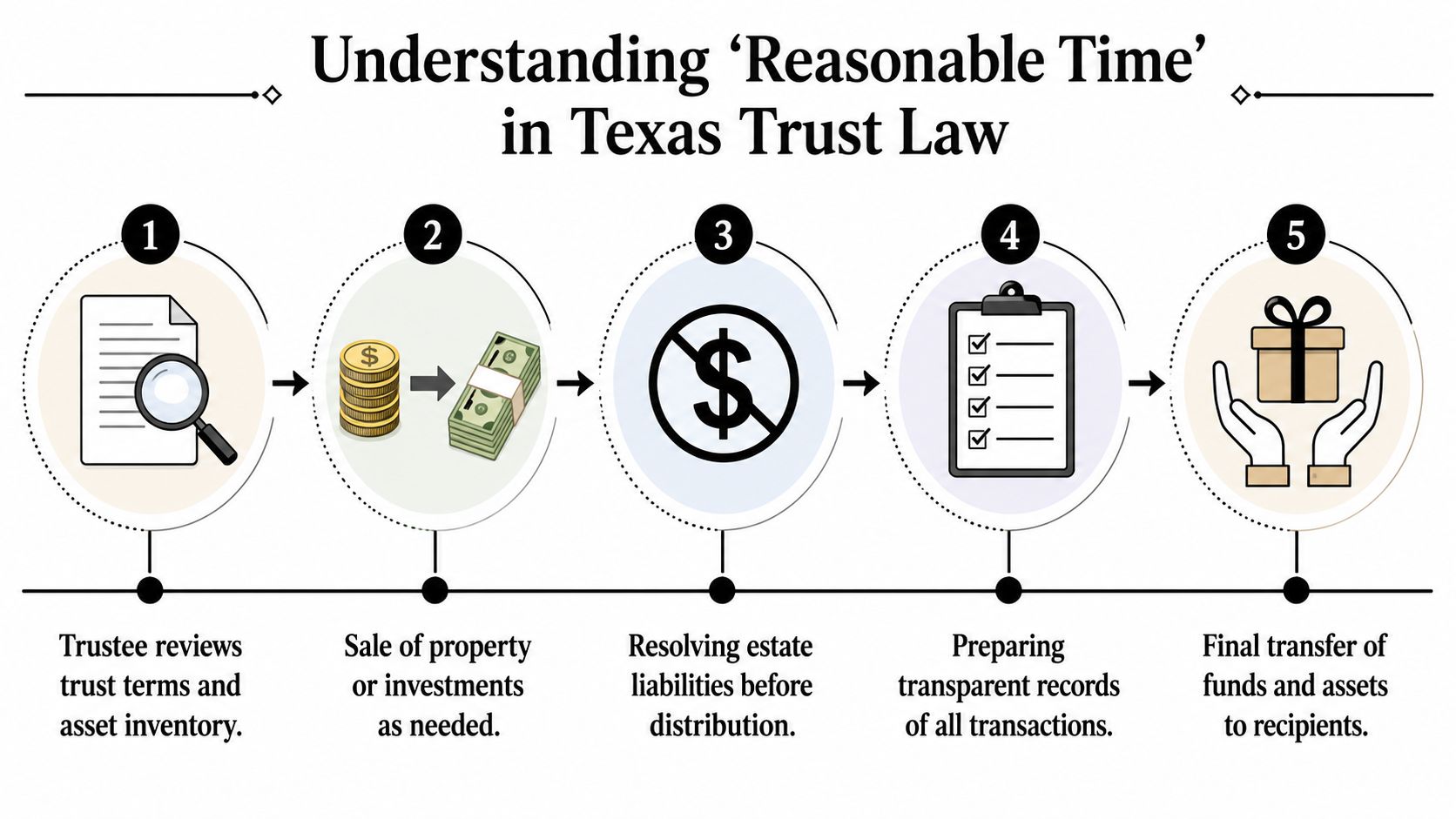
That point matters because many people expect trust administration to work like a bill due on a certain date. It usually does not. Texas law measures the trustee's timing by reasonableness under the circumstances. A trustee should keep the process moving, gather the information needed to distribute safely, and avoid delay that has no real administrative purpose.
What reasonable time means in practice
Reasonableness is a standard of conduct. It asks whether the trustee is doing the work a careful person in that role would do before turning over trust property.
That often includes several layers of review. The trustee may need to confirm who the beneficiaries are, determine whether any conditions must be satisfied first, collect account statements, value hard-to-price assets, review tax issues, and decide how much cash should stay in reserve. If the trust owns a house, mineral interests, a closely held business, or jewelry that needs valuation, the process can slow for good reason. In a family with high-value personal property, even practical tasks such as sorting, insuring, and getting inherited jewelry appraisal tips can affect when a final distribution is prudent.
A careful trustee also has to read the trust instrument closely. Some trusts direct mandatory distributions after a named event. Others are discretionary trusts, and that changes the timeline in a major way.
Discretionary trusts can change the answer entirely
This is the point beneficiaries and first-time trustees often miss.
If the trust gives the trustee sole or broad discretion to decide whether to make distributions, a beneficiary may have no right to force payment on a fixed schedule. The trustee still must act in good faith, follow the trust language, and honor fiduciary duties. But the calendar alone does not create a right to immediate payment. In other words, a discretionary trust is not merely “late” because a beneficiary expected money by a certain month.
That distinction is especially important in larger estates. Families sometimes assume all trust beneficiaries stand in the same position. They do not. A beneficiary of a mandatory distribution provision may be entitled to payment once the triggering conditions are met and administration allows it. A beneficiary of a discretionary trust may only be entitled to the trustee's honest judgment, exercised within the limits of the document.
Why trustees often hold funds before making final distributions
Caution is often part of doing the job correctly. If a trustee distributes too much too early and later discovers taxes, expenses, or valid claims that should have been paid first, the trustee may have to recover funds or cover the shortfall personally.
For that reason, trustees commonly retain a reserve while open issues are being resolved. The trust may need money for final bills, professional fees, asset transfer costs, or disputes about valuation and ownership. Beneficiaries do not always see that background work, which is why a period of silence can feel suspicious even when real administration is still underway.
Silence is the problem.
A trustee who needs more time should usually be able to explain why, describe what remains to be done, and keep records showing progress. As noted earlier in the article's discussion of Texas trust administration timing, there is no single date on the calendar that fits every trust. The safer question is whether the trustee can connect the delay to an actual duty under the trust and Texas fiduciary law.
Texas Trust Code and fiduciary principles at work
The Texas Trust Code and related fiduciary principles require the trustee to follow the trust, act loyally, use sound judgment, keep appropriate records, and treat beneficiaries fairly according to their interests. Speed matters, but only as part of a larger duty to administer the trust correctly.
A trustee who rushes can make expensive mistakes. A trustee who stalls without explanation can also create legal exposure.
The strongest position is a steady process with documentation, communication, and close attention to whether the trust is mandatory or discretionary. That last distinction often answers the hardest timing questions before a dispute grows into litigation.
Common Factors That Trigger or Delay Distribution
The timeline often becomes clearer when you separate what starts distribution from what slows it down. Families sometimes lump these together, which makes the process seem more mysterious than it is.

Events that trigger the trustee's duty to act
Some trusts become ready for administration after a clear event named in the document. Common examples include:
- Death of the settlor: Many revocable living trusts become fully operative for distribution after the person who created the trust dies.
- Trust termination language: Some trusts say assets must be distributed when the trust ends under stated terms.
- A beneficiary reaching a milestone: A trust may direct distribution when a beneficiary reaches a stated age or satisfies another condition.
- A trustee decision under the document: In some trusts, the trustee must decide whether conditions for distribution have been met.
When the trigger is clear and the trust holds mostly liquid assets, the administration is usually more straightforward.
Problems that delay the process
Other trusts look simple at first but become slow because the assets are hard to value, transfer, or sell.
Here are common delay points:
- Asset complexity: Real estate, mineral interests, closely held business interests, and collections can take time to review and transfer.
- Family conflict: If beneficiaries disagree about value, fairness, or trustee conduct, the process can stall.
- Tax and accounting work: A trustee may need professional help to prepare records and resolve filing questions.
- Creditor and liability issues: Open debts, reimbursement claims, or threatened lawsuits can require reserves or investigation.
- Missing information: Sometimes a trustee doesn't have clean records, or a beneficiary cannot be located quickly.
A simple example helps. Suppose a trust leaves equal shares to three siblings, but the main asset is a small family business. One sibling wants to keep it, one wants it sold, and one believes the business has been undervalued for years. The trustee can't distribute that asset responsibly until they determine what the trust requires and how to handle valuation, transfer, or sale.
Personal property can create hidden delay
Families are often surprised by how much time personal items can consume. Jewelry, collectibles, firearms, artwork, and heirlooms may carry both financial and emotional value. If the trust or related documents don't clearly assign those items, disputes can grow quickly.
When jewelry is part of the trust estate, practical resources like these inherited jewelry appraisal tips can help families understand why valuation matters before any sale or division takes place.
The hardest delays usually don't come from one big legal issue. They come from several small issues piling up at the same time.
Communication often determines whether delay feels reasonable
Two trustees may face the same obstacle and get very different reactions from beneficiaries. The difference is often communication.
A trustee who explains that a property sale is pending, records are being organized, and an accounting is in progress will usually reduce suspicion. A trustee who says little may trigger avoidable conflict, even if the timeline itself is justified.
That's one reason trustees should keep a written file of updates, decisions, expenses, and beneficiary communications. Good records support good administration.
Exceptions and Special Circumstances That Affect Timelines
Some trusts change the timeline question completely. This is especially true with discretionary trusts, which many families misunderstand.

Discretionary trusts don't work like mandatory payout trusts
A major source of confusion is the assumption that every beneficiary can demand payment once some ordinary administration period has passed. That isn't true.
As explained in this discussion of discretionary trust distribution rights under Texas law, a beneficiary of a discretionary trust has no ownership interest in the trust assets until the trustee elects to distribute. The same source explains that creditors and beneficiaries generally cannot compel payment on a fixed schedule when the trust grants true discretion.
That changes the question from “Why hasn't the trustee paid me yet?” to “What authority does the trust give the trustee?”
A discretionary trust may allow distributions for health, education, maintenance, support, or other stated purposes. It may also give the trustee broad authority to decide whether a distribution should happen at all. In that setting, the trustee still has fiduciary duties, but the beneficiary may not have a right to force payment by pointing to a typical administrative timeline.
Why this matters in Texas families
This issue comes up often in high-asset estate plans and asset protection planning. A parent may intentionally create a trust that slows or limits access so a child's creditors, divorcing spouse, or poor spending habits don't quickly consume inherited wealth.
That doesn't mean the trustee can act arbitrarily. It does mean the beneficiary's rights depend heavily on the trust language.
Here's a simple comparison:
| Trust type | Beneficiary expectation |
|---|---|
| Mandatory distribution trust | Beneficiary may have a stronger basis to expect transfer when the stated condition occurs |
| Discretionary trust | Beneficiary may have no right to compel payment on a fixed timeline |
| Continuing protective trust | Trustee may hold and manage assets for an extended period under the trust terms |
A trustee and beneficiary who miss this distinction can end up in a preventable dispute.
Other provisions that can extend administration
Some trusts continue for years because the trust itself says they should. A trust might hold assets until a beneficiary reaches a certain age, satisfy educational or support needs over time, or preserve family wealth across generations. In those situations, “distribution” may happen in stages rather than in one final event.
Spendthrift provisions can also affect how distributions are handled by restricting a beneficiary's ability to assign their interest or allowing the trustee to manage distributions carefully. These clauses don't erase fiduciary duties, but they often reinforce the trust's protective purpose.
A brief overview can help if you're trying to understand how these issues show up in practice:
When a trust includes special language, a Texas trust administration lawyer can interpret whether the beneficiary is entitled to an immediate distribution, a partial distribution, or only discretionary consideration.
A Trustee's Step-by-Step Distribution Checklist
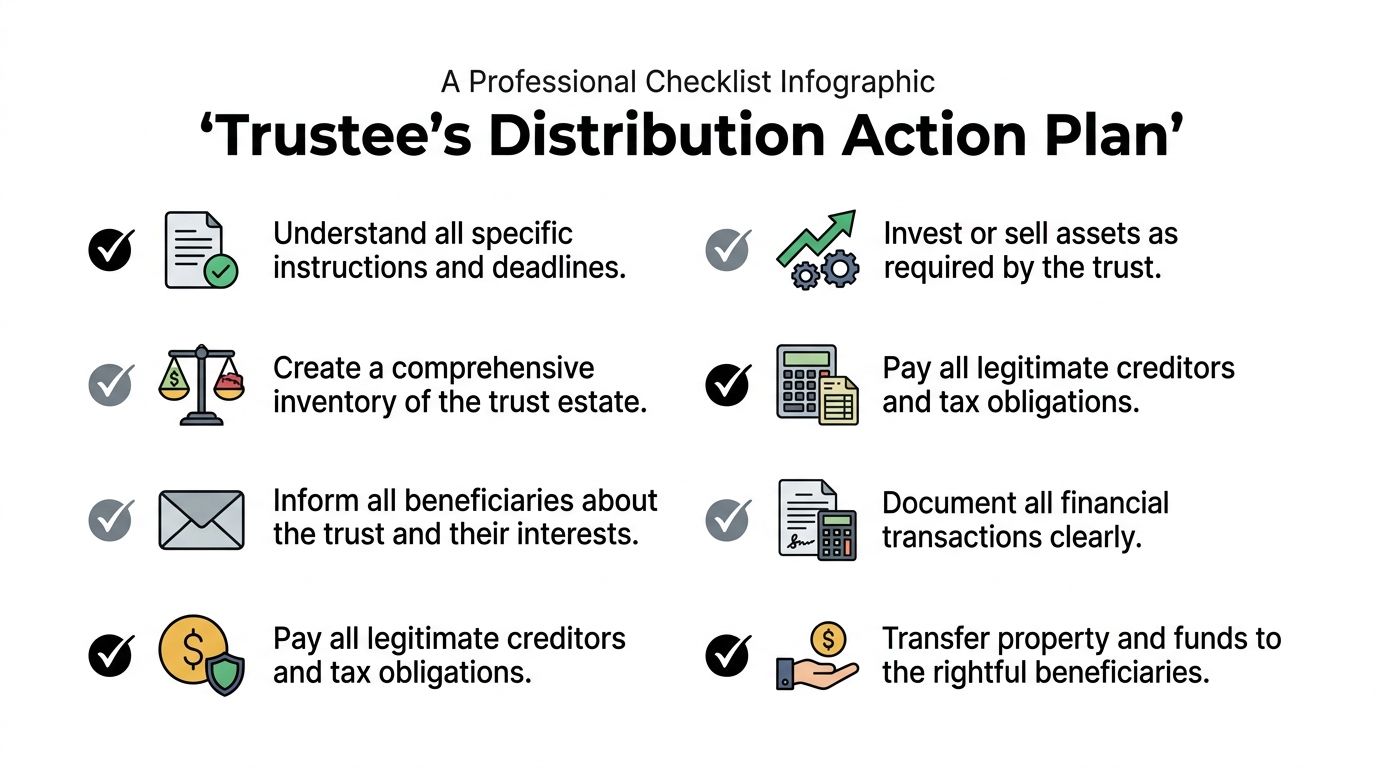
A trustee often feels pressure from both sides at once. Beneficiaries want to know when they will receive assets, and the trustee wants to avoid making a mistake that creates personal liability. A checklist helps because trust administration works much like closing out a business account. You verify what exists, pay what must be paid, document each decision, and only then transfer what is ready to go.
Follow the trust first
Begin with the trust instrument, not with beneficiary demands or family assumptions. Read the sections on trustee powers, distribution standards, successor trustee authority, accountings, and termination. Small wording differences can change the entire timeline.
Focus on five questions:
- Who is entitled to receive information and distributions
- Whether the trust requires payment or gives the trustee discretion
- Whether any gifts of specific property must be handled separately
- Whether the trust ends now or continues for ongoing management
- What notices, approvals, or records the trust requires before distribution
This is the point where many disputes start. If the trust is discretionary, the beneficiary may not have a legal right to demand payment on a fixed schedule. The trustee must still act in good faith and follow fiduciary duties, but the calendar often looks very different from a trust that says assets must be distributed outright after death.
If a clause is unclear, pause before transferring anything. Getting advice early is usually cheaper than correcting an improper distribution later.
Build the administration file before you send money out
A trustee should be able to show the path of every asset from the date of death or the date the trust became distributable through the final transfer. That file usually includes account statements, deeds, titles, business records, appraisals, tax returns, trust amendments, and written communications with beneficiaries.
A practical sequence usually looks like this:
- Secure and inventory the assets. Confirm what the trust owns, how title is held, and whether any property needs immediate protection, insurance, or valuation.
- Notify beneficiaries and set expectations. A short written update can calm tensions, especially if some assets can be distributed quickly and others cannot.
- Review debts, expenses, and taxes. A trustee should know what must be paid or reserved before making final distributions.
- Manage property during administration. Real estate may need maintenance, investments may need oversight, and closely held business interests may require special handling.
- Prepare an accounting. Beneficiaries should be able to see what came in, what went out, and what remains on hand.
- Get consents, receipts, or releases where appropriate. Signed records help confirm that the beneficiary received the distribution described.
- Transfer the assets using the right documents. Cash, securities, deeds, assignments, and business interests each require different paperwork.
Order matters here. A trustee who distributes too early can create a shortfall later if taxes, expenses, or a title problem surfaces after the money is gone.
Treat the accounting as part of the distribution process
An accounting is not just paperwork. It is the beneficiary's map of what happened inside the trust.
Without that map, even an honest trustee can look evasive. Beneficiaries usually want straightforward answers. What assets were in the trust? What was sold? What was paid? Why is a reserve still being held? Clear records often prevent conflict before it starts.
The accounting also helps the trustee separate assets that are ready for distribution from assets that are still tied up by tax work, valuation questions, or trust terms. In a discretionary trust, that distinction matters even more. The trustee may be making ongoing judgment calls about health, education, maintenance, support, or other stated standards rather than merely cutting checks on demand.
Good records protect everyone. They show beneficiaries what happened, and they show the trustee why each step was taken.
Use professional help based on the assets involved
Some trusts are simple. Others hold rental property, a family business, concentrated investments, mineral interests, or assets that raise tax issues. A trustee does not need to do all of that alone.
For trustees who want a clearer overview of responsibilities, Texas Trust Administration: A Trustee's Guide outlines the basics of trust administration and how it differs from probate. In some cases, a firm such as Law Office of Bryan Fagan, PLLC can assist with trustee duties, fiduciary accounting, distribution planning, and dispute resolution under Texas law.
The main goal is steady, documented progress. A careful trustee reads the trust closely, gathers records before acting, explains delays when they are justified, and remembers that discretionary language can change what a beneficiary may demand and when.
When Delays Become Unreasonable What Beneficiaries Can Do
A common Texas trust dispute starts the same way. A beneficiary waits for a distribution, hears little from the trustee, and begins to wonder whether the delay is normal or a sign that something is wrong.
The answer usually depends on two questions. Is the trustee still doing real administration work, or has the process stalled without a good reason? And does the trust require distribution, or does it give the trustee discretion about whether and when to make payments at all?
That second question changes everything. In a discretionary trust, the trustee may have sole authority to decide whether a beneficiary should receive money for health, education, maintenance, support, or another stated purpose. A beneficiary in that situation often cannot force payment on a fixed schedule merely because time has passed. The trustee still must act in good faith and follow the trust, but delay alone does not prove misconduct if the trust gives broad discretion.
What unreasonable delay often looks like
A reasonable delay usually has a paper trail. The trustee can explain what remains to be done, identify the assets involved, and give a realistic estimate of timing.
Concern grows when the trustee does the opposite. Warning signs include long periods of silence, repeated excuses that never lead to action, refusal to provide information the beneficiary is entitled to receive, or unexplained gaps in the trust records. A trustee who says only "it is being handled" month after month is inviting conflict.
Silence matters. So does inconsistency.
Start with a written request, not an accusation
Beneficiaries often get better results by starting with a focused written request. Ask for the current status of administration, what tasks remain, whether any assets are still being valued or sold, and whether the trust terms give the trustee discretion over timing or amount.
Specific questions usually work better than broad demands. A message that asks, "What assets are still pending, and what is the expected timeline for each?" gives the trustee something concrete to answer. A message that says, "You are hiding money," usually hardens positions without producing useful information.
Keep every letter, email, and response. If a dispute later reaches mediation or court, that record works like a timeline on paper. It shows whether the beneficiary asked reasonable questions and whether the trustee responded responsibly.
A practical escalation path
If the trustee still does not respond or the answers do not match the trust terms, beneficiaries often move through these steps:
- Send a follow-up written request. Ask direct, fact-based questions and set a reasonable deadline for a response.
- Request an accounting if one is appropriate. An accounting can show whether the trustee is actively managing the trust or delaying.
- Review the trust language closely. Pay special attention to discretionary distribution provisions, standards for payment, and any conditions that must be met before distribution.
- Use mediation if communication has broken down. A neutral third party can help separate legal issues from family tension.
- Ask a Texas trust lawyer to evaluate the delay. The underlying issue is often whether the trustee failed to perform a duty, not whether the beneficiary is frustrated.
- Go to court only if necessary. A judge may order an accounting, instruct the trustee to act, or consider removal in serious cases.
What courts usually care about
Courts tend to focus on conduct, documentation, and the trust document itself. They look at whether the trustee is carrying out duties with care, whether the reasons for delay are legitimate, and whether the beneficiary is entitled to a mandatory distribution.
This is why discretionary trusts deserve special attention. If the trustee has sole discretion, a beneficiary may be able to challenge bad faith, self-dealing, or complete failure to act, but may not be able to demand an immediate payout on a calendar deadline. That distinction surprises many families, especially when they assume every trust works like a simple inheritance account.
A mandatory trust distribution is closer to a bill that eventually must be paid. A discretionary distribution is closer to a decision the trustee is authorized to make under stated standards. The timing analysis is different from the start.
Focus on records and trust language
Beneficiaries strengthen their position when they stay grounded in facts. Read the trust. Compare the trustee's explanations to the actual distribution language. Look for objective signs of progress, such as tax filings, appraisals, property listings, account statements, or partial distributions where appropriate.
Trust disputes become more expensive when people argue from assumptions instead of documents. A calm, organized record often does more to resolve delay than a threatening letter sent too early.
If the trustee is acting reasonably, the records usually show that. If the trustee is failing to act, the records usually show that too.
Conclusion Ensuring a Smooth and Lawful Trust Distribution
Trust distribution in Texas is rarely about one simple date. The key question is whether the trustee is acting within a reasonable time, following the trust, honoring fiduciary duties, and keeping the process moving with proper care.
For trustees, that means careful records, steady communication, and a willingness to slow down when debts, taxes, valuation issues, or special trust provisions require it. For beneficiaries, it means understanding that some delays are legitimate, while others deserve closer review. The most important distinction is often not the calendar. It's the trust language itself, especially when discretionary provisions change whether a beneficiary can demand payment at all.
Managing a trust can feel heavy, but it's manageable when the legal duties are clear and the next steps are organized. Whether you need help with trust administration, a dispute over distribution, how to modify a trust in Texas, or a broader estate plan, informed guidance can make the process far less stressful.
If you're managing a trust or planning your estate, contact Law Office of Bryan Fagan, PLLC for a free consultation. Our attorneys provide trusted, Texas-based guidance for every step of the process.