Managing a loved one's trust can feel overwhelming, especially when you're the family member doing the work without knowing whether you may be paid. You may be balancing accounts, arranging property repairs, communicating with beneficiaries, and working with a CPA while trying to avoid the appearance of self-dealing. In Texas, trustee compensation isn't governed by one automatic fee schedule. The answer usually depends on the trust document, the services performed, and whether the compensation is reasonable under the circumstances.
This guide explains trustee compensation in Texas in plain English. It covers the Texas Trust Code, fiduciary duties, fee structures, accounting records, income and principal allocation, trust modification, and the rights of beneficiaries who question a charge. Whether you're a new trustee, a concerned beneficiary, or a family planning for future administration, the goal is to replace guesswork with a careful process.
When a Texas Family Trustee Wonders Whether to Take a Fee
Maria became trustee of her parents' $1.8 million revocable trust after her father died. She wasn't a professional fiduciary. She was a daughter who knew the family, understood the household finances, and believed she could help.
The work took more time than she expected. She spent weekends balancing checkbooks, answering her brother's calls, gathering financial statements, and meeting with a CPA. She also coordinated maintenance for a rental property and tried to understand which expenses belonged to the trust. After several months, Maria wondered whether requesting compensation would make her look greedy or trigger a lawsuit.
That concern is common. A family trustee may feel that helping relatives should be a favor, while beneficiaries may assume the trustee is already receiving enough value from serving. At the same time, unpaid service can create resentment, rushed decisions, or poor recordkeeping. A trustee who accepts compensation also takes on added scrutiny because fiduciary principles require loyalty, prudence, impartiality, and careful administration.
Practical rule: A trustee shouldn't decide a fee by emotion alone. The decision should be tied to the trust document, the actual work performed, and records that allow beneficiaries to understand the charge.
The trustee's role also overlaps with broader fiduciary standards. Advisors and professionals who work around trusts may find this overview of compliance for fiduciary advisors useful when building systems for disclosure, documentation, and conflicts of interest.
The sections that follow address the questions Maria needs answered: What does Texas law permit? Which fee method fits the trust? How should a trustee document compensation? How are fees divided between income and principal? When can a beneficiary object? And what should happen before a disagreement becomes a court case?
How the Texas Trust Code Sets the Ground Rules
Texas starts with a flexible rule. Texas Property Code section 114.061 provides that, unless the trust says otherwise, a trustee is entitled to reasonable compensation from the trust. The statute doesn't establish a fixed dollar amount or universal percentage for ordinary trustee compensation. It also allows a court to deny all or part of a trustee's compensation if the trustee commits a breach of trust. Texas Property Code section 114.061 supplies the central legal framework.
A trustee should analyze the issue in steps:
- Read the trust first. The instrument may authorize a fee, set a method, refer to a corporate schedule, or waive compensation.
- Identify the services. Asset management, distributions, tax coordination, real estate, business interests, litigation, and beneficiary communication may require different levels of work.
- Measure reasonableness. Consider time, difficulty, responsibility, results, risk, and customary charges for comparable fiduciary work.
- Check for conflicts. A trustee can't use compensation as an opportunity to benefit personally at the expense of beneficiaries.
- Keep beneficiaries informed. Texas fiduciary duties include meaningful communication and appropriate trust information, not merely holding documents until someone files a lawsuit.
This differs from certain probate compensation rules. Texas estates law separately uses a 5% commission standard for executors and administrators in qualifying cases, with an aggregate cap of 5% of the estate's gross fair market value, as described in the statutory framework for executor compensation under Texas Estates Code section 401.001. That comparison highlights the important distinction: executor compensation may follow a statutory commission model, while trustee pay under section 114.061 is generally fact-specific.
| Factor | Trustee, Property Code §114.061 | Independent Executor, Estates Code §401.001 |
|---|---|---|
| Basic standard | Reasonable compensation unless the trust provides otherwise | Statutory commission standard in qualifying cases |
| Formula | No universal fixed dollar rate or percentage | 5% commission standard |
| Aggregate limit | No comparable statutory percentage cap stated in section 114.061 | 5% of the estate's gross fair market value |
| Main focus | Services, complexity, fiduciary conduct, and trust terms | Statutory commission rules and estate administration |
| Effect of misconduct | Court may deny all or part of compensation | Compensation may also be affected by statutory and fiduciary issues |
A practical overview of the difference between trust administration and probate appears in Texas Trust Administration: A Trustee's Guide. Trustees who want a deeper explanation of their role can also review the Texas Trust Code and trustee duties.
Choosing the Right Compensation Method for Your Trust
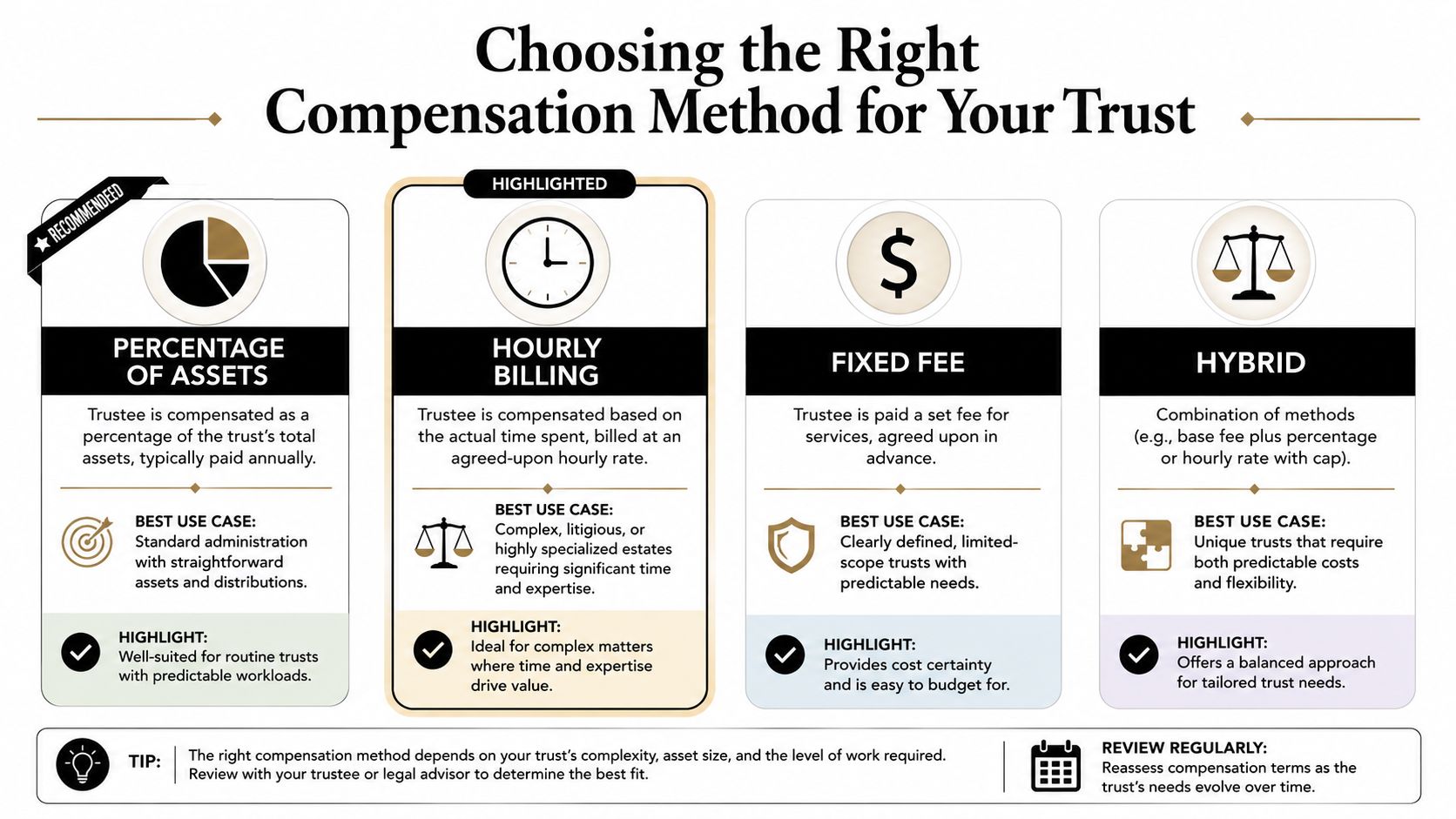
No single fee model works for every Texas trust. A trustee managing a straightforward investment portfolio may need a different arrangement from one handling a closely held business, contested distributions, or property that requires hands-on oversight. Whatever method the parties choose, reasonableness under section 114.061 remains the controlling benchmark unless the trust document establishes a different enforceable arrangement.
Hourly billing
Hourly compensation fits work that varies from month to month. A trustee dealing with litigation, real estate, business interests, unusual tax issues, or extensive beneficiary requests can record the time spent and describe each task. Detailed logs make the fee easier to review.
The weakness is administrative. Vague entries such as “trust work” won't help a beneficiary or court determine whether the charge was necessary. A good log identifies the date, task, time spent, and connection to trust administration.
Flat fees
A flat fee may suit a narrow assignment, such as completing a simple accounting, handling a defined trust termination, or coordinating a discrete administrative project. The agreement should identify what the fee includes and what happens if the work expands.
A flat fee can create tension if the trustee performs far more work than expected. It can also create questions if the trustee performs little work but collects the full amount.
Percentage compensation
A percentage of trust principal or income can provide a predictable method for continuing administration. It may fit a long-running trust with regular investment oversight and ordinary distributions. The concern is that asset value alone doesn't always measure workload. A trust with valuable but uncomplicated assets may require less work than a smaller trust with difficult property or family conflict.
Corporate schedules and hybrid arrangements
Institutional trustees often use published schedules or tiered rates. Those schedules may be easier to apply consistently, particularly for a trust expected to continue for a long time. A hybrid arrangement can combine a regular administration fee with hourly charges for unusual services, but the document should prevent double billing.
Trustees should also consider the trust's duration, asset complexity, family relationships, and whether the instrument already specifies compensation. Before charging expenses in addition to compensation, review what expenses a Texas trustee can legally charge, then confirm that the trust terms and fiduciary duties support the charge.
Sample Calculations That Put Real Numbers on the Page
Worked examples show why the same fee method can produce very different results. These examples are illustrations of arithmetic and documentation, not automatic legal entitlements. A trustee must still consider the trust instrument, services performed, beneficiary interests, and the reasonableness standard.
Example one, hourly compensation
A part-time family trustee records 42 hours during a year at $75 per hour under a court-confirmed rate. The calculation is:
42 hours × $75 = $3,150
The result is easier to defend when the trustee keeps time entries, copies of invoices, and notes showing why the work was required. The same charge could invite scrutiny if the trustee can't explain the entries or includes personal errands unrelated to the trust.
Example two, percentage and tiered compensation
A trust with $1.4 million in assets uses a 1% annual fee, producing:
$1.4 million × 1% = $14,000
A tiered schedule may produce a different result. Under a schedule charging 0.85% on the first $1 million, 0.60% on the next $1 million, and 0.40% above that, the fee on $1.4 million would be:
- First $1 million at 0.85% = $8,500
- Remaining $400,000 at 0.60% = $2,400
- Total = $10,900
The stated comparison of $13,800 would require a different application of the tiered schedule or additional charges. That's why fee agreements should explain exactly how asset values, tiers, minimums, and extraordinary services are handled. A trustee shouldn't present a total without showing the underlying rule.
Example three, corporate administration
A corporate trustee may apply a published tariff to a $2.5 million trust and add an annual administrative flat charge. The exact total depends on that institution's schedule and the services provided. Beneficiaries should request the tariff, the asset valuation method, and an itemized explanation of any separate charges.
| Model | Trust Size / Time | Calculation Rule | Annual Fee | Best Fit |
|---|---|---|---|---|
| Hourly | 42 hours | 42 × $75 | $3,150 | Active but limited family administration |
| Percentage | $1.4 million | 1% of trust value | $14,000 | Predictable ongoing administration |
| Tiered | $1.4 million | Stated asset tiers | Depends on the exact schedule | Institutional or structured administration |
| Corporate tariff | $2.5 million | Published graduated fees plus flat charge | Schedule-specific | Long-term institutional management |
Drafting Fee Agreements and Updating Compensation Terms
A clear compensation provision prevents many disputes before they begin. The settlor may place the method in the trust instrument, or the trustee and interested parties may document the arrangement separately when the trust permits that approach. The document should state whether compensation is hourly, flat, percentage-based, tied to a corporate tariff, or governed by a general reasonableness standard.
A useful provision answers practical questions:
- What work does the fee cover? Separate ordinary administration from unusual services.
- Who pays? State whether the trust pays directly and whether the charge affects income, principal, or both.
- When is payment made? Identify whether fees are paid periodically, after an accounting, or upon completion of a defined task.
- Can the rate change? Explain what triggers an adjustment and how beneficiaries receive notice.
- What records are required? Require time logs, invoices, valuation records, and descriptions of extraordinary work.
A provision that says “the trustee may charge any fee the trustee considers appropriate” creates unnecessary risk. It may appear to give the trustee unlimited discretion, but fiduciary duties still constrain self-interested decisions. A court can examine whether the trustee acted loyally and prudently, and section 114.061 allows compensation to be denied after a breach of trust.
Trust modification and decanting
Trust restructuring raises a separate question: how to modify a trust in Texas without improperly changing compensation. Texas law addresses compensation when assets move into a second trust. An authorized trustee generally may not use decanting powers solely to change compensation provisions. The trustee may be able to decant for another valid and reasonable purpose, and the second trust may continue the first trust's compensation method in some circumstances.
The purpose of the transaction matters. A trustee should document the legitimate reason for restructuring, explain the compensation effect, and confirm that any new compensation stays within reasonable limits authorized by state law. Beneficiary notice and legal review can reduce the risk that a restructuring will look like an effort to increase personal pay.
Accounting, Taxes, and the Income-vs.-Principal Split
Trustee compensation is paid from trust property, but the accounting question is more specific: should the charge reduce current income, long-term principal, or both? Texas Property Code section 116.201 provides that one-half of regular trustee compensation is charged to income by default, unless the trustee, consistent with fiduciary duties, determines that a different allocation is appropriate. The statute also addresses allocations for accounting and judicial proceeding expenses. Review Texas Property Code section 116.201 when preparing the trust accounting.
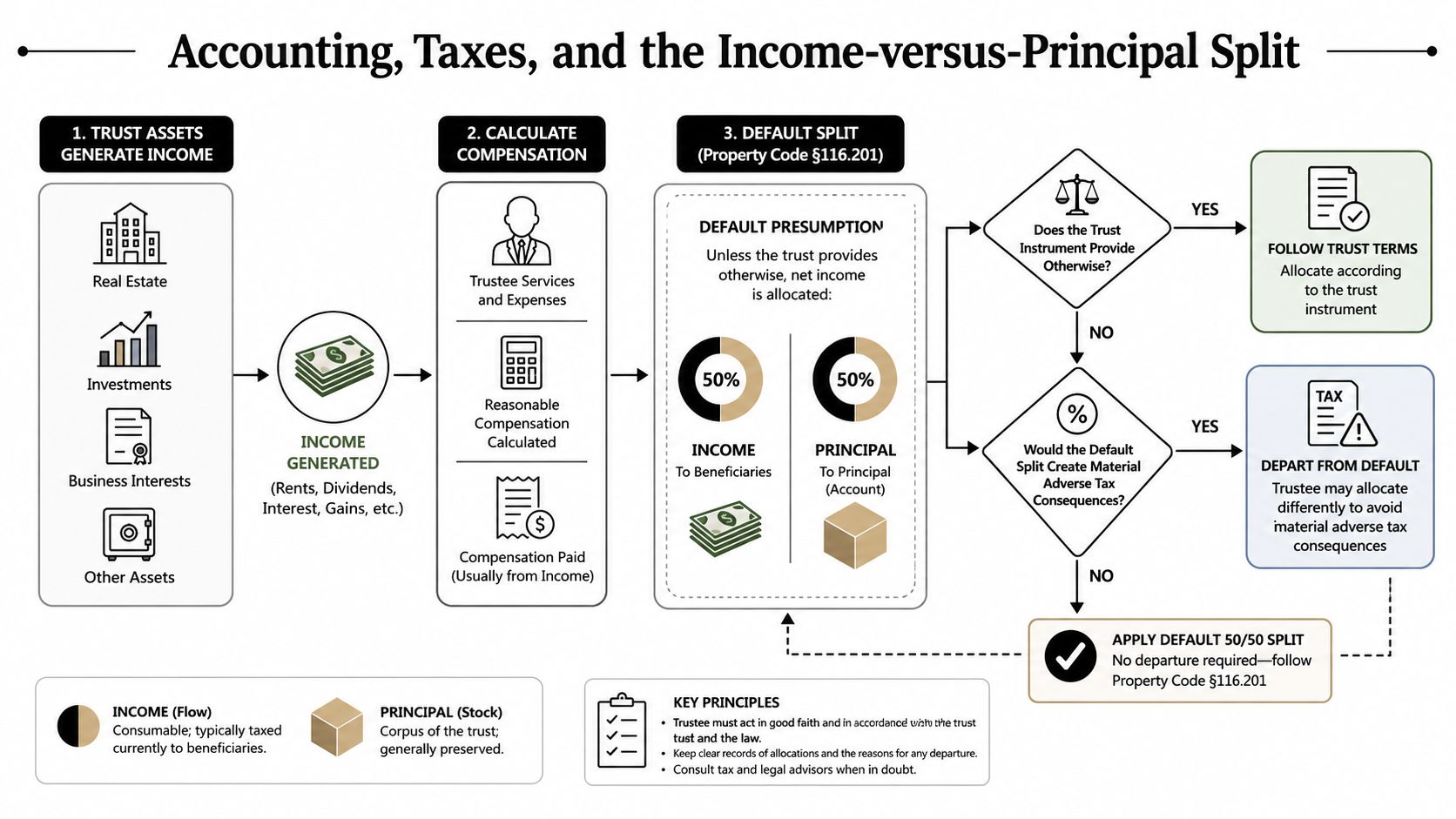
The split matters because income and remainder beneficiaries may have different economic interests. An income beneficiary may depend on distributions from interest, dividends, or rent. A remainder beneficiary may focus on preserving principal for a later distribution. Charging too much to income can reduce current cash flow, while charging too much to principal can reduce what remains for future beneficiaries.
The trustee should work through the accounting in an orderly way:
- Identify the compensation as regular or extraordinary.
- Read the trust's allocation provisions.
- Apply the statutory default unless a different allocation is justified.
- Record the reason for departing from the default.
- Provide supporting statements and vouchers with the accounting.
Tax treatment adds another layer. Trustee fees may be deductible by the trust on Form 1041, but the tax result can depend on the nature of the fiduciary, the character of the trust's assets, and applicable limitations. Fees connected to tax-exempt assets may receive different treatment. A trustee should coordinate with a CPA rather than assume that the accounting allocation automatically determines the tax deduction.
A detailed explanation of the records and procedures involved appears in this resource on trust accounting.
How Beneficiaries Can Review or Challenge Trustee Fees
A beneficiary doesn't have to accept a trustee's fee without information. Texas fiduciary principles support a beneficiary's ability to request relevant trust information and examine whether the trustee has administered the trust properly. The request should be specific, written, and directed to the trustee or the trustee's counsel.
A practical request may ask for the trust instrument, current asset list, bank and investment statements, fee calculations, invoices, time logs, and an accounting showing payments from income and principal. The beneficiary should keep proof of delivery and identify a reasonable response date. Silence shouldn't be treated casually, particularly where the trust document or applicable law creates a deadline for objections.
What a court may examine
Courts generally focus on the relationship between the fee and the trustee's actual conduct. The following comparison captures the central difference:
| Factor | Reasonable Fee | Breach of Trust |
|---|---|---|
| Duties performed | Trustee completed necessary administration | Trustee charged for work not performed or outside the role |
| Time spent | Records support the time claimed | No reliable logs, invoices, or explanation |
| Asset complexity | Work matches the trust's property and obligations | Fee ignores the actual level of difficulty |
| Comparable charges | Method resembles customary fiduciary practice | Charge appears excessive, inconsistent, or self-serving |
| Billing structure | One coherent method is applied | Trustee double-bills through hourly and percentage fees |
A trustee who keeps contemporaneous records and communicates clearly has a stronger reasonableness defense. By contrast, charging twice for the same work, billing for unqualified services, or assigning expenses to the wrong beneficiary class can support an objection and may create broader breach-of-trust concerns.
Resolving the disagreement
Beneficiaries and trustees should first exchange the records needed to evaluate the fee. Mediation can help when the dispute involves family relationships as well as money. A beneficiary committee may provide ongoing oversight for a long-lived trust, while a formal trust modification proceeding may be more appropriate when the document no longer works as intended.
Beneficiaries should avoid filing first and asking questions later. A well-supported objection identifies the disputed entry, explains why it appears unreasonable, and proposes a workable correction. Trustees should treat that objection as a fiduciary communication, not a personal attack.
Next Steps for Trustees and Beneficiaries in Texas
A sound compensation process begins with separate responsibilities for each side.
Trustees
- Review the instrument. Look for fee language, waiver provisions, payment timing, and allocation terms.
- Choose a defensible method. Match hourly, flat, percentage, tariff, or hybrid compensation to the actual administration.
- Keep detailed records. Log time, describe tasks, preserve invoices, and document unusual decisions.
- Prepare accountings. Show trust assets, receipts, disbursements, compensation, and income-versus-principal treatment.
- Get advice early. A Texas trust administration lawyer can review an unusual arrangement before payment creates a dispute.
Beneficiaries
- Request the records. Ask for the trust, accounting, fee calculation, and supporting documents.
- Review the method. Compare the charge with the work performed and the trust's complexity.
- Raise concerns promptly. Follow the trust's notice provisions and any applicable statutory deadlines.
- Consider structured oversight. A beneficiary committee or mediation may protect relationships while improving accountability.
Texas Estates Code section 1301.101 creates a separate compensation framework for certain management trusts. In that specific setting, a trustee is entitled to reasonable compensation subject to court approval and statutory limits, while a management trust for a person with only a physical disability may allow reasonable compensation without court approval and without bond. Because that rule applies in a defined estates context, trustees should not assume it controls an ordinary family trust.
If you're managing a trust or planning your estate, contact The Law Office of Bryan Fagan, PLLC for a free consultation. Our attorneys can review compensation provisions, guide trust administration, assist with disputes, and connect trustee decisions with broader estate planning, probate, guardianship, and asset protection needs.
If you're managing a trust or planning your estate, Law Office of Bryan Fagan, PLLC offers Texas-focused guidance on trustee compensation, fiduciary accounting, trust modification, beneficiary disputes, estate planning, probate, guardianship, and asset protection. Schedule a free consultation to discuss your trust documents, records, and next steps with an attorney who can help you move forward with clarity.