Managing a loved one's trust can feel overwhelming, especially when a clerk, a court packet, or a surety company starts asking for paperwork you've never seen before. If you've just stepped into the trustee role, or you're a beneficiary trying to understand why a bond is part of the process, the rules can look colder and more technical than they really are. In Texas, though, trustee bonding is a legal safeguard built to protect the people who depend on the trust, and the requirements change depending on the kind of trust, who's serving, and whether the trust document says something different.
That's why trustee bond and surety requirements in Texas trust administration deserve a clear, statute-based explanation. The Texas Trust Code and Texas Estates Code don't use one one-size-fits-all rule, and that's where families get confused. A private trust, a court-created management trust, a regulated trust company, and a probate estate can all trigger different bonding mechanics, and each one changes the practical path for the trustee, executor, and beneficiaries.
If you're trying to figure out whether a bond is required, how the amount is set, or whether a waiver clause changes the outcome, you're in the right place. For a helpful overview of beneficiary concerns as those questions come up, beneficiary rights in Texas trust administration is a useful companion resource.
Why Trustee Bonding Matters for Texas Families
A bond often shows up at the exact moment a family is already stressed. A successor trustee may be trying to sell property, transfer accounts, or answer a probate clerk's questions, and suddenly the word bond enters the conversation as if everyone should already know what it means. In plain English, the bond is there so the court and the people interested in the trust have financial protection if the trustee mishandles the job.
Why Texas law uses bonds at all
Texas law treats bonding as a real fiduciary safeguard, not a ceremonial checkbox. Under Texas Property Code § 113.058, a noncorporate trustee must post bond payable to the trust estate, the court registry, or interested persons, unless the trust instrument says otherwise, and the bond is conditioned on faithful performance of fiduciary duties (Texas Property Code § 113.058). That structure matters because it gives beneficiaries an actual remedy if the trustee mismanages the trust.
For families, the key idea is simple. A bond does not replace honesty, recordkeeping, or accounting, and it does not make a trustee careless. It works like a financial backstop if duties are breached, which is why bond questions often appear in disputes involving mismanagement or failure to account. The issue is closely tied to Breach of Fiduciary Duty by a Texas Trustee, because that is where beneficiaries start looking for remedies when the trustee's conduct falls short.
Practical rule: if a trust is valuable, contested, or hard to administer, bonding questions matter early, not after a dispute grows.
What readers should expect next
The rest of the process is more navigable than it first appears. You need to know which statute applies, whether the trust document changes the default rule, what the bond amount is based on, and how the surety company gets involved. Once those pieces are separated, the process starts to make sense.
For a worried family member, the reassurance is this, the bond exists to make the trustee more accountable, not to punish the trustee for being appointed. With the right Texas trust administration lawyer, the filing and underwriting steps become manageable instead of mysterious.
What a Trustee Bond and Surety Actually Are
A trustee bond is a financial promise tied to the trustee's duties. A surety is the insurance company or bonding company that stands behind that promise, so the trustee does not have to set aside the full bond amount in personal cash. In practical terms, the trustee obtains the bond, the surety evaluates the risk, and the court or interested persons receive a layer of protection if fiduciary duties are not carried out faithfully.
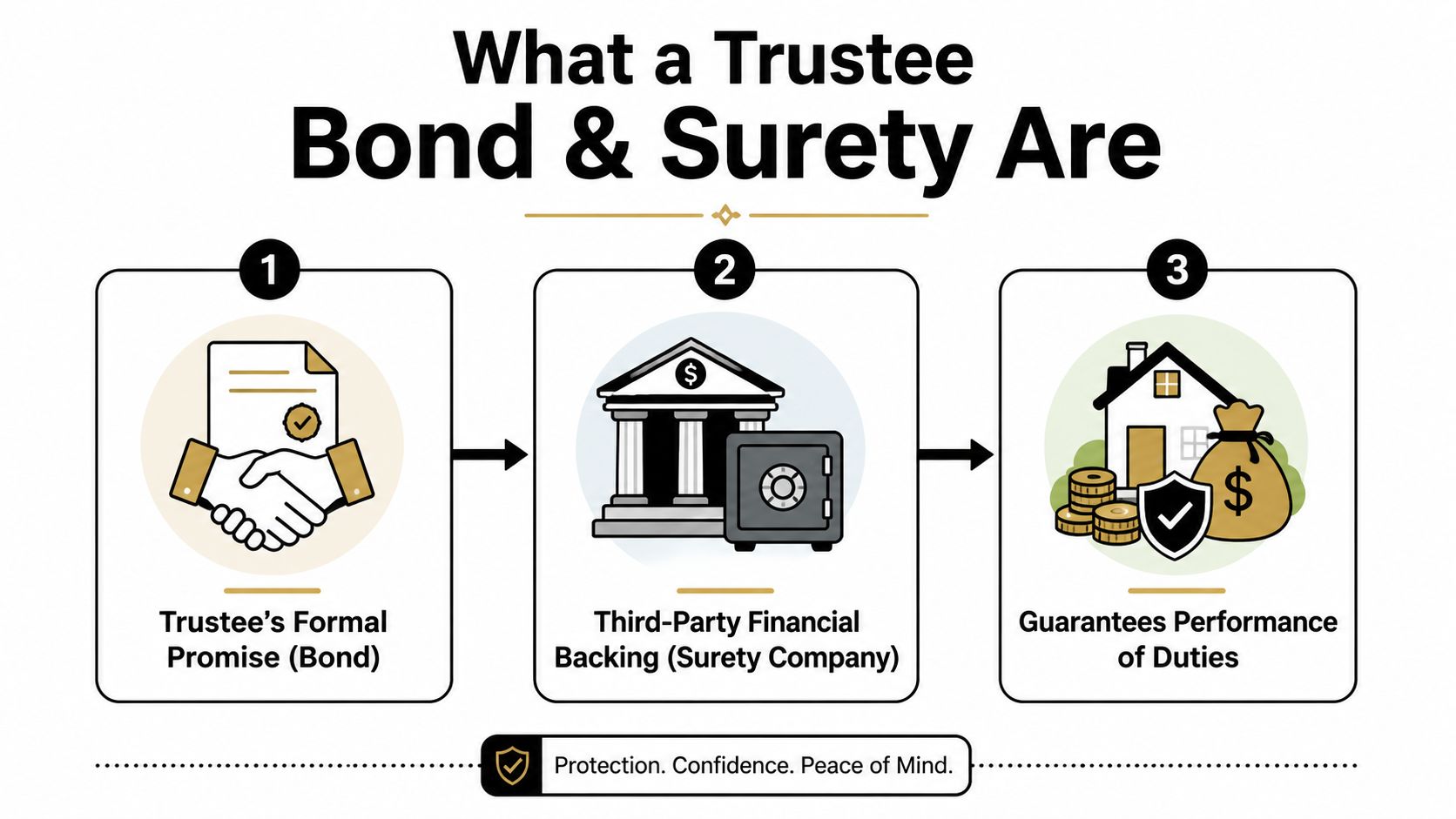
The bond is a promise, the surety is the backstop
The bond serves as the legal promise, and the surety is the company standing behind it. The trustee still owes the ordinary fiduciary duties, loyalty, prudence, disclosure, and careful recordkeeping, but the bond creates a separate source of recovery if those duties are breached. That is why the bond is treated as a fiduciary safeguard rather than a punishment.
Texas law uses that structure in private trusts and in court-created management trusts. For private trusts, Texas Property Code § 113.058 sets the default rule for a noncorporate trustee, while Texas Estates Code § 1301.058 sets the rule for certain court-created management trusts (Texas Estates Code § 1301.058). Those statutes serve different roles, but both reflect the same policy choice. Texas wants trust assets protected when court oversight or beneficiary protection is on the line.
A bond does not excuse bad conduct, and it does not insure against every bad result. It only responds when the trustee's performance falls below the legal standard.
Why the bond is paid for like insurance
The trustee bond is usually a paid product, not a deposit held in the trustee's own name. That distinction matters because families sometimes assume the trustee must hand over the bond amount in cash. That is not the usual structure. Instead, the surety reviews the trust, the trustee, and the risk profile, then issues the bond as a financial guarantee.
People also get confused about the terminology. A bond is the obligation, a surety is the company that guarantees it, and the premium is the cost to obtain it. If the trustee is also serving as a family fiduciary, that premium becomes part of the administrative burden of taking on the role.
A bond matters most when the trustee has access to substantial assets or when beneficiaries are already watching closely. In those settings, the bond adds another reason to keep records clean, distributions documented, and communications prompt.
Three Bonding Regimes Texas Trustees Should Know
Texas doesn't use one universal bonding rule for every fiduciary. It uses separate regimes, and families often blend them together by mistake. If you're trying to understand your own situation, the first question is whether you're dealing with a private express trust, a court-created management trust, or a regulated trust company.
Private trusts, court-created management trusts, and trust companies
For a private express trust, Texas Property Code § 113.058 is the starting point. The trust instrument can control the outcome, and if it doesn't waive bond, a noncorporate trustee may need one payable to the trust estate, the court registry, or interested persons (Texas Property Code § 113.058). That's the regime most families think of when they ask about a private trustee.
For a court-created management trust, the default is different. Texas Estates Code § 1301.058 sets the bond at the trust's principal plus projected annual income, unless a statutory exception applies, and some trustees of management trusts for people with only a physical disability may serve without bond under the trust terms (Texas Estates Code § 1301.058). This is a court-supervised setting, so the bond rule is more explicitly tied to protection of the beneficiary and the size of the trust.
For a regulated trust company, the bonding rules are separate again. Texas administrative rules require bonds for directors, managers, officers, and employees, and the focus is on institutional losses tied to dishonesty, fraud, defalcation, forgery, theft, and similar insurable losses (Texas Administrative Code, trust company bonding rules). That regime protects the regulated institution, not the family trustee acting under a trust document.
Bonding regimes at a glance
| Regime | Governing Law | Default Bond Rule | Who It Covers |
|---|---|---|---|
| Private trust | Texas Property Code § 113.058 | Bond unless the trust instrument says otherwise | Noncorporate private trustees |
| Court-created management trust | Texas Estates Code § 1301.058 | Bond equals principal plus projected annual income, unless an exception applies | Court-created management trustees |
| Trust company | Texas administrative rules | Institutional bonding for covered personnel and specified losses | Regulated trust companies |
If you're reading advice online, this is the point where confusion usually starts. Many articles lump all three together and then give one vague answer, which isn't helpful when a family trustee is trying to decide what the court expects.
Practical rule: identify the trust type first. The bond analysis changes as soon as the trust moves from private administration to a court-created or institutional setting.
If you're comparing professional guidance, a Texas trust administration lawyer can sort out the governing regime before the trustee spends time on the wrong application or the wrong court filing. Families also sometimes ask about a Texas estate planning attorney at this stage, because the best solution may be in the trust document itself, not in the bond form.
How Texas Courts Calculate the Bond Amount
The math matters because bond amounts are not arbitrary. Texas ties the number to the size of the trust, the expected income, or the value of the assets being administered, which is why two families can have very different bonding obligations even when both are serving as trustees. In other words, the court is looking at economic exposure, not just a title on paper.
The statutory formula and why it can be large
For a court-created management trust, Texas Estates Code § 1301.058 sets the default bond at the trust's principal plus projected annual income (Texas Estates Code § 1301.058). That formula can produce a substantial figure when the trust holds income-producing property or a significant principal balance. It also explains why the requirement tends to matter most in higher-value estates and contested administrations.
In one Texas probate court special-needs trust packet, the trustee's bond must be executed by a surety company, left with the court before the hearing, equal to twice the value of the assets funding the trust, with a $20,000 minimum, alongside a 3-month inventory and biennial accounting (Texas probate court special-needs trust packet). That packet shows how Texas sometimes calibrates the bond to the actual asset value instead of using a flat amount.
What courts and sureties are really measuring
A court wants to know whether beneficiaries would have meaningful protection if the trustee mishandles assets. A surety wants to know whether the trustee appears organized, honest, and capable of tracking money accurately. That means clean statements, clear ownership records, and no commingling issues go a long way.
The bigger the trust and the less transparent the records, the more friction a trustee should expect from the surety side.
For families in major Texas markets, the practical takeaway is that the bond grows with the scale of the administration. High-value real estate, brokerage accounts, closely held business interests, and income-producing assets all increase the stakes, and sureties underwrite that exposure accordingly. If the packet, the statute, and the trust terms point in different directions, the court controls the final answer.
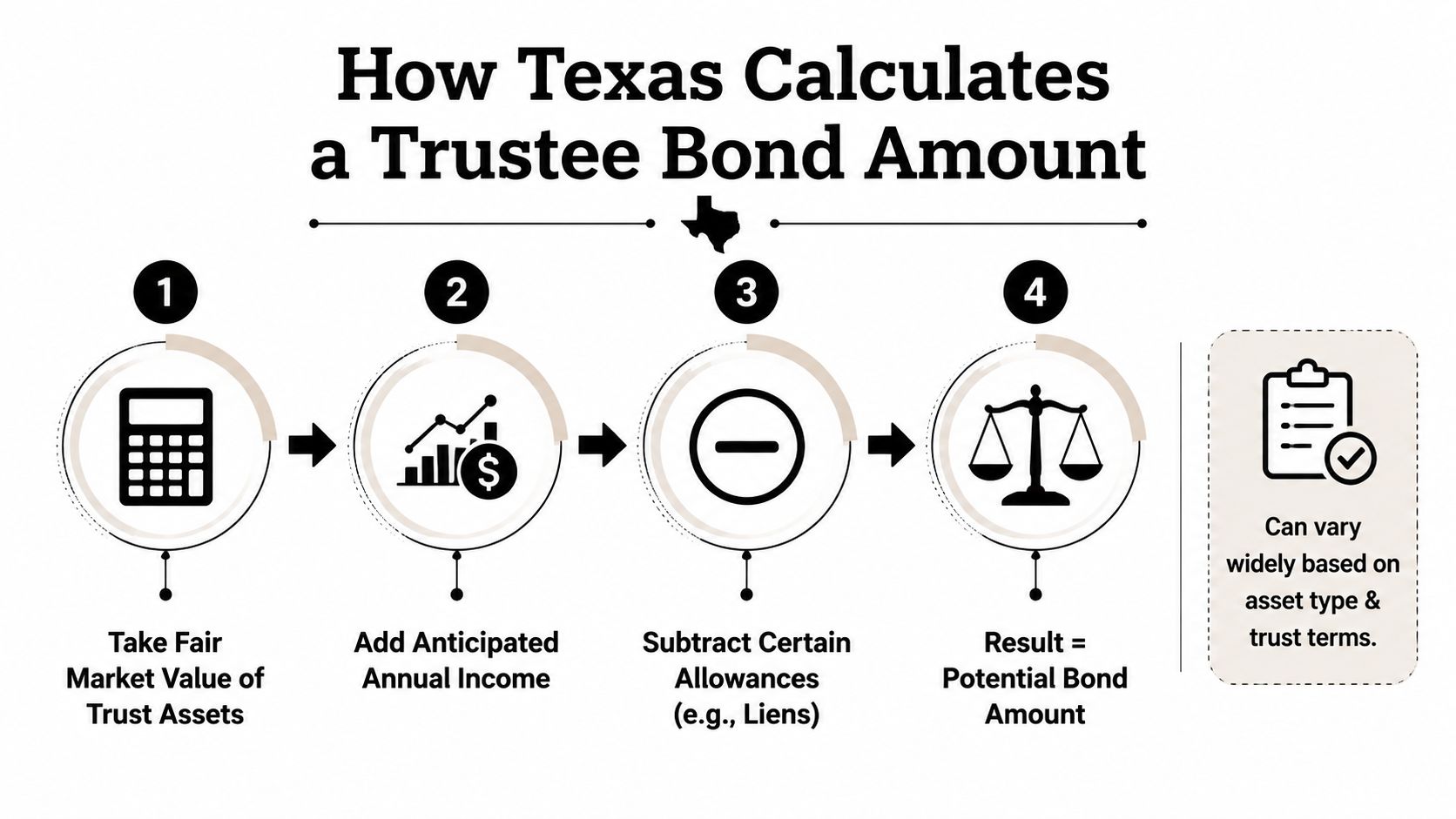
If a family is already dealing with tax planning or probate coordination, the bond number becomes one more reason to organize the administration early. That's where careful trust administration and thoughtful recordkeeping reduce friction before the hearing even happens.
How Trustees Actually Obtain Surety Coverage
The practical process starts with the right surety company. Texas trust-company rules require bonds from a corporate insurance or surety company authorized in Texas, and the underwriting focus is on losses from dishonesty, fraud, defalcation, forgery, theft, errors and omissions, and similar insurable losses (Texas Administrative Code, trust company bonding rules). That's a good preview of what the surety cares about in any fiduciary setting, even when the exact trust rule is different.
The filing and underwriting steps
The trustee usually completes a fiduciary application, provides financial information, and answers questions about experience, recordkeeping, and the trust assets. The surety then decides whether to issue the bond, and if so, on what terms. The premium is the price of that guarantee, and the bond itself is filed with the court or county clerk when the statute or order requires it.
Some courts require the bond to be left with the clerk before the hearing or before letters issue, so timing matters. Under Texas law in probate, bond can be a qualification step before letters testamentary or administration are issued, although a named executor in a probated Texas will may serve without one if the will expressly waives bond and the court finds the person qualified, and a corporate fiduciary is also exempt (Texas Estates Code § 305.101). Even though that statute addresses probate administration rather than trust administration, families often encounter both at the same time and assume the rules are identical. They aren't.
Why sureties look closely at controls
Sureties are underwriting risk, not just checking a box. If a trustee has weak controls, poor documentation, or commingled accounts, the surety may treat that as a warning sign. The bond exists to cover fiduciary risk, not ordinary market loss, so the focus stays on bad conduct, bad accounting, and bad process.
If you're asking who helps with this step, a Texas trust administration lawyer can coordinate the trust paperwork with the surety's forms and the court's filing requirements. In some families, a broader team also includes estate planning counsel and probate counsel, especially when the trust sits alongside a will or a guardianship matter. For readers who want to understand the institutional side of the issue, what a trust company is helps separate family trustees from regulated fiduciaries.
A trustee should also remember that the bond is conditioned on faithful performance. That means the best way to avoid claims is still the oldest one, keep the books clean, keep beneficiaries informed, and don't let personal funds mingle with trust funds.
Waivers, Corporate Trustees, and Other Ways to Reduce Bonding
The fastest way to reduce a bond requirement is often in the trust itself. Texas Property Code § 113.058 respects the trust instrument, so if the settlor wrote a valid waiver into the document, that language can change the default private-trust result (Texas Property Code § 113.058). That's a reminder that settlor intent still matters a great deal in Texas trust law.
Three common paths families use
An express waiver in the trust instrument is the cleanest option when the settlor wants to relieve a trustee from bonding. It works only when the document says it clearly enough to control the default rule, which is why drafting matters so much at the estate planning stage.
A corporate trustee can also reduce or eliminate the need for an individual bond in the private-family setting, because the law treats corporate fiduciaries differently from noncorporate trustees. That's one reason many families with long-duration or high-value trusts consider an institutional fiduciary. The tradeoff is that the trust moves from a family-managed model to a professional administration model, which may or may not be what the settlor wanted.
A beneficiary consent or indemnity approach can sometimes help in contested or transitional situations, but it needs careful handling. If the beneficiaries are not all aligned, or if the court wants more protection, the trustee may still face bond-related conditions. Families should treat this as a legal strategy, not a casual agreement.
Probate personal representatives are different
Many people encounter challenges with this concept. Texas Estates Code § 305.101 generally requires a bond before letters testamentary or administration issue, but a named executor in a probated Texas will may serve without one if the will expressly waives bond and the court finds the person qualified, and corporate fiduciaries are exempt (Texas Estates Code § 305.101). That rule applies to probate personal representatives, not private trustees.
If you're comparing options for a family trust, it helps to think in terms of control, protection, and administration style. A waiver keeps the process simpler, a corporate trustee shifts the burden away from family hands, and consent-based solutions depend on beneficiary cooperation and court approval. For readers evaluating broader planning choices, a Texas estate planning attorney can often reduce future bonding friction by building the right language into the trust from the start.
When a Bond Claim Actually Triggers
A bond matters most when a trustee's conduct starts causing real harm. Suppose a successor trustee mixes trust money with personal funds, makes distributions without clear records, and then misses repeated requests for an accounting. At that point, a beneficiary may petition the court, the trustee may be removed, and a bond claim can become part of the remedy process.
What the bond responds to
The bond is payable to the trust estate, the court registry, or interested persons, depending on the governing rule and the bond language. That means the people harmed by the trustee's conduct are the ones the bond is designed to protect, not the trustee. The surety does not automatically pay just because there's a complaint, though, it investigates whether the trustee breached duties covered by the bond.
The earlier distinction between fiduciary misconduct and ordinary investment loss is significant. A bond is aimed at dishonesty, fraud, defalcation, failure to account, and similar wrongful administration, not just a bad market year or a poor but honest judgment call. That's why beneficiaries shouldn't assume every disappointing outcome creates a bond claim.
Why the surety investigates first
A surety will look at the trust records, the accounting history, the court filings, and the conduct complained of before deciding whether the bond responds. If the trustee can show faithful administration, the claim may go nowhere. If the trustee can't explain missing funds or undocumented distributions, the claim becomes more serious.
A bond is not a substitute for a trustee's records. It becomes important when the records fail.
For families, that means the bond is not the main protection by itself. The primary protection begins with early documentation, clear communication, and prompt action when someone sees a problem. If beneficiaries wait too long, the administration can become more difficult to unwind, even when a bond exists.
Practical Steps for Trustees and Beneficiaries
Trustees and beneficiaries usually want the same thing, a clean administration without surprise disputes. The difference is that each side has a different job. Trustees have to gather documents, file the bond if required, and keep records straight, while beneficiaries have to know what to ask for and when to push for accountability.
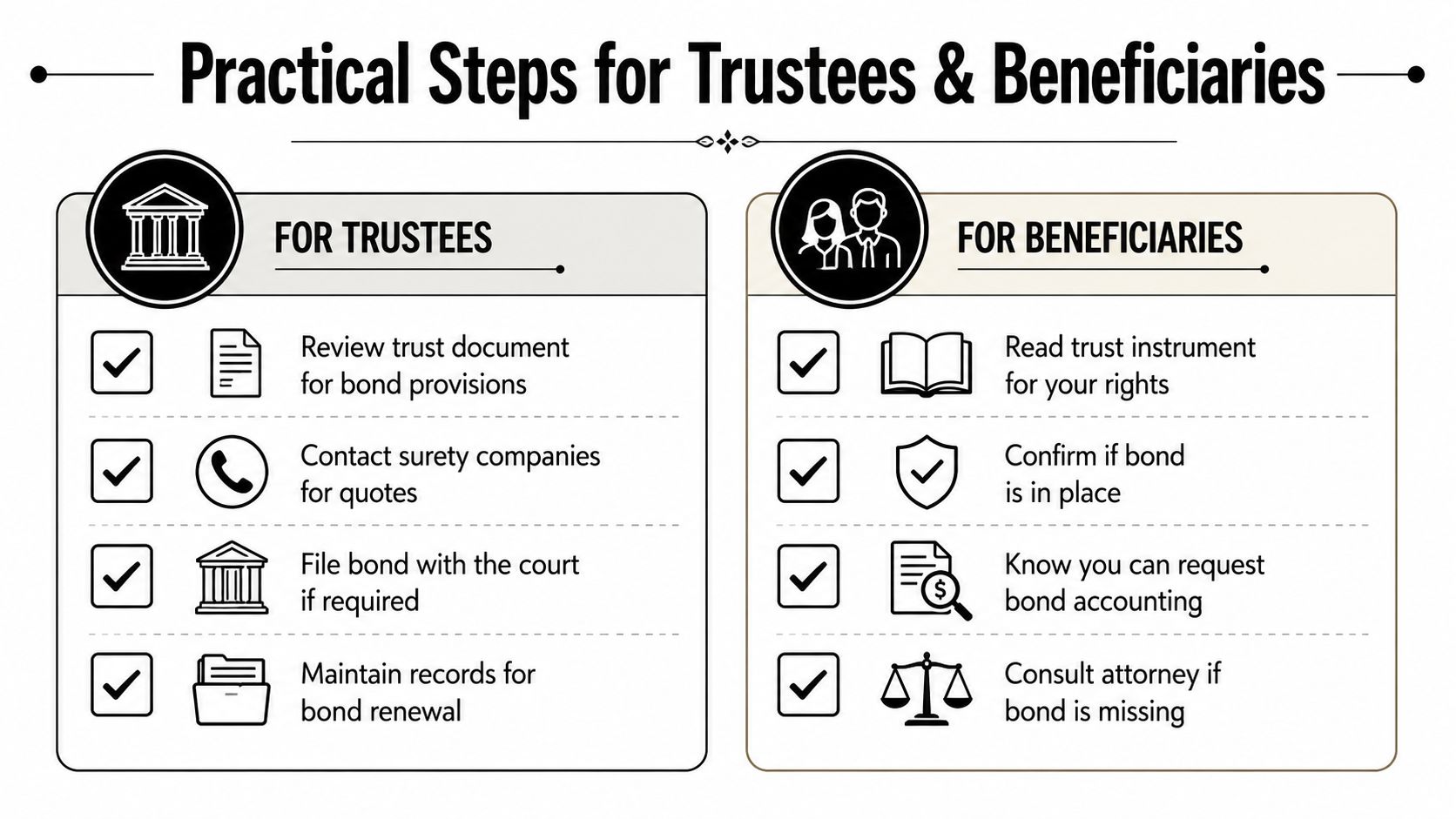
Trustee and beneficiary bonding checklist
| Trustee Action | Beneficiary Action |
|---|---|
| Review the trust document for bond provisions | Read the trust instrument for your rights |
| Contact authorized surety companies for quotes | Confirm whether a bond is in place |
| File the bond with the court or clerk if required | Request bond-related accounting information |
| Keep records clean and avoid commingling | Call a lawyer if the bond is missing or unclear |
What trustees should do next
A trustee should start by reading the trust instrument for waiver language. Then gather financial information the surety will want, file the bond with the proper court or clerk if required, and calendar any reporting or accounting deadlines that come with the appointment. In any trust administration, clean records are your best defense.
Beneficiaries should do the opposite, in the best sense. Ask for the trust document, confirm whether a bond exists, watch for missed accountings, and document any signs of mismanagement early. If the trustee refuses to provide information or the bond appears absent when it should be present, legal advice should come quickly.
For families dealing with trustee liability concerns, how to protect yourself from trustee liability in Texas is a practical next read. That kind of issue often overlaps with bond questions because the same conduct can create both administrative problems and beneficiary claims.
The Law Office of Bryan Fagan, PLLC helps Texas families with trust administration, estate planning, probate, guardianship, and asset protection matters, and that includes trustee bond questions that arise during a trust administration or dispute. If you're serving as trustee, worried about a beneficiary claim, or trying to understand whether a bond should have been filed, contact Law Office of Bryan Fagan, PLLC for a free consultation. Our attorneys provide trusted, Texas-based guidance for every step of the process.