Managing a loved one's trust can feel overwhelming, especially when the trust holds only modest assets and still generates accounting, tax, and administrative work. You may be wondering whether the trust can be closed, whether every beneficiary must agree, or whether a court must approve the distribution.
Texas law provides more than one answer. A trustee may have an efficient option for an uneconomic trust valued below $50,000, but that route still requires careful valuation, notice, fiduciary judgment, and distributions consistent with the trust's purpose. Other trusts may need beneficiary consent or a court-supervised termination. The right path depends on the trust document, the asset value, the beneficiaries, and the reason the trust no longer needs to continue.
When Ending a Small Texas Trust Makes Sense
An Austin woman becomes trustee of her late father's family trust. The trust holds $40,000, but annual accounting fees of $1,200 steadily reduce the balance. The trust was created to help family members during a period of transition, yet continuing to maintain it now consumes money that could go to the beneficiaries.
That situation raises the central question in terminating a small trust Texas families often face: does continued administration still serve the settlor's purpose, or has the trust become too costly and complicated for the benefit it provides?
A small trust usually has a modest corpus, meaning the property held in trust. It may contain one brokerage account, a piece of rural land, or a single rental property. It may also have only a few beneficiaries. Size alone doesn't answer whether the trust should end, but a low balance combined with ongoing expenses can make continued administration unreasonable.
Practical rule: A trust shouldn't remain open merely because nobody has taken the time to determine whether its purpose has already been fulfilled.
Trusts sometimes hold money for a defined purpose, such as education, support during a beneficiary's transition, or management of property until a beneficiary reaches a stated age. Once that purpose has been achieved, the trustee should review the trust terms rather than continuing administration automatically. Texas law recognizes termination when the trust ends under its own terms, and it also provides statutory and judicial routes when circumstances change. Texas Property Code § 112.052 explains that a trust ends when its stated duration expires or its terminating event occurs, while the trustee may continue limited activity for a reasonable period to wind up the trust.
The process still includes more than closing a bank account. A trustee must identify the proper legal route, review fiduciary duties, value the assets, settle legitimate expenses, account to beneficiaries, provide notice, address tax matters, and distribute property consistently with the settlor's intent. Families considering whether all beneficiaries can agree should also review beneficiary consent and trust dissolution in Texas.
A careful trustee can treat termination as an orderly conclusion, not a crisis. The sections below explain the available routes and the practical decisions that help protect both the beneficiaries and the trustee.
Texas Law on Trust Termination
The Texas Trust Code provides several ways a trust may end. The most useful way to understand them is to match the statute to the reason termination is being considered.
The three main routes
Section 112.052 addresses termination under the trust's own terms and related winding-up authority. If the trust says it ends on a particular date, event, or condition, that provision controls. The trustee may take reasonable steps to collect property, pay proper expenses, and distribute what remains. This route fits a trust whose final beneficiary has reached the required distribution point or whose stated event has occurred. Texas Property Code § 112.052 also reflects that Texas courts may terminate a trust when its purposes have been fulfilled, become illegal, or become impossible to fulfill.
Section 112.054 gives a court authority to modify or terminate a trust in specified circumstances. A trustee or beneficiary may petition when the purpose has been fulfilled, has become illegal or impossible, changed circumstances justify relief, or continuation is no longer necessary to achieve a material purpose. The statute can also support modifications directed toward tax objectives or government-benefit eligibility. Court involvement matters because the judge must evaluate the trust's purpose, beneficiary interests, and the requested relief. Texas Property Code § 112.054 describes this judicial mechanism.
Section 112.059 creates a specific path for an uneconomic trust. When total trust property is worth less than $50,000, and the trustee determines that the trust's purpose and assets don't justify continued administration costs, the trustee may terminate after giving required notice. The trustee must distribute the property in a way consistent with the trust's purposes. Texas Property Code § 112.059 provides the statutory benchmark.
In plain English, the settlor is the person who created the trust. A qualified beneficiary generally means a beneficiary whose interest is sufficiently connected to the trust's current or expected distributions to require consideration under the applicable statute. Court approval means a judge reviews the petition, notice, objections, evidence, and proposed order before termination becomes effective.
| Statute | Who Can File | Key Requirement | Typical Use |
|---|---|---|---|
| Texas Property Code § 112.052 | Trustee may wind up under the trust terms; court involvement may apply when statutory judicial relief is needed | The trust's stated duration or terminating event controls, or a legally recognized termination basis exists | The trust's purpose or duration has ended |
| Texas Property Code § 112.054 | Trustee or beneficiary may petition the court | The statutory grounds must support modification or termination, with proper beneficiary participation | A purpose is fulfilled, impossible, illegal, or unnecessary |
| Texas Property Code § 112.059 | Trustee | Total property is below $50,000, administration is not economically justified, and required notice is provided | A low-value trust with excessive ongoing costs |
Texas families often benefit from understanding how the state's approach differs from general uniform trust concepts. A comparison of the Uniform Trust Code and the Texas Trust Code can provide additional context, but the trust document and current Texas statutes should guide the actual decision.
The $50,000 Uneconomic Trust Shortcut
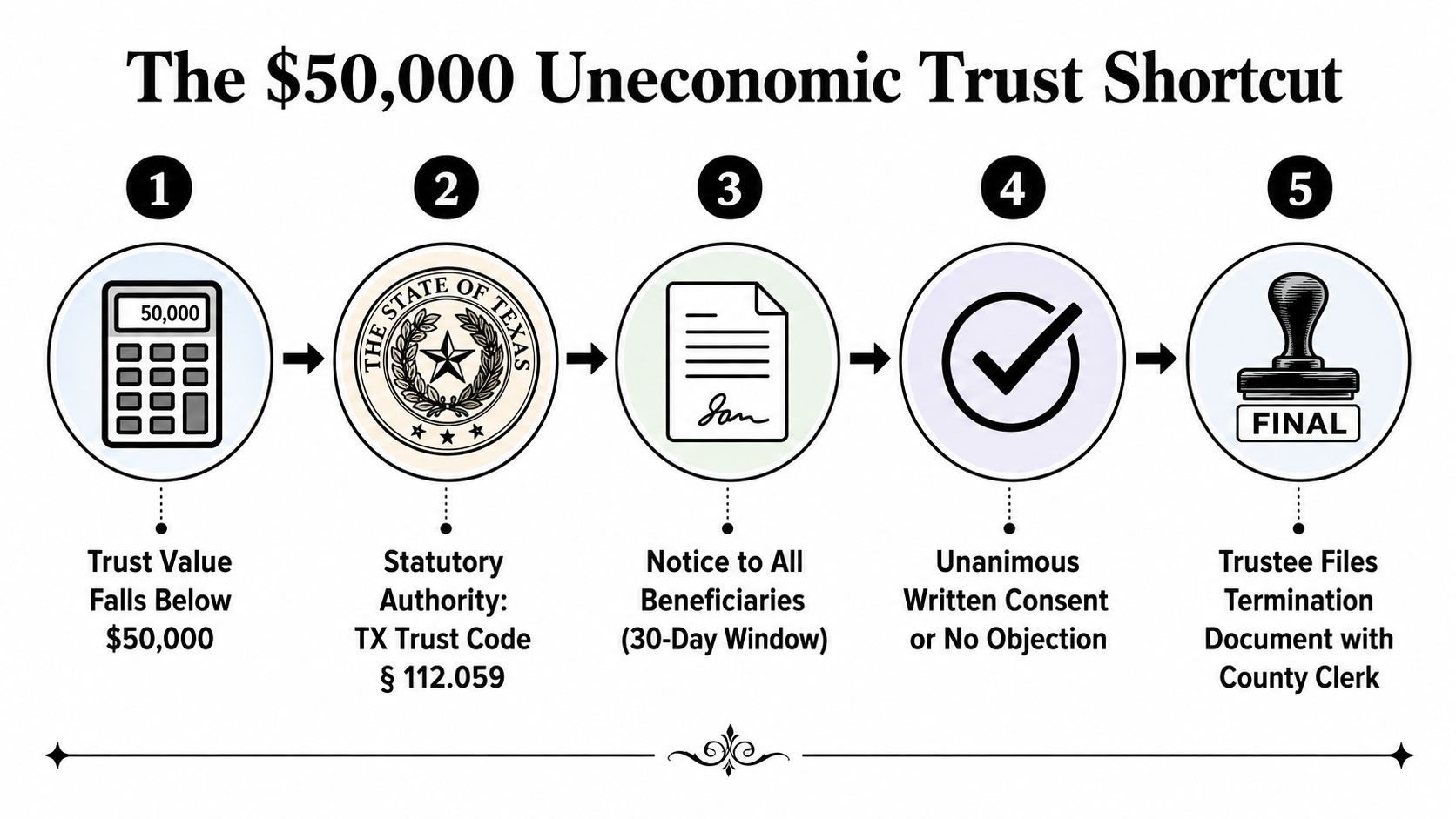
Section 112.059 is designed for a trust that has become too small to justify its administrative burden. It allows a trustee to terminate without court approval when the total trust property is valued at less than $50,000, the trustee determines that continued administration costs aren't justified, and the trustee provides notice to current or potential income or principal distributees. Texas trust code materials describing Section 112.059 explain the notice and value requirements.
The trustee must still act carefully. The statute doesn't authorize a casual payout or permit the trustee to ignore the trust's purpose. Distribution must remain consistent with that purpose, and the statute doesn't apply if the trustee's control would cause the trust assets to be included in the trustee's taxable estate for federal estate tax purposes. Texas authority on uneconomic trust termination and tax inclusion addresses those limits.
A practical decision sequence
Value the entire trust. Review cash, investments, real estate, personal property, debts, and expenses. The relevant question is the value of the trust property, not just the amount in one account.
Review the trust purpose. Ask whether the original reason for holding the property still exists. A trust created to manage a temporary transition may no longer need to continue.
Make the fiduciary determination. The trustee must decide that the trust's value and asset mix don't justify continued administration costs.
Provide statutory notice. Notice must reach beneficiaries who are current or potential income or principal distributees. Keep proof of delivery and the content of the notice with the trust records.
Resolve expenses and distribute property. Sell or transfer assets as appropriate, pay proper trust obligations, and document the final distribution.
A Houston trustee might oversee a $28,000 trust whose only asset is a small rental house. If the trustee sells the property, pays valid expenses, and distributes the net proceeds consistently with the trust's purpose after following the required process, the trustee may be able to close the trust without a full court proceeding. Real estate sales, title questions, liens, and tax consequences can still justify advice from a Texas trust administration lawyer. Guidance on terminating a trust early in Texas can help frame that decision.
A successor trustee who has just taken office may also find First Steps for a Successor Trustee in Texas useful for understanding what to do immediately after stepping into the trustee role.
Trustee Duties Before You Close the Trust
Termination is the final stage of trust administration, not a substitute for administration. Before distributing anything, the trustee should be able to show what the trust owned, what it owed, what it earned, what expenses it paid, and why the proposed distribution follows the trust document.
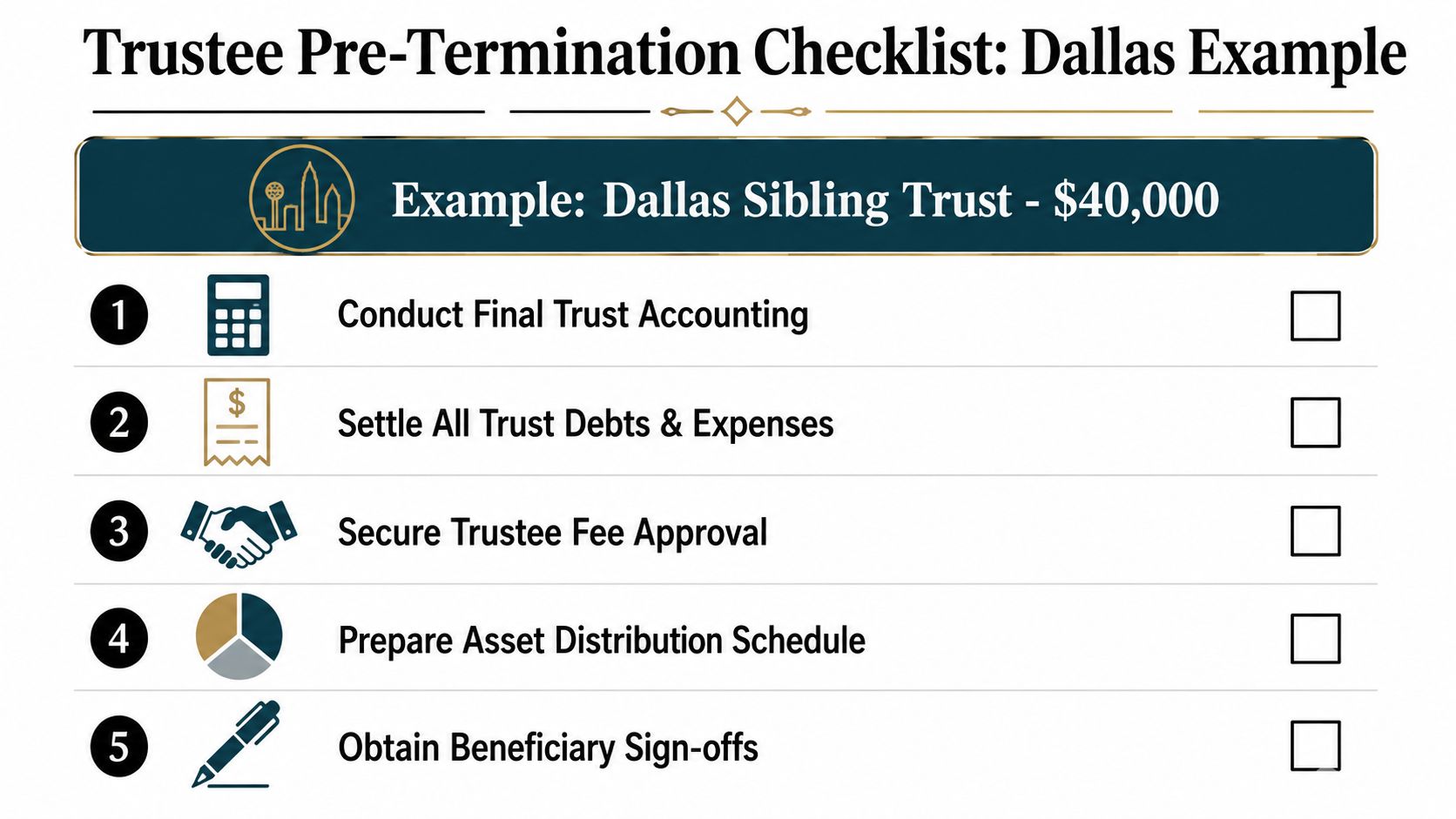
Consider a Dallas trustee closing a sibling trust that holds $40,000 several years after the settlor's death. The trustee should first locate the complete trust agreement and amendments, verify the current beneficiaries, review prior distributions, and determine whether the trust contains a termination provision. A trustee who relies only on a bank statement may miss a small parcel of land, an unpaid debt, or a condition that limits distribution.
A sound pre-termination file
Final accounting: List opening assets, income, expenses, distributions, current values, and the proposed ending balance. Give beneficiaries enough information to understand the transaction.
Asset valuation: Use reliable records and appropriate professional assistance for investments, real estate, business interests, or property that's difficult to value. Document the valuation date and method.
Outstanding obligations: Pay legitimate trust expenses and address known creditor, tax, and service-provider claims before distributing the balance.
Distribution schedule: Identify each asset, recipient, transfer method, and supporting trust provision. In-kind distributions need particular care because the beneficiaries may receive different risks, liquidity, or tax characteristics.
Trustee compensation: Check the trust agreement and applicable law before taking or requesting a fee. Disclose the amount and basis clearly.
Texas fiduciary principles require the trustee to act loyally, prudently, and impartially. Impartiality doesn't always mean equal dollar distributions. It means the trustee must treat current and remainder interests fairly under the governing document and circumstances. Even if every adult beneficiary wants the trust closed, the trustee still must preserve the settlor's material purpose and avoid favoring one beneficiary without legal support.
A signed consent doesn't erase a trustee's duty to account.
Skipping the final accounting can create a record problem and expose the trustee to claims for losses or improper distributions. Texas Property Code provisions governing fiduciary remedies can permit relief against a trustee who breaches a duty, so documentation should be treated as part of the closing process, not optional paperwork. Once the accounting and distribution plan are ready, the trustee can prepare the beneficiary notice required for the selected termination route.
Beneficiary Notice and Consent Requirements
A Houston trustee once prepares to close a small family trust and assumes the beneficiaries are the two adult children listed in the trustee's file. During a records review, the trustee discovers that one child's deceased sibling has a grandchild with a contingent interest. That overlooked interest changes the notice and representation analysis and can stop an otherwise simple termination.
The problem isn't limited to identifying people who currently receive checks. A beneficiary may hold a present interest, a future interest, or a contingent interest that becomes important if another beneficiary dies or fails to qualify. Texas practice treats beneficiary identification and notice as central safeguards, especially for court-approved modification or termination. Under Texas Property Code § 112.054 materials, court-approved modification or termination generally requires consent from all beneficiaries, including contingent or future interests, unless valid representation or deemed-consent mechanisms apply.
What the trustee should verify
Start with the trust agreement, amendments, family records, death certificates, and current contact information. Then identify:
- Current distributees: People presently entitled to income or principal.
- Remainder beneficiaries: People who may receive property later.
- Contingent beneficiaries: People who take if a stated condition occurs.
- Minors or incapacitated adults: Individuals who may need a legally authorized representative.
- Unknown or unreachable interests: Situations that may require court procedures or appointed representation.
Written notice should describe the proposed termination, the reason for it, the assets involved, the proposed distribution, and the response process. Do not assume silence means consent. A trustee should also avoid using a family member as an informal representative where that person's interests may conflict with the person being represented.
An adult beneficiary may sign a written consent after receiving adequate information. A minor or incapacitated adult may require a guardian ad litem or another court-approved protection. An attorney-in-fact may act only when a valid power of attorney authorizes the relevant decision and no conflict prevents reliance on that authority.
A simple consent might say:
“I acknowledge receipt of the trust accounting, proposed termination notice, and distribution schedule. After reviewing those materials, I consent to the proposed termination and distribution, subject to the terms of the trust and applicable Texas law.”
That language is only a starting point. It doesn't replace a careful review of the trust, the beneficiary's legal capacity, or the selected statutory route. If one interest is missing, the trustee should pause rather than distribute first and try to repair the problem later.
Common Pitfalls When Terminating a Trust
Small trusts create a dangerous temptation: because the balance is modest, the trustee may treat the closing as informal. Fiduciary duties don't disappear because administration has become inconvenient. The trustee remains responsible for protecting trust property, following the governing document, addressing known claims, and documenting the final transaction.
A trustee may also face personal exposure if the trustee distributes property prematurely, ignores a beneficiary's interest, or takes action outside the authority granted by the trust and Texas law. Texas Property Code § 114.008 provides court remedies for trustee breaches, which can include monetary relief and other corrective measures. The safer approach is to slow down at the points where a rushed closing could create irreversible harm.
| Common Mistake | Correct Action |
|---|---|
| Distributing assets before settling creditor claims | Review known claims and trust expenses, reserve or pay valid obligations, and document the decision |
| Assuming beneficiary agreement is automatic | Identify every present, future, and contingent interest and obtain legally effective consent or representation |
| Ignoring a trustee's duty to defend against known claims | Investigate the claim, preserve trust records, and obtain advice before distributing disputed property |
| Failing to check the trust's termination language | Read the complete agreement and amendments before selecting a statutory route |
| Using the uneconomic-trust shortcut when the value is uncertain | Obtain a defensible valuation and determine whether the statutory threshold applies |
| Treating an in-kind distribution as tax-neutral | Review the tax basis, reporting obligations, and consequences for each recipient |
| Closing the bank account before completing tax work | Coordinate with the tax professional on the trust's final federal filings and beneficiary reporting |
Tax administration deserves specific attention. A trust may need a final Form 1041 and Schedule K-1s for beneficiaries, depending on its income and filing obligations. The trustee should coordinate with a CPA or tax attorney rather than assume that a final distribution eliminates the need for reporting.
A trustee should preserve the trust agreement, notices, delivery records, accountings, valuations, receipts, releases, consents, tax filings, and distribution confirmations. Those records can answer questions long after the final check clears. They also help distinguish an intentional, well-supported decision from an unexplained transfer.
The best closing file tells the story of the trust from opening balance to final distribution.
Next Steps and When to Call a Texas Attorney
A trustee can begin with a focused fact-gathering process. The objective isn't to make a legal conclusion immediately. It's to collect the information needed to choose between a trust-term provision, the uneconomic-trust route, beneficiary consent, or a court petition.
Start with these four actions
Confirm the trust's value. Gather current statements, property records, appraisals or broker estimates, liabilities, and expected closing costs. If the value may be near the statutory benchmark, don't rely on a rough estimate.
Identify every beneficiary. Read the distribution provisions carefully and trace contingent, remainder, and substituted interests. Check whether a beneficiary has died, become incapacitated, or cannot be located.
Pull the complete trust document. Include amendments, assignments, trustee appointment documents, and any prior court orders. A termination clause or special distribution restriction may control the analysis.
Request a current accounting. Prepare a record of assets, income, expenses, distributions, taxes, and proposed final transfers. Beneficiaries need enough information to evaluate the closing.
A trustee may be able to proceed without a court petition when the trust clearly qualifies under Section 112.059 and the trustee can satisfy the notice and fiduciary requirements. A consensual modification or termination under Section 112.054 still requires careful analysis of beneficiary interests, representation, and whether continuation serves a material purpose. The trustee should seek court relief under Section 112.052 or another applicable procedure when the trust document, beneficiary interests, disputed facts, or asset complexity make informal action unsafe.
Call a Texas trust administration lawyer promptly if trustee fees are disputed, a beneficiary is a minor or deceased, a beneficiary cannot be located, real estate or business interests must be transferred, tax exposure may result from an in-kind distribution, or a creditor has asserted a claim. Those facts don't always make termination impossible. They do make professional review more valuable.
Families also sometimes need related support. A Texas estate planning attorney can review whether the trust still fits the family's broader plan, while probate counsel may be needed if a beneficiary's estate or the settlor's estate affects title. Guardianship and conservatorship issues can arise when an incapacitated beneficiary cannot provide legally effective consent. Asset protection planning may also matter if a beneficiary's personal creditors or public-benefit eligibility are part of the trust's purpose. For law firms building clearer client education around these services, Netco Design law firm growth strategies offers broader background on communicating legal services online.
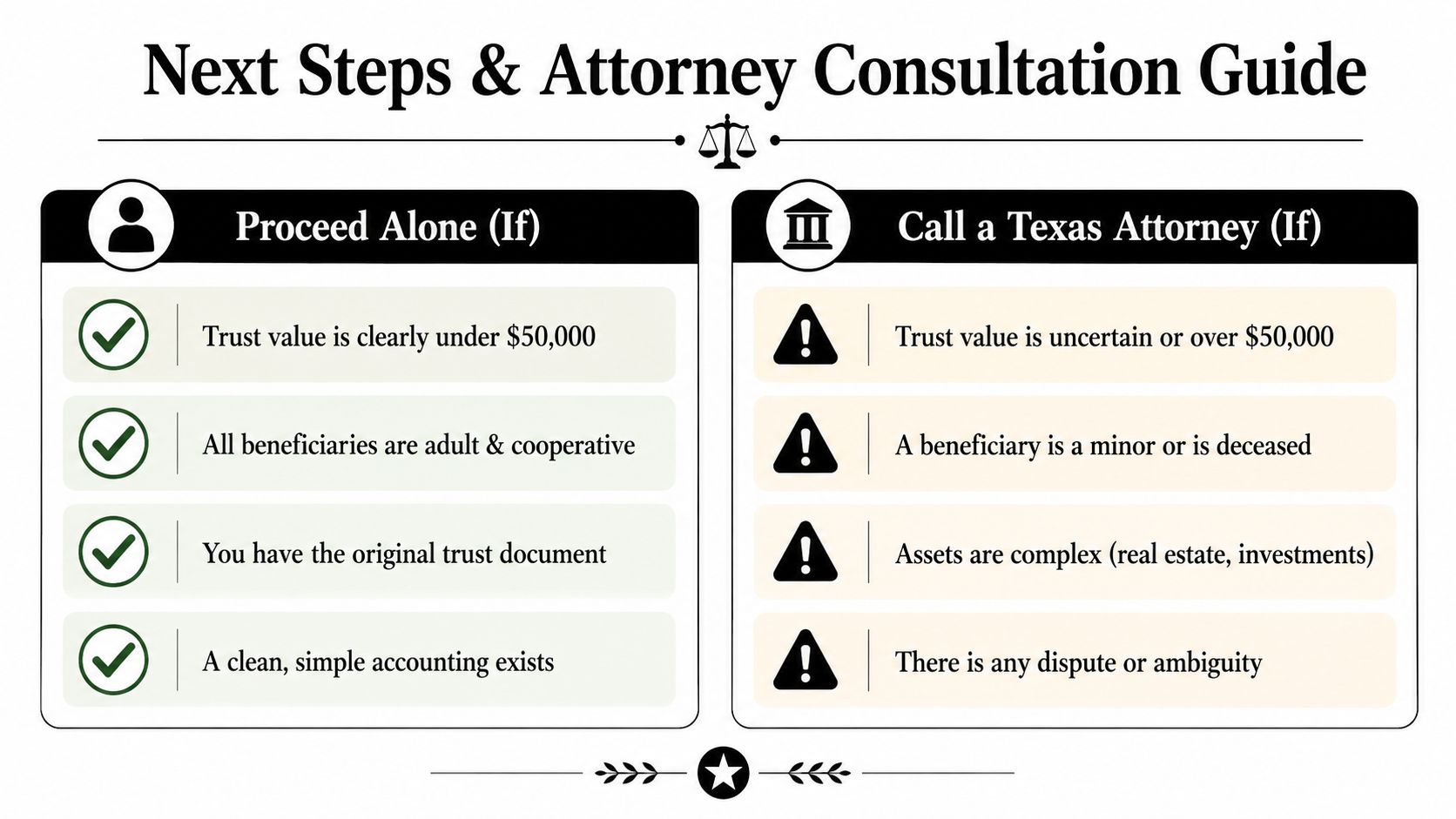
For a consultation, gather the trust agreement, its EIN, recent financial statements, beneficiary contact information, tax records, and a draft distribution list. A lawyer can help test the valuation, identify the correct statute, prepare notice and consent documents, and determine whether court approval protects everyone involved.
If you're managing a trust or planning your estate, contact The Law Office of Bryan Fagan, PLLC for a free consultation. Our Texas attorneys can help with fiduciary accounting, beneficiary communication, tax planning, trust termination, probate, guardianship, and asset protection so you can move forward with a clear and documented plan.