Managing a loved one's trust can feel overwhelming when a late amendment suddenly changes everything. One sibling may be standing close to the parent, another may be left out of meetings, and the family only learns the full story after signatures are already on paper.
In Texas, how to challenge trust amendment undue influence starts with understanding that this is a legal claim, not just a family disagreement. The question is whether someone's pressure, control, or manipulation was strong enough to overpower the settlor's free choice and change the trust in a way the person would not have made on their own.
A trust dispute usually turns on documents, timing, and behavior around the signing date. That is why the first people to act are often beneficiaries, trustees, executors, or adult children who notice that the amendment arrived late in life, with the same person always present, and with explanations that never quite add up.
When a Trust Amendment Raises Red Flags in Texas
A son watches his mother sign a trust amendment after months of private meetings with a neighbor who suddenly knows every detail of her finances. The amendment changes the distributions, cuts out one branch of the family, and lands in the mail with a short explanation that sounds polished but incomplete. That kind of fact pattern is exactly where beneficiaries start asking whether the change came from the settlor's own judgment or from someone else's pressure.

What Texas courts care about
Undue influence is not a moral complaint. It is a legal theory focused on whether another person improperly overrode the settlor's free agency at the time the amendment was signed. Texas courts look for facts, not family arguments, and the claim usually becomes stronger when the amendment appears to benefit the person who arranged access, transportation, drafting, or signing.
Beneficiaries who may have standing often include adult children, grandchildren, charities named in an earlier version, and sometimes others whose interests were reduced or eliminated by the amendment. The practical question is whether the challenger can point to a real legal injury, not just hurt feelings.
Practical rule: If the amendment arrived late, changed long-standing terms, and involved a person who was unusually involved in the settlor's daily life, treat it as a legal issue immediately.
Why disputes often surface after death
These fights often start only after the settlor dies or loses capacity, because that is when the people affected can finally compare the amendment to prior documents. At that stage, the issue is no longer about family suspicion alone. It becomes a record-based dispute over who influenced whom, when the change happened, and whether the settlor still had enough independent judgment to make it.
A quick self-check helps. If the answer to any of these is yes, legal review is warranted, there was sudden isolation from other relatives, a helper controlled access to the settlor, the amendment was signed in a rushed setting, or the change broke sharply from the prior plan. Those facts do not prove undue influence by themselves, but they do tell you the dispute needs to be treated like litigation, not a family conversation.
The Texas Legal Standard for Undue Influence
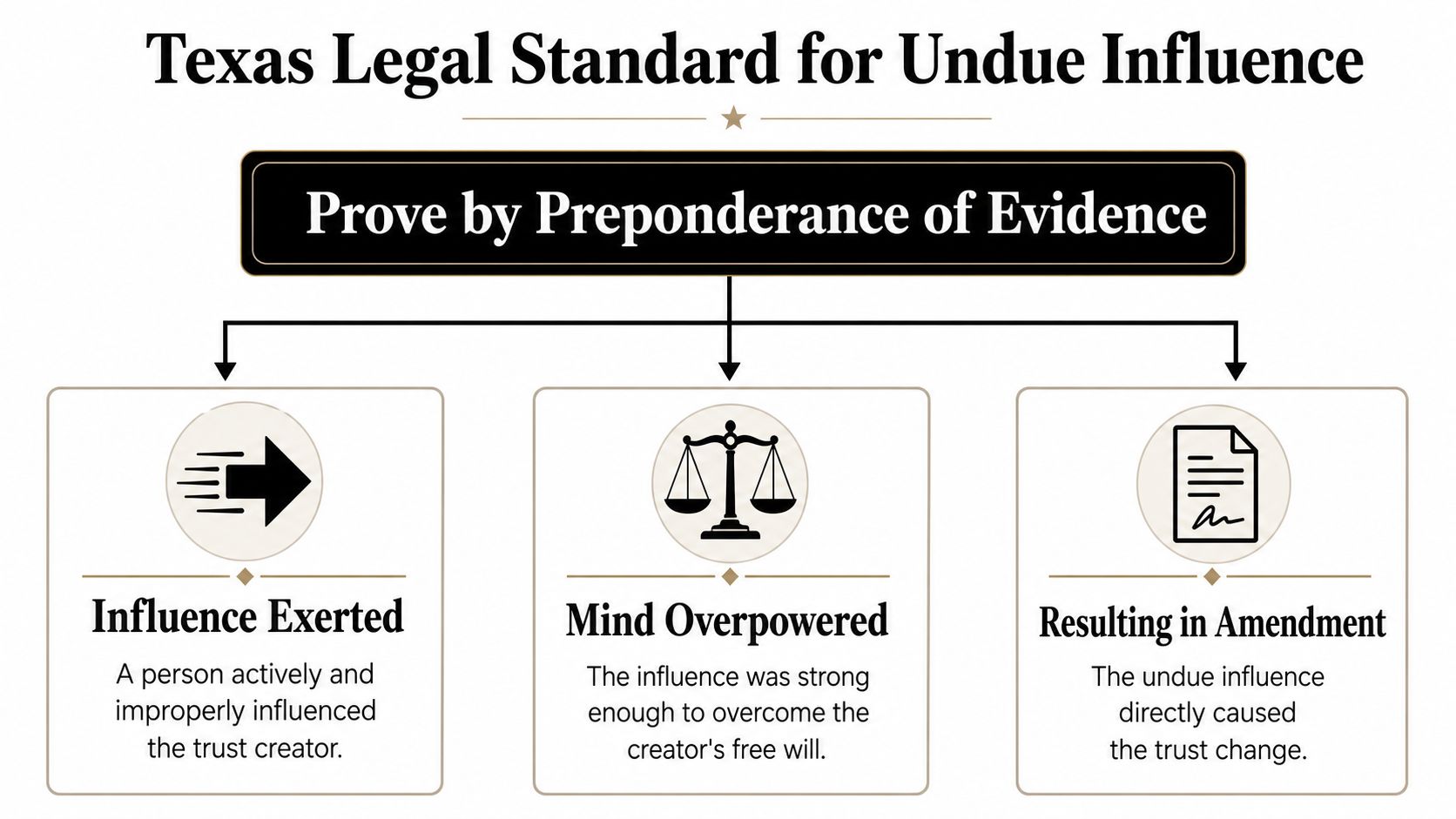
Texas does not let a challenger win on suspicion alone. The claim has to be proved by a preponderance of the evidence, which means the facts must show it is more likely than not that the amendment came from undue influence rather than free choice. In Texas undue-influence trust litigation, the challenger must prove three elements by a preponderance of the evidence: that influence existed and was exerted, that it overpowered the settlor's mind at the time of execution, and that the trust was executed in a way the settlor would not have done but for that influence. Texas undue-influence proof standard
The three elements in plain English
The first element asks whether someone exerted influence. That can mean pressure, control, dependency, or manipulation, but the court still wants proof that the person did something, not just that they were a favored helper.
The second element asks whether that pressure was strong enough to overpower the settlor's mind at the time the amendment was signed. Timing matters most here, because a person can be strong-minded on one day and vulnerable on another, especially if illness, isolation, or medication is in play.
The third element asks whether the amendment reflects what the settlor would have done without the pressure. A challenged trust amendment often looks unnatural because it shifts benefits to the very person who controlled access, arranged the meeting, or pushed for the change.
Confidential relationship and burden shifting
Texas courts also look at a confidential relationship, active participation in procuring the document, and an undue benefit to the accused influencer. When those facts line up, the burden may shift to the person who benefited to explain why the amendment was fair and voluntary. That is one reason carefully documented independence matters so much in fiduciary disputes.
A practical Texas trust administration lawyer will often move quickly to lock down the record, because Texas cases are won and lost on proof, not suspicion. Deadlines still matter, but the more immediate question is whether the challenge is filed and postured in a way that preserves medical records, witness testimony, and the drafting trail before those details get harder to recover.
For context on fiduciary conduct, The Fiduciary Duties of a Texas Trustee explains the core duties of loyalty, prudence, and impartiality under the Trust Code. Those duties matter because a trustee who helps shape, favor, or conceal an amendment can create the kind of fact pattern that courts examine closely.
A medical case can also overlap with proof from other disciplines. If the settlor's condition is disputed, understanding forensic pathology in court can help explain how records and expert testimony fit together when capacity, medication, or physical decline are part of the story.
What wins and what fails
A winning case usually has dates, witnesses, and a clean timeline. A weak case usually has only family suspicion, missing records, and vague claims that “something felt wrong.” Courts want a chain of events that shows pressure, dependence, and a result that makes sense only if someone else was steering the outcome.
Evidence That Strengthens or Weakens a Challenge
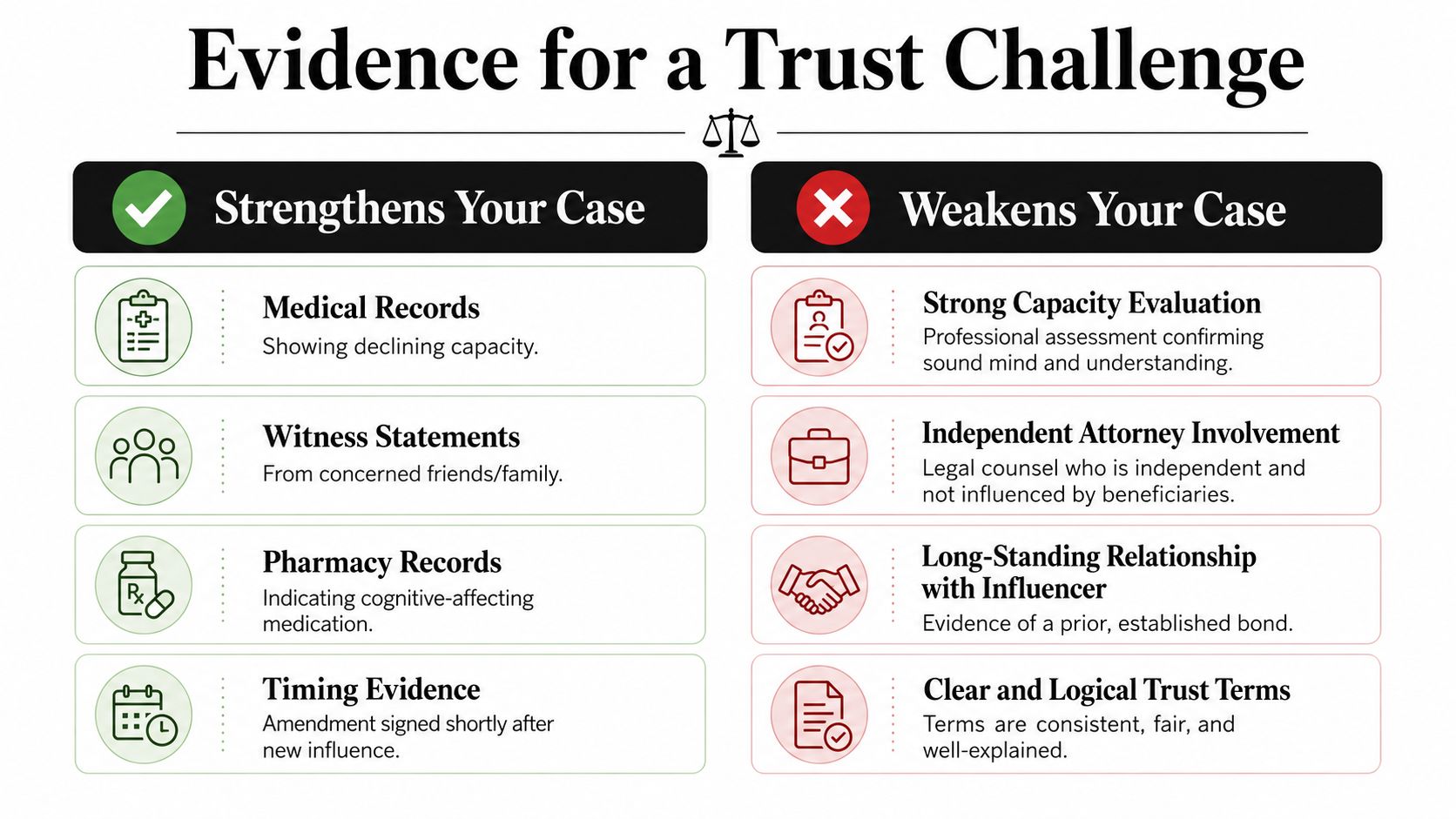
The strongest undue-influence cases are built from records made close to the signing date. Medical records, caregiver notes, pharmacy history, and witness accounts usually matter more than anyone's memory months later, because after-the-fact testimony tends to get colored by grief, anger, or litigation strategy.
What a strong paper trail looks like
Medical records can show whether the settlor had deficits in memory, reasoning, or decision-making near the amendment date. Capacity evaluations, hospital notes, and physician observations help connect those deficits to the exact signing period, which is where the legal fight usually lives. Financial records can also matter when they show that the person who benefited suddenly gained access, control, or new advantages around the same time.
Text messages and emails often help because they reveal tone, urgency, or isolation. A message asking who will be at the appointment, who arranged the lawyer, or why the family was excluded can be more useful than a long conversation told from memory later.
Document early: If records exist today, assume they may be harder to recover later. Ask for medical files, the trust file, and communications before relationships sour and documents disappear.
What tends to weaken the claim
A strong capacity evaluation, independent attorney involvement, a long-standing relationship with the influencer, and clear, logical trust terms all make a challenge harder. Those facts do not automatically defeat the case, but they give the defending side a credible story that the settlor acted freely and knowingly.
Texas courts generally treat undue influence as a fact-intensive claim that can be supported by evidence of a confidential relationship, active participation in procuring the document, and an undue benefit to the alleged influencer. That is why the best evidence is usually ordinary, not dramatic, such as a calendar entry, a physician note, a copied email, or a witness who can describe who drove the process.
For families trying to understand how experts reconstruct timelines from records, the resource on understanding forensic pathology in court is useful because it shows how documented facts can become courtroom proof. The same discipline applies here, the chronology matters.
If you are building a file now, collect the trust amendment, prior versions, medical records, banking activity, caregiver communications, and names of everyone present at meetings. That is the evidence that usually decides whether a Texas judge sees a real undue-influence claim or just a family dispute wrapped in suspicion.
Filing a Challenge in a Texas Probate Court
A Texas challenge usually starts with preservation, not drama. Keep the original trust, every amendment, the envelope or notice that came with it, and any drafts or correspondence you can lawfully obtain. The earlier those materials are secured, the less chance there is that the record gets shaped by one side after the fact.
The procedural path that actually matters
The next move is usually a written request for the complete trust file, including any trustee notes, correspondence with counsel, and records showing how the amendment was signed. If the file suggests coercion or concealment, a petition can be filed in probate court in the county where the trust is administered. That filing may ask the court to set aside the amendment, require an accounting, or pause distributions while the dispute is pending.
Texas trust disputes are guided by the Texas Trust Code and the Texas Estates Code, especially where fiduciary administration, judicial proceedings, and beneficiary rights overlap. Those statutes matter because the court will look closely at how the trustee handled notice, disclosure, and administration once the amendment became an issue.
There is no single Texas deadline that mirrors California's short contest window. Instead, courts often look at timing concerns like when the challenger learned of the amendment and whether delay makes the claim unfair under doctrines such as laches. In plain English, waiting too long can create its own problem even if the substance of the claim is strong.
A practical Texas trust administration lawyer will often move quickly for interim relief, especially if distributions are about to go out or records may be lost. That can include asking for a fiduciary accounting, asking the court to preserve assets, or asking the court to limit actions until the dispute is resolved. For a basic overview of the filing path, how to contest a trust is a helpful starting point.
Who gets pulled into the case
A trust protector or independent trustee can become part of the procedure if that person helped approve, implement, or shield the amendment. That does not automatically make them liable, but it does make their role relevant to how the amendment was obtained. In some cases, the procedure itself reveals the pressure points, especially when one person handled all the communications and nobody else had a meaningful chance to review the change.
Courts move faster when the record is organized. A clean timeline, complete file, and preserved communications can do more for a claimant than a stack of emotional declarations.
The practical takeaway is simple. File early enough to preserve the record, but not so quickly that you skip the evidence-gathering that makes the petition credible.
Common Defenses and How Texas Courts Treat Them
The defense usually starts with a clean story. The favored beneficiary says the settlor had independent counsel, knew exactly what they were doing, and changed the trust because they wanted to. That story can be persuasive when the file is well documented, and it is exactly why challengers need more than a hunch.
The defenses you will see most often
Independent attorney involvement is one of the most common defenses. If the lawyer met privately with the settlor, explained the change, and left a record of the settlor's reasons, the defense becomes much stronger. The same is true when the settlor's stated intent is consistent across drafts, emails, and prior planning documents.
No-contest clauses can also be raised to discourage a challenge, and Texas families often want to know whether those clauses will block a claim entirely. They can matter, but they do not automatically erase a valid undue-influence argument. A clause is only as strong as the underlying process that created the amendment, and a tainted amendment can still be vulnerable if the evidence shows it was improperly procured. For more on that issue, no-contest clauses in a Texas trust is the relevant reference point.
Trust protectors, caregiving, and family pressure
A trust protector structure can complicate the analysis if influence is routed through the protector rather than directly through a family member. But a title does not sanitize bad procurement. If the amendment was still driven by manipulation, secrecy, or pressure, the court can look past the role and focus on how the change happened.
Texas courts also distinguish between normal caregiving and legally actionable coercion. Family members may help with transportation, meals, or appointments without crossing the line. The problem starts when care turns into control, access is restricted, or the settlor stops making independent choices because the person helping has become the gatekeeper.
Religious influence and cultural expectations are treated similarly. Courts understand that families advise, persuade, and rely on one another, but lawful influence ends where free agency ends. The key question is whether the settlor still had room to choose differently without fear, isolation, or dependence being used against them.
A proper defense therefore needs more than a general denial. It needs records showing independence, consistency, and a clean signing process.
Remedies, Settlements, and Practical Next Steps
A successful challenge does not always wipe out every trust decision. Texas courts can void only the amendment, restore the prior trust terms, or grant a narrower remedy that matches the misconduct proved. In the right case, the court can also surcharge a trustee, remove a fiduciary, or order a full fiduciary accounting under the Trust Code.
What winning can look like
A remedy often starts with undoing the harmful change and putting the earlier trust terms back in place. If the trustee mishandled distributions, hid information, or used the amendment to justify self-serving conduct, the court may also address the losses tied to that conduct. Fee recovery may be available in some cases, but it depends on the facts and on how the judge views the dispute.
Settlement is common because family trust fights are expensive and public. Mediation can produce a workable result when both sides want certainty more than a full trial. A negotiated amendment or distribution agreement sometimes resolves the dispute while still leaving room for accountability.
For families trying to plan around a dispute, related issues often travel together. A trust challenge may connect to probate administration, guardianship questions, or broader estate planning choices that should be reviewed at the same time. The same is true when the trust may need to be modified, which is why coordinated legal advice matters.
Immediate next steps that actually help
Preserve text messages, emails, voicemail, bank statements, and the original trust file. Avoid posting about the dispute on social media, because casual comments can become evidence later. Then speak with a Texas trust litigation attorney who can evaluate the claim, identify missing documents, and decide whether the case belongs in probate court, settlement talks, or both.
The Law Office of Bryan Fagan, PLLC also helps families with related matters like probate, guardianship, asset protection, and estate planning, so the legal picture can be handled as a whole rather than in fragments. In practice, that makes it easier to address the trust fight without overlooking the rest of the estate plan.
Undue Influence Questions Texas Families Ask Most
What if the beneficiary did not learn about the amendment until after the settlor died, or received only partial notice? In Texas, that timing can shape both the strategy and the defenses, especially when the delay came from hidden documents, controlled access, or incomplete disclosure. The practical move is to act as soon as the amendment is discovered and preserve every record that shows who knew what, and when.
Can a no-contest clause stop an undue-influence claim? It can raise the stakes, but it does not automatically bar a challenge if the amendment itself was procured through improper pressure or control. Texas courts still look at how the change was obtained, and whether the underlying amendment can stand on its own.
What does a trust protector do in this setting? A trust protector can matter if the influence flowed through that role, but the title does not protect an amendment from review when the conduct behind it is the problem. Courts examine the actual facts, including who drafted the change, who pushed for it, and who had access to the settlor.
Can the same proof support a will contest or a financial-exploitation claim? Often it can, because the same medical records, text messages, bank activity, and witness statements may support more than one theory. A Texas lawyer should review the estate and financial picture together so one filing does not weaken another or create an avoidable procedural problem.
How Texas deadlines affect the case matters as much as the facts. A family that waits too long may lose influence, face a filed motion to dismiss, or miss the chance to preserve testimony while memories are still fresh. Texas uses a preponderance-of-the-evidence standard, so the case usually turns on whether the challenger can show it is more likely than not that confidential influence crossed the line into undue influence.
That makes the confidential-relationship framework a practical starting point. If the person who benefited controlled medication, transportation, finances, or communication, those facts can support the claim that the settlor was vulnerable to pressure. If the record instead shows independent advice, clear intent, and consistent statements over time, the defense becomes harder to overcome.
Families also ask whether settlement changes the strategy. It can, but only if the evidence is strong enough to create real risk for the other side. A weak demand can stall, while a well-supported claim, built on the trust file, medical records, and third-party testimony, can move the discussion toward resolution.
If you are sorting out whether an amendment was the product of undue influence, contact The Law Office of Bryan Fagan, PLLC for clear, Texas-based guidance. Visit Law Office of Bryan Fagan, PLLC to schedule a free consultation and get help with the next step in your trust, probate, or estate planning matter.